
Today’s Current Affairs: 22nd January 2026 for UPSC IAS exams, State PSC exams, SSC CGL, State SSC, RRB, Railways, Banking Exam & IBPS, etc
Table of Contents
Asiatic Wild Dog:
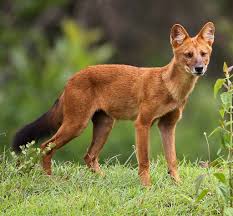
A rare Asiatic Wild Dog ‘Dhole’, has been seen for the first time in Ratapani Tiger Reserve in Madhya Pradesh recently.
- The Asiatic wild dog, also called Dhole, is a wild Asian carnivore of the dog family (Canidae).
- Scientific Name: Cuon alpinus
- Other Names: Indian wild dog, whistling dog, red wolf, red dog, and mountain wolf.
- They are found throughout Central, Eastern and Southeastern Asia.
- In India, they are found in three clusters across India, namely the Western and Eastern Ghats, the central Indian landscape, and Northeast India.
- The Western and Eastern Ghats are stronghold regions for dholes.
- They inhabit dense jungles, steppes, mountains, scrub forests, and pine forests.
- Features:
- It is a sleek, reddish-brown, medium-sized
- This species tends to live in groups.
- They are great communicators and use an eerie whistle to communicate with each other.
- Conservation Status: IUCN Red List: Endangered
Anna Chakra : In News
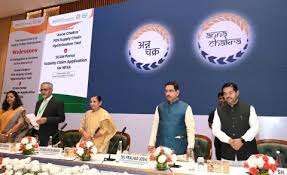
The Department of Food and Public Distribution (DFPD) has achieved a remarkable milestone by being named as finalist for the 2026 Franz Edelman Award for its Anna Chakra initiative.
- It is a supply chain optimization tool under the Public Distribution System (PDS).
- It is an operations research–based decision support system designed to optimise state-specific food grain logistics under India’s Public Distribution System (PDS)
- The initiative was developed through a Government–UN–Academia partnership, involving:
- The Department of Food and Public Distribution,
- The United Nations World Food Programme (WFP) in India, and Indian Institute of Technology (IIT) Delhi.
- It leverages advanced algorithms to identify optimal routes and ensure seamless movement of food grains across supply chain nodes.
- It is integrated with the PM Gati Shakti platform and FOIS (Freight Operations Information System) portal of the Railways through Unified Logistics Interface Platform (ULIP).
Franz Edelman Award:
- It recognizes the world’s most impactful, high-value applications of advanced analytics.
- It is widely regarded as the “Nobel Prize of Operations Research and Analytics”.
- It recognizes and reward outstanding examples of operations research, management science, and advanced analytics practice in the world.
- Award: Winner gets a $10,000 prize.
ASC Arjun : Humanoid Robot

The Indian Railways has introduced a humanoid robot named “ASC ARJUN” at Visakhapatnam Railway Station.
- It is a humanoid robot introduced by the Indian Railways.
- The robot will operate alongside Railway Protection Force (RPF) personnel to assist in station operations, particularly during periods of heavy passenger movement.
- It is designed and developed entirely in Visakhapatnam using home-grown technology.
- It is equipped with a Face Recognition System (FRS) for intrusion detection, AI-based crowd monitoring and real-time alert generation for RPF control rooms.
- It can also make automated public announcements in English, Hindi and Telugu to assist passengers and promote safety awareness.
- It also features semi-autonomous navigation with obstacle-avoidance capability,
- It can patrol station platforms round the clock, supporting surveillance and optimising manpower deployment.
- It is also fitted with fire and smoke detection systems to aid timely response during emergencies.
- It has been designed for passenger interaction, offering gestures such as a ‘Namaste’ for passengers and salutes for RPF personnel, along with an interface to provide information and assistance.
Subhash Chandra Bose Aapda Prabandhan Puraskar:

The Sikkim State Disaster Management Authority (SSDMA), in the Institutional Category, and Lieutenant Colonel Seeta Ashok Shelke, in the individual Category, have been selected for the Subhash Chandra Bose Aapda Prabandhan Puraskar 2026.
- Subhash Chandra Bose Aapda Prabandhan Puraskar is an annual award instituted to recognize and honour the invaluable contribution and selfless service rendered by individuals and organizations in India in the field of disaster management.
- The award is announced every year on the 23rd January, the birth anniversary of Netaji Subhash Chandra Bose.
- Only Indian nationals and Indian institutions are eligible to apply for the award.
- Institutions, voluntary organisations, corporate entities, academic/research institutions, response/ uniformed forces or any other institution may apply as an institution for the award.
- The candidate for the award must have worked in the area of Disaster Management like Prevention, Mitigation, Preparedness, Rescue, Response, Relief, Rehabilitation, Research/ Innovations or Early Warning related work in India.
- A Screening Committee may be constituted by Member secretary/ member, NDMA to screen all the applications received.
- In case the winner being an institution, it shall receive a certificate and a cash prize of Rs.51 This cash prize shall be utilized by the winning institution for Disaster Management related activities only.
- In case of the winner being an individual, winner shall receive a certificate and a cash prize of Rs.5.00 lakhs.
Beti Bachao Beti Padhao Scheme : Completed 11 Years
The Beti Bachao Beti Padhao campaign completed 11 years.
- Beti Bachao Beti Padhao (BBBP) initiative, meaning “Save the Girl Child, Educate the Girl Child,”
- It is a flagship initiative of the Government of India launched in 2015.
- It is a Centrally Sponsored Scheme and is component of SAMBAL sub-scheme under Mission Shakti.
- It aims to address the declining child sex ratio, prevent gender-based discrimination, and promote education and empowerment of girls across the country.
- Objectives of Beti Bachao Beti Padhao Scheme
- Prevent Gender-Based Discrimination: Combat societal norms and practices that lead to discrimination against the girl child.
- Improve Child Sex Ratio (CSR): Address the declining number of girls per 1,000 boys by curbing practices like female foeticide.
- Promote Education for Girls: Ensure access to quality education for girls, thereby empowering them to lead independent lives.
- Enhance Participation of Girls: Encourage the active participation of girls in various spheres, including sports, arts, and leadership roles.
- Strengthen Existing Schemes: Integrate and reinforce existing government schemes aimed at the welfare of the girl child.
- It was initiated as a tri-ministerial effort of Ministries of Women and Child Development, Health & Family Welfare and Ministry Of Education.
- From 2021-22, the Ministry of Skill Development and Entrepreneurship and Ministry of Minority Affairs have also been added as partners.
Liberalised Remittances Scheme:
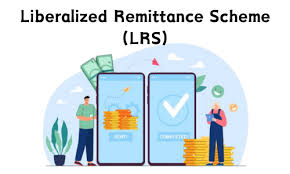
Analysis of data on the outward remittances under the RBI’s Liberalised Remittances Scheme (LRS) shows that the amount of money sent or spent abroad by Indians fell to a two-year low of $1.94 billion in November 2025, pulled down in large part by a sharp dip in the amount spent on foreign studies.
- It is part of the Foreign Exchange Management Act (FEMA) 1999, which lays down the guidelines for outward remittance from India.
- Under LRS, all resident individuals, including minors, are allowed to freely remit up to USD $250,000 per financial year (April–March).
- This can be for any permissible current or capital account transaction, or a combination of both.
- Any remittance exceeding this limit requires prior permission from the RBI.
- Only individual Indian residents, including minors, are permitted to remit funds under LRS.
- Corporates, partnership firms, Hindu Undivided Family (HUF), trusts, , are excluded from its ambit.
- There is no restriction on the frequency or number of transactions during a financial year.
- However, the total amount of foreign exchange remitted through all sources in India under LRS during the current FY should be within the LRS limit.
- Types of transactions permitted:
- Opening of a foreign currency account abroad with a bank;
- Acquisition of immovable property abroad, overseas direct investment (ODI), and overseas portfolio investment (OPI);
- Extending loans, including loans in Indian Rupees to non-resident Indians (NRIs) who are relatives as defined in the Companies Act, 2013;
- Private visits abroad (excluding Nepal and Bhutan);
- Maintenance of relatives abroad;
- Medical treatment abroad;
- Pursuing studies abroad;
- Any other current account transaction that does not fall under the definition of current account (FEMA 199);
- Types of transactions not permitted:
- Remittance for purposes specifically prohibited, such as buying lottery tickets or restricted items.
- Sending money from India for margins or margin calls to overseas exchanges or parties.
- Remittance for buying Foreign Currency Convertible Bonds (FCCBs) issued by Indian companies in the overseas secondary market.
- Sending money for trading in foreign exchange abroad.
- Sending money to individuals and entities identified as posing a significant risk of terrorism.
- Sending money to countries identified as “non-cooperative countries and territories” by the Financial Action Task Force (FATF).
- Tax Imposed on LRS:
- Tax Collected at Source (TCS) applies to LRS transactions exceeding INR 7 lakh in a financial year.
- Current TCS rates are 20% for general remittances and may vary based on the purpose and the total amount remitted.
- Any profit made from abroad investments under LRS is subject to tax in India depending on the holding period.
Phulkari:

Over 40 rare pre-Partition textiles at an exhibition trace how phulkari functioned within women’s lives, and their everyday worlds.
- Phulkari, meaning “flower work,” is a traditional embroidery of Punjab and Haryana.
- The term first appeared in 18th-century Punjabi literature and may be linked to the Iranian art of gulkari.
- Historically, phulkari chaddars were an essential part of a girl’s marriage trousseau, crafted by mothers and grandmothers from the girl’s birth.
- Girls learned to embroider early, with the number of phulkaris reflecting the family’s status and marking cultural milestones.
- It is a form of counted-thread embroidery recognised by its neat, regular patterns of geometric and natural motifs.
- Phulkari embroidery uses khaddar, a handspun and handwoven cotton fabric, traditionally dyed in madder brown, rust red, indigo, or green.
- Colourful silk threads are used to create flower patterns on the fabric.
- The mix of colourful silk threads creates a beautiful and exciting design.
- The floral imagery used in phulkari includes marigolds, jasmines, lotuses, and Tree of Life motifs.
- Modern motifs such as trains, trucks, and cars have also found their way into phulkari patterns.
- Phulkari’s product range includes embroidered chaddars, dupattas, and stoles, traditionally worn by brides or for ceremonies.
Lambadi Tribe:
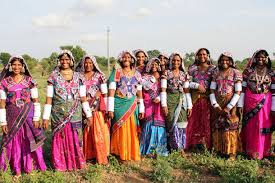
Supreme Court is once again being asked to rule on long-standing controversy of Parliament’s decision on Scheduled Tribe status to Lambadi community in Telangana.
- They are found in Telangana, Andhra Pradesh and Karnataka states in South India.
- They are also known as Sugali or Banjara.
LanguThey speak Gor Boli also called Lambadi which belongs to the Indo-Aryan Group of Languages. Lambadi has no script.
Belief System: The majority of Banjara in India are Hindu; some have combined Hindu practices with their own animistic beliefs.
Culture of Banjara Community:
Banjara people celebrate the festival of Teej during Shravanam (in the month of august).
In this festival young unmarried Banjara girls pray for a good groom.
Fire dance and Chari are the traditional dance forms of the banjara people.
Tattoos are very common in their community.
Women, Lambadi / Gor women (Thandri) wear a very colourful red style dress and lots of jewellery. The clothes we wear are decorated with pieces of mirror and cowl. we wear ivory bangles and ornaments.
Ammonia Spikes In The Yamuna
Officials explained that ammonia spikes in the Yamuna are a chronic winter issue, generally occurring between 15 and 22 times a year.Ammonia is a colorless, pungent gas composed of nitrogen and hydrogen with the formula NH3.It is the simplest stable compound of these elements and serves as a starting material for the production of many commercially important nitrogen compounds.In the environment, ammonia is part of the nitrogen cycle and is produced in soil from bacterial processes.Ammonia is also produced naturally from decomposition of organic matter, including plants and animals.
Engineering Export Promotion Council of India (EEPC India)
The Engineering Export Promotion Council of India (EEPC) recently demanded lowering of income tax for non-corporate manufacturing MSMEs in the Union Budget and expediting payment of GST refunds.Engineering Export Promotion Council of India (EEPC India) is the premier trade and investment promotion organization in India, catering to the Indian engineering sector. Sponsored by the Ministry of Commerce & Industry, it actively contributes to the policies of the Government of India as an advisory body and acts as an interface between the engineering industry and the government.EEPC India facilitates sourcing from India and encourages MSMEs to raise their standard at par with international best practices.It also encourages MSMEs to integrate their business with the global value chain.Motto: Engineering the Future



