
Today’s Current Affairs: 23rd January 2026 for UPSC IAS exams, State PSC exams, SSC CGL, State SSC, RRB, Railways, Banking Exam & IBPS, etc
Table of Contents
Granth Kutir:
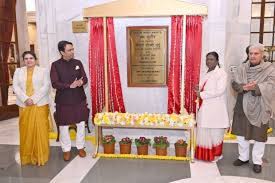
The President of India inaugurated Granth Kutir at Rashtrapati Bhavan.
- Granth Kutir has a rich collection of manuscripts and books in classical languages of India which are Tamil, Sanskrit, Kannada, Telugu, Malayalam, Odia, Marathi, Pali, Prakrit, Assamese, and Bengali.
- The aim of developing the Granth Kutir is to enhance awareness among the citizens regarding the rich cultural and literary heritage of India.
- The collection covers a wide range of subjects such as epics, philosophy, linguistics, history, governance, science, and devotional literature as well as the Constitution of India in these languages.
- It has been developed through collaboration with Central Government, State Governments, universities, research institutions, cultural organisations, and individual donors from across the country.
- It supports the vision of Gyan Bharatam Mission.
- The Gyan Bharatam Mission is a comprehensive national initiative under the Ministry of Culture, Government of India, dedicated to the systematic survey, documentation, conservation, and digitisation of India’s vast manuscript heritage.
Madras Hedgehog:
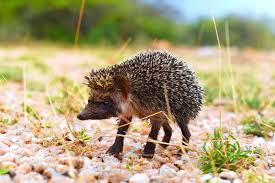
The Tamil Nadu forest department has begun a study on the rare mammal species Madras Hedgehog at the Theri forests in the district.
- Madras Hedgehog, locally known as Mulleli is a tiny mammal.
- It is also known as the bare-bellied hedgehog.
- It has sharp spines on its back.
- It curls into a ball to protect itself from predators.
- It is a nocturnal species.
- It has mastered survival in some of the harshest and driest landscapes.
- The species prefers dry scrublands, thorn forests, grasslands and the edges of farmlands.
- It is found only in peninsular India, primarily across Tamil Nadu, Kerala, Andhra Pradesh and parts of Karnataka.
- It feeds on insects such as beetles, ants, earthworms and termites, apart from plants.
- Conservation Status: IUCN: Least Concern
- Its population declined largely due to hunting driven by mythical beliefs that its quills and meat have medicinal value.
- Hedgehog Species in India: Of the 17 species of hedgehog around the world, India is home to three:
- Indian Long-eared or collared hedgehog
- Indian hedgehog
- Bare-bellied or Madras hegehog
Gandak River:
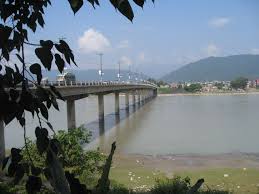
The Gandak River has emerged as the second major river after the Chambal with the highest number of gharials, also known as fish-eating crocodiles.
- The Gandak River, also known as the Narayani and Gandaki, is one of the major rivers in Nepal and a left-bank tributary of the Ganges in India.
- It is mentioned in the ancient Sanskrit epic Mahabharata.
- It originates to the north of Dhaulagiri Mountain in Tibet near the Nepal border.
- After flowing through Tibet, it crosses Nepal, where it is also known as Narayani, to enter the Indian Territory.
- The river enters India from Valmikinagar in the West Champaran district of Bihar. The entry point of the river is at the Indo–Nepal border and is known as Triveni.
- In India, it flows southeast, across the upper Gangetic plain in eastern Uttar Pradesh and northwestern Bihar.
- Gandak joins Ganga near Patna in Vaishali district of Bihar.
- It is bounded on the north by the Himalayas, south by the River Ganga, east by the Burhi Gandak Basin and on the west by the Ghagra Basin.
- Due to the steep slope and loose soil in the upper catchment, Gandak carries a lot of silt and other deposits to the Indian side, resulting in a continuous shifting course of the river.
- While flowing through the Nepal Himalayas, it forms the Kali Gandaki gorge, one of the deepest river gorges in the world.
- Two important protected areas, Chitwan National Park in Nepal and the adjacent Valmiki Tiger reserve in India, have been established in the basin.
- Major Tributaries: Daraudi, Seti, Madi, Marsyandi, and Budhi Gandaki.
Vitamin B1:
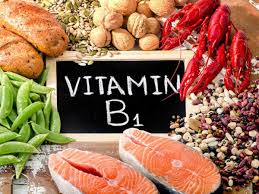
In over 268,000 people reveals how thiamine-related genes influence gut motility, linking constipation and diarrhea to shared biology and suggesting new IBS treatments.
- Vitamin B1 also known as thiamine or thiamin, vitamin B1 is a water-soluble vitamin, as are all vitamins of the B complex.
- Thiamine helps convert carbohydrates into energy, allowing our cells to function optimally.
- It is also involved in supporting the nervous system, promoting healthy brain function, and aiding in the metabolism of proteins and fats.
- Vitamin B1 helps prevent complications in the: nervous system, brain,muscles,heart,stomach,intestines
- It is also involved in the flow of electrolytes into and out of muscle and nerve cells.
- Thiamine occurs naturally in specific diets, is added to food products, and is available in dietary supplements.
- Brown rice, whole grains, pork, poultry, soybeans, nuts, peas, dried beans, and fortified or enriched grain products such as bread, cereals, and infant formulas are rich sources of thiamine.
- Humans need a continuous supply of vitamin B1 because the body does not store it in significant amounts.
- A deficiency in thiamine can lead to a condition known as beriberi, which can cause symptoms like weakness, fatigue, nerve problems, and heart issues.
- Wernicke-Korsakoff syndrome severe form of thiamine deficiency is often associated with alcohol abuse and can lead to symptoms such as:
- Confusion and memory loss.
- Difficulty with balance and coordination.
- Visual disturbances, including double vision or eye muscle weakness.
What are Tailings?

The central government recently announced the country’s first tailings policy, setting guidelines for exploration of critical minerals from primary as well as the secondary sources like mine dumps and tailings of existing mines.
- India’s First Tailings Policy for Critical Minerals sets guidelines for exploration of critical minerals from primary as well as secondary sources like mine dumps and tailings of existing mines.
- The new policy is developed on the idea that a few commodities currently mined in India as primary ore may have scope for recovery of companion metals or elements from the tailings, anode slimes, pot linings, and slags.
- For example, a copper mine may have Selenium, Tellurium, Molybdenum, Cobalt, Rhenium, Gold, and Silver as companion elements.
- Similarly, Zinc is found along with Germanium, Silver, Cadmium, and Indium.
- Critical minerals, including lithium, cobalt, nickel, rare earth elements (REE), etc., are vital for solar panels, wind turbines, batteries and are essential for India’s economic growth.
- Tailings are the leftover materials from the processing of mined ore.
- They consist of finely ground rock, unrecoverable or uneconomic metals, chemicals, organic matter, and effluent from the extraction process.
- They usually take the form of a liquid slurry made of fine mineral particles, created as mined ore is crushed, ground, and processed.
- Effective tailings management is integral to the safe and sustainable production of metals and minerals.
- Tailings can be stored in a variety of ways; which way depends on numerous factors, for instance, the local topography, how much rainfall an area gets, whether there is regular or irregular seismic activity recorded, the type of mineral being mined, and how close the mine is to populated areas.
- There is no one-size-fits-all solution; each tailings facility (also commonly known as a tailings storage facility) is unique.
- Dams, embankments, and other types of surface impoundments are by far the most common storage methods used today.
Indira Gandhi Peace Prize:
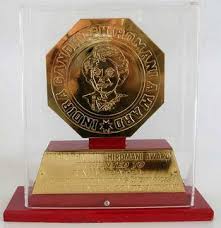
Mozambican rights activist and humanitarian Graca Machel has been selected for the Indira Gandhi Prize for Peace, Disarmament and Development for 2025.
- It was instituted in the memory of the former Prime Minister Indira Gandhi by a trust in her name in 1986.
- It is also known as the Indira Gandhi Prize for Peace, Disarmament, and Development,
- It consists of a monetary award of 25 lakh rupees along with a citation.
- It is awarded annually by the Indira Gandhi Memorial Trust to a person or organization without any distinction of nationality, race or religion, in recognition of creative efforts towards:
- Promoting international peace and disarmament, racial equality, and goodwill and harmony among nations;
- Securing economic co-operation and promoting a new international economic order;
- Accelerating the all-round advancement of developing nations;
- Ensuring that the discoveries of science and modern knowledge are used for the larger good of the human race; and
- Enlarging the scope of freedom and enriching the human spirit.
Metadon ghorpadei and Metadon reemeri : Two Rare Ant-Fly Species
Researchers recently discovered two rare ant-fly species in India, Metadon ghorpadei and Metadon reemeri.They are two new species of ant flies.
These insects belong to the Microdontinae subfamily of hoverflies.Metadon ghorpadei was discovered in Delhi’s Northern Ridge Forest.Metadon reemeri was found in the Siruvani Hills of the Western Ghats.Globally, many Microdontinae species are considered rare or threatened due to their specialised habitat requirements and patchy distribution.They are known for their unique association with ants, as their larvae live inside ant nests and feed on ant broods, a specialised behaviour called myrmecophily that makes them exceptionally rare and difficult to detect.
Indo-Pacific Oceans Initiative : Spain Joined
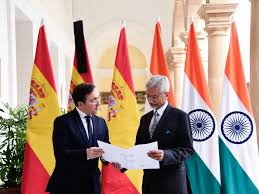
India has welcomed Spain joining the Indo-Pacific Oceans Initiative (IPOI).
- Indo Pacific Oceans Initiative was launched by India at the ASEAN-led East Asia Summit (EAS) in Bangkok.
- Objective is to promote cooperation for a free and open Indo-Pacific and the rules-based regional order.
- It is a non-treaty-based voluntary arrangement.
- It aims to achieve greater cohesion and integration through common understanding and actions related to shared interests.
- It leans heavily on the EAS mechanism, which includes ASEAN member states and its eight dialogue partners.
- It has outlined seven pillars, and it was indicated that one or two countries could take the lead for a pillar with others joining in voluntarily.
- The seven IPOI pillars are:
- Maritime Security: The United Kingdom (UK) and India
- Maritime Ecology: Australia and Thailand
- Maritime Resources: France and Indonesia
- Capacity Building and Resource Sharing: Germany
- Disaster Risk Reduction and Management: India and Bangladesh
- Science, Technology, and Academic Cooperation: Italy and Singapore
- Trade, Connectivity, and Maritime Transport: Japan and the United States (US).
Household Stability:
As the Union Budget 2026 approaches, India’s macroeconomic indicators present a picture of aggregate stability and relative strength amidst global uncertainty.A deeper analysis of the Reserve Bank of India’s (RBI) Financial Stability Report ( 2025) and Annual Report 2024–25 reveals a concerning structural shift that households are saving less, borrowing more, and increasingly absorbing economic risks that were previously shared by the State.Despite stable macro indicators ahead of Union Budget 2026, RBI data reveal declining and volatile household savings, rising debt, and increasing reliance on credit to sustain consumption, shifting economic risk from the State to households.Debt-financed consumption and growing unsecured credit threaten financial stability, widen inequality, strain banks, and weaken India’s demographic dividend, underscoring the need to boost real incomes, savings, and social safety nets.
Reusable Launch Vehicle (RLV) Technology:
The global space sector is shifting from government-led exploration to private-driven commercial activity, with Reusable Launch Vehicle (RLV) technology emerging as a key disruptor.As the market is projected to exceed USD 1 trillion by 2030, reusability has reduced launch costs by 5–20 times, enabling more sustainable and frequent access to space. An RLV is a space launch system designed to allow for the recovery of some or all of its component stages.Unlike “expendable” rockets that burn up or are discarded in the ocean, RLVs return to Earth to be refurbished and flown again. Rocket motion is governed by the Tsiolkovsky rocket equation, which shows that carrying fuel itself adds weight, and additional weight demands even more fuel.



