
Musa sikkimensis:
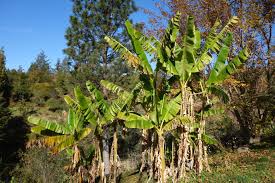
Researchers at Nagaland University highlighted genetic richness of wild banana Musa sikkimensis for climate-resilient farming.
- It is a wild banana species.
- It is native to the Eastern Himalayas and Northeast India.
- It is commonly known as the ‘Darjeeling banana’ or ‘Sikkim banana’,
- It is a tall, evergreen perennial plant that belongs to the banana family.
- It has large, paddle-shaped leaves that can grow up to 10 feet (3 meters) long and 2 feet (60 cm) wide.
- The plant produces beautiful, pendulous flowers that are a deep maroon color and can grow up to 2 feet (60 cm) long.
- It is not widely cultivated for edible fruit. It plays a crucial role in strengthening crop resilience and ensuring sustainable production.
- Its germplasm exhibits strong adaptive potential across diverse environmental conditions.
- It is a wild-seeded species that serves as a crucial genetic reservoir.
- Required Climatic Conditions for Musa sikkimensis:
- It prefers high humidity levels, around 50-60%.
- It prefers warm temperatures between 20-30°C.
- It can tolerate cooler temperatures, but not below 10°C.
- It possesses traits linked to disease resistance, environmental stress tolerance and climate adaptability, making it an invaluable resource for future banana breeding and crop improvement programmes.



