
Great Salt Lake:
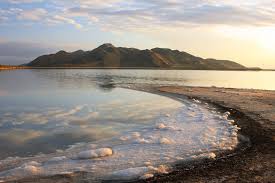
Researchers at the University of Utah have found that freshwater saturates the rock and sediment beneath the Great Salt Lake to depths of up to 13,000 feet.
- Great Salt Lake is a saline lake located in northern Utah, United States.
- It is the largest inland body of salt water in the Western Hemisphere and one of the most saline inland bodies of water in the world.
- The lake is fed by the Bear, Weber, and Jordan rivers and has no outlet.
- The lake has fluctuated greatly in size, depending on the rates of evaporation and the flow of the rivers that feed it.
- Like the Dead Sea, the Great Salt Lake exists within an arid environment and has chemical characteristics similar to that of the oceans.
- It has a much greater salinity than the oceans, however, since natural evaporation exceeds the supply of water from the rivers feeding the lake.
- It is surrounded by great stretches of sand, salt land and marsh, the Great Salt Lake remains eerily isolated from the nearby cities, towns and other human habitations.
- Some notable avian species that are found here include American avocet, Wilson’s phalarope, California gull, black-necked stilt, American white pelican, peregrine falcon, marbled godwit, etc.



