
Today’s Current Affairs: 6th May 2026 for UPSC IAS exams, State PSC exams, SSC CGL, State SSC, RRB, Railways, Banking Exam & IBPS, etc
Table of Contents
Dorjilung Hydroelectric Power Project:
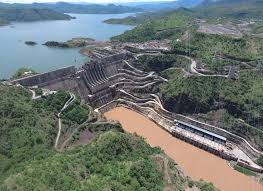
The Bhutan government and the World Bank recently signed financing agreements worth $515 million for the 1,125 MW Dorjilung Hydroelectric Power Project, with nearly 80% of its 4,500 GWh annual generation set to be supplied to India.
- It is a run-of-river project to be built on the Kurichhu River in eastern Bhutan.
- The Kurichhu River is a tributary of the Drangmechhu River that flows into India as Manas River.
- The project involves a concrete-gravity dam and an underground powerhouse housing six Francis turbines.
- The project is financed by the World Bank.
- The project is being developed by Dorjilung Hydro Power Limited, a joint venture between Bhutan’s Druk Green Power Corporation (DGPC) and
- India’s Tata Power, with DGPC and Tata Power holding equity shares of 60% and 40%, respectively.
- The project is slated for commissioning in 2031, and 80% of its generation will be supplied to India.
UDGAM Portal:
The Reserve Bank of India (RBI) recently told the Supreme Court that 30 banks have been integrated into its centralised web portal, UDGAM, to enable legal heirs to trace funds belonging to deceased account holders.
- UDGAM (Unclaimed Deposits-Gateway to Access inforMation) is an online portal developed by the Reserve Bank of India (RBI).
- The RBI collaborated with Reserve Bank Information Technology Pvt Ltd (ReBIT), Indian Financial Technology & Allied Services (IFTAS), and selected banks to develop this platform.
- It facilitates the registered users to search unclaimed deposits/accounts across multiple banks at one place in a centralized manner.
- There are 30 banks, which are part of UDGAM portal, and they cover around 90% of unclaimed deposits (in value terms) in the Depositor Education and Awareness (DEA) Fund of RBI.
- All unclaimed deposits/accounts that are part of the DEA Fund of RBI can be searched in the UDGAM portal.
- It provides information related to both individual and non-individual category of unclaimed deposits.
Unclaimed Deposit Reference Number (UDRN):
- After registration on the UDGAM portal, a person will get UDRN, which is a unique number generated through Core Banking Solution (CBS) by banks and assigned to each Unclaimed account/ deposit transferred to the DEA Fund of RBI.
- This number is used so that the account holder or the bank branch where the account is maintained cannot be identified by any third party.
- The UDRN enables the bank branches to seamlessly settle claims received from the customers/depositors, who have made successful searches in the UDGAM portal.
Unclaimed Deposits:
- According to RBI, “Unclaimed Deposits” refers to funds held in savings or current accounts that have remained inactive for a duration of 10 years, or in the case of fixed deposits (FDs), have not been withdrawn within 10 years from the maturity date.
- Such amounts are transferred by banks to the “Depositor Education and Awareness” (DEA) Fund, which is maintained by the Reserve Bank of India (RBI).
Indopotamon alipurduarense:
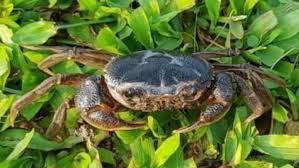
Scientists recently discovered a new species of freshwater crab named Indopotamon alipurduarense beneath the agricultural fields of West Bengal.
- It is a new species of freshwater crab.
- It was discovered in the sub-Himalayan Dooars region of West Bengal.
- It marks only the second species ever recorded in the Indopotamon genus and pushes the total number of known freshwater crab species in India to 183.
- These highly secretive animals spend the vast majority of the year hidden securely underground.
- They only emerge from their subterranean homes during the region’s heavy rainy season, making them visible to researchers and locals only between May and August.
- The crab’s newly assigned scientific name, alipurduarense, is a direct nod to its origins, honouring the Alipurduar district of West Bengal.
Mahi River:
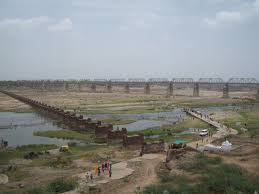
Two persons, including an eight-year-old boy, went missing after a boat capsized in the Mahi River in Rajasthan’s Banswara recently.
- Mahi River is one of the major west-flowing interstate rivers of India.
- It flows through the states of Madhya Pradesh, Rajasthan, and Gujarat.
- The river is popularly described as “Mahisagar” due to its vastness.
- It originates in the northern slope of the Vindhya Mountain Range in Madhya Pradesh.
- It enters the southeastern portion of Rajasthan, which is the Vagad region.
- Before entering Gujarat, the river makes a `U` shaped loop in Rajasthan.
- Finally, the river surrenders itself to the Arabian Sea by a wide estuary near Khambat.
- Its basin is bounded by the Aravalli Hills on the north and the northwest, by the Malwa Plateau on the east, by the Vindhyas on the south, and by the Gulf of Khambhat on the west.
- The silt brought down by the Mahi River has contributed to the thinning of the Gulf of Khambat and the abandonment of its once-rich ports.
- The riverbed lies considerably lower than the land level and is of little use for irrigation.
- Tributaries: Eru, Nori, Chap, Som, Jakham, Moran, Anas, Panam, and Bhadar.
- Major Dams: Mahi Bajaj Sagar Dam, Kadana Dam, and Panam Dam are crucial for water management.
Lake Chad:
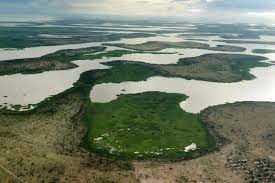
At least 23 Chadian soldiers have been killed and 26 injured in a Boko Haram attack on a military post in Chad’s Lake Chad region recently.
- It is a freshwater lake in the semi-arid Sahel region west-central Africa.
- It is located in western Chad, with some of its parts extending into Cameroon, Nigeria, and Niger.
- Lake Chad was once the sixth largest lake in the world, but prolonged drought and increased water use have shrunk the lake dramatically. It now spans less than a tenth of the area it covered in the 1960s.
- The lake is endorheic (no outlet to the sea).
- The Chari River is the main river feeding into the lake. It accounts for up to 90% of Lake Chad’s water.
- Chad has several small islands, mud banks, and reed beds, which take up half of its area.
- Around the lake, sand deserts and water meet in a complex network of meanders, which are sometimes cultivated.
Jim Corbett National Park : Death Of Vikram, an Old Bengal Tiger
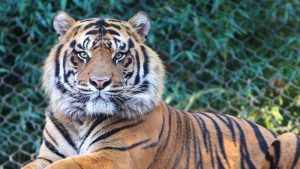
Uttarakhand recently witnessed the death of Vikram, a 21-year-old Bengal tiger and one of the most well-known residents of Jim Corbett National Park.
- Jim Corbett National Park is located in the foothills of the Himalayas in the Nainital district of Uttarakhand.
- It is a part of the Corbett Tiger Reserve.
- It was established in 1936 as Hailey National Park and was later renamed in 1957 in memory of Jim Corbett, a famous hunter turned conservationist, who played a key role in the establishment of the park.
- It is not only the first national park in India but also the first to come under the Project Tiger
- It is spread over the Bhabar and lower Shivalik regions with a deep-water table.
- The tract is porous with boulders and sand deposits.
- The Ramganga River (West) and its important tributaries – Sonanadi, Palain, and Mandal, constitute the primary water source for the region.
- Additionally, the Kosi River runs adjacent to the national park.
New Plant Species:
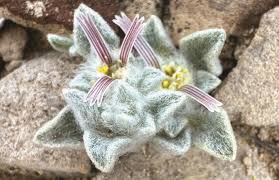
Scientists have identified three new plant species named Euphorbia ananthapuramensis, Euphorbia chalamensis,and Ceropegia andhrica, in the Eastern Ghats of Andhra Pradesh.
Euphorbia ananthapuramensis:
- It is a new shrubby plant species.
- It was discovered inNigidi Forest in the Sri Sathya Sai district, Andhra Pradesh.
- It grows among granite rocks in scrub forests.
- It has medicinal properties and is used by local tribal communities to treat wounds, skin diseases, and digestive disorders.
- The species faces threats from granite mining and forest fires.
- IUCN Red List Classification: Critically Endangered
Euphorbia chalamensis:
- It is a small annual herb.
- It was discovered in Chalama Forest in Gundla Brahmeswaram Wildlife Sanctuary in Nandyal district, Andhra Pradesh.
- It was found in dry deciduous forests.
- It has medicinal properties and is used by local tribal communities to treat wounds, skin diseases, and digestive disorders.
- Forest fires and human activity have been listed among the major threats.
- IUCN Red List Classification: Critically Endangered
Ceropegia andhrica:
- It is a dwarf tuberous herb.
- It was discovered in Paderu forest division in Alluri Sitharamaraju district, Andhra Pradesh.
- It was found in open forest edges.
- The plant is leafless during flowering, which occurs after the first rains between May and June, and produces leaves later.
- It produces edible tubers roughly the size of small potatoes.
- Grazing, forest fires, and habitat loss threaten the species.
- IUCN Red List Classification:Critically Endangered
Samarth Panchayat Portal:
The central government is set to expand the rollout of its Samarth Panchayat portal to states including Assam, Uttar Pradesh and Maharashtra.
- It is a unified digital platform designed to empower Panchayati Raj Institutions with efficient governance tools.
- It aims to digitally empower the panchayats to efficiently collect and monitor revenue under the own source revenue (OSR) Framework.
- It enables seamless access to services, enhances transparency, and simplifies administrative processes for both citizens and officials.
- It shall facilitate in strengthening of the financial capabilities and local governance of panchayats, ensuring improved quality of life for residents at the grassroots level.
- Nodal Ministry: Ministry of Panchayati Raj
- Own Source Revenue (OSR) of Panchayats:
- It is the income generated by Gram Panchayats from local sources such as taxes, service charges, rents, leases, and fees.
- A strong OSR provides financial independence, enabling Panchayats to build better infrastructure, improve water and sanitation, create greener public spaces, and deliver efficient services.
Caracal:
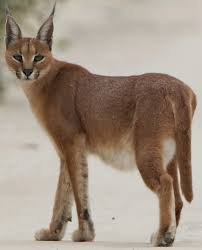
Officials have confirmed the return of the rare caracal in the Thar Desert near the India-Pakistan border.
- Caracal is an elusive medium-sized wild cat species.
- It is often referred to as the desert lyn; however, they are more closely related to the African golden cat and the Serval.
- In India, it is called siya gosh, a Persian name that translates as ‘black Ear’.
- The caracal has a solid build, long legs, a short face, and tufted ears.
- The cat’s fur is generally a red-tan or sand, although some black caracals have also been seen.
- It can be found in many environments, such as semi-deserts, savannahs, shrublands, steppes, forests, and woodlands. It prefers dry areas with very little rainfall.
- It is native to Africa, Central Asia, the Middle East, northwestern India (primarily in Rajasthan and Gujarat) and arid areas of Pakistan.
- Characteristics:
- Like most species of cat, the caracal is predominantly nocturnal.
- They live in small herds and it is shy and elusive nature makes them difficult to spot in the wild.
- Diet: Caracals are carnivores
- Conservation Status:
- IUCN: Least Concern
- Wildlife Conservation Act 1972: Schedule 1



