
Today’s Current Affairs: 6th jul 2026 for UPSC IAS exams, State PSC exams, SSC CGL, State SSC, RRB, Railways, Banking Exam & IBPS, etc
Table of Contents
Modified UDAN Scheme: In News

The Prime Minister of India has recently inaugurated the new terminal building at Jodhpur airport and launched the modified UDAN Scheme.
- The scheme aims to accelerate the next phase of aviation-led development.
- A key emphasis is on the development of 100 aerodromes from existing unserved airstrips to expand aviation infrastructure across the country.
- The scheme has been earmarked for Operations and Maintenance (O&M) support to ensure the viability of regional airports during their initial years of operation.
- Additionally, an investment will fund the creation of modern helipads, and a continued Viability Gap Funding for airlines to sustain regional airline operations.
- The scheme promotes the induction of indigenous aircraft and helicopters, including HAL Dhruv and Dornier platforms, for operations in underserved and remote regions.
- The Ude Desh ka Aam Nagrik (UDAN) scheme is a Regional Connectivity Scheme (RCS) launched in October 2016 by the Government of India to enhance air connectivity to underserved and unserved regions.
- Objectives:
- Improve regional connectivity across Tier-2 and Tier-3 cities.
- Make air travel affordable for common citizens.
- Promote balanced regional development.
- Enhance the infrastructure utilisation of unused and underutilised airports.
- The mission has two parts.
- First, make air travel affordable on short regional sectors where train journeys take 10-18 hours.
- Second, revive unserved and underserved airports — places that had runways but no scheduled commercial flights.
- The first UDAN flight took off on 27 April 2017, connecting Shimla to Delhi.
- Key Features:
- Airlines are selected through a competitive bidding mechanism.
- Viability Gap Funding (VGF) is provided to airlines to operate on less profitable routes.
- The Airports Authority of India has also waived off the airport fee for the same.
- At the same time, the state governments are also providing security, electricity, and fire-fighting facilities free of cost.
- 50% of seats are offered at a capped fare of around Rs. 2,500 per hour of flight.
- Focus on connecting remote, hilly, and island regions.
- Funding Mechanism:
- Initially funded through a Regional Connectivity Scheme levy imposed on flights operating on major routes.
- The levy subsidised airlines operating on regional routes.
- The Ministry of Civil Aviation runs it through the Airports Authority of India (AAI), which acts as the implementing agency for bidding, monitoring, and viability gap funding payouts to airlines.
Rutile Oxides:
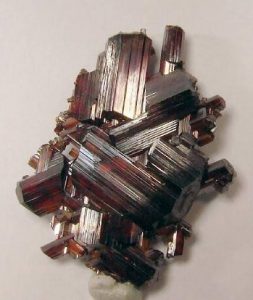
When a team at IIT-Delhi recently compared the members of a family of minerals called rutile oxides, they found a significant difference between metals and insulators that a well-known mathematical model could not explain.
- Rutile is a mineral composed primarily of titanium dioxide, TiO2.
- It is the most common and stable form of titanium dioxide found in nature.
- It is one of the three main minerals of titanium, along with ilmenite and leucoxene.
- It forms red to reddish brown, hard, brilliant metallic, slender crystals, often completely surrounded by other minerals.
- Natural Rutile can contain up to 10% iron and large amounts of niobium and tantalum.
- It was first described in 1803 by Abraham Gottlob Werner.
- It is found in igneous, metamorphic, and sedimentary rocks throughout the world.
- Rutile has a high specific gravity and is often concentrated by stream and wave action in “heavy mineral sands” that exist today in both onshore and offshore deposits.
- Much of the world’s rutile production is mined from these sands.
- Rutile ore is largely available in countries like Australia, India, South Africa, Ukraine, and Sierra Leone.
- India has significant rutile deposits in the coastal sands of states such as Kerala, Tamil Nadu, Odisha, and Andhra Pradesh.
- Rutile has several important industrial applications due to its high refractive index and strong resistance to heat and chemical corrosion.
- One of its main uses is as a pigment in paints, plastics, ceramics, and other materials. It imparts a bright white color and excellent opacity to these products.
- Rutile has minor uses in porcelain and glass manufacture and in making some steels and copper alloys.
- Rutile is also used as a source of titanium metal, which has a wide range of applications in industries such as aerospace, automotive, electronics, and medical devices.
- In addition to its industrial uses, rutile is valued as a collector’s mineral and gemstone.
- Transparent rutile crystals are sometimes cut and polished for use as gemstones.
Tandulwadi Fort:
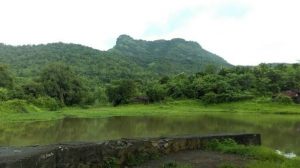
Six tourists were recently rescued after they lost their way and got stranded in dense fog while coming down from Tandulwadi Fort in Maharashtra’s Palghar district.
- Tandulwadi Fort is located near Lalthane village in Palghar district, about 104 km from Mumbai, Maharashtra.
- The fort dates back 800 years and was primarily used as a watch tower over the surrounding plain.
- Tandulwadi is not a fully built up fort, but a series of structures spread over the top of the mountain.
- In the thirteenth century, King Bhimdev’s kingdom comprised the cities of Shurparak (Nalasopara) and Mahikawati (Mahim).
- The first known history of the fort was in the 15th century (about 1429) during the rule of Jafar Khan, son of Ahmed Shah of the Gujarat Sultanate.
- It was used as a reconnoiter fort to keep a watch on neighboring forts and the Arabian Sea.
- In 1454, the Sultan of Ahmedabad captured Mahikavati (Mahim Fort) and one of his Sardars named Mallik Allauddin was made chief of Tandulwadi fort.
- In 1509, the Portuguese took the fort but lost control of the area to the Marathas in 1737 after the Battle of Bassein.
- It has several rock cut water cisterns.
- There are no bastions, walls or houses on the fort.
- There is no evidence of fortification except for a small stone wall on the southern side.
- A small water pond is situated in the center.
Canscora agni : New Plant Species
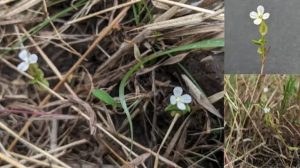
Researchers recently discovered a new plant species, named Canscora agni, in the fire-prone savannas of western India.
- Canscora agni is a new species of plant.
- It was found on Sus Hill in Maharashtra’s Pune district.
- Discovered in the fire-prone savannas of western India, this tiny plant highlights the often-misunderstood role that natural fires play in keeping ecosystems healthy.
- In the ancient Indian savannas, frequent natural fires are a vital force of nature that clear away overgrown woody vegetation, allowing native grasses and unique dwarf plants like C. agni to thrive.
- The specific name ‘agni’ means ‘fire’ in several Indian languages, including Marathi.
- Canscora agni is a small herb with white petals and uniquely winged stems.
- It has several unique characteristics that easily differentiate it from its closest relative, Canscora alata.
- C. agni is a dwarf herb.
- Closer examination of its stems reveals that the wing-like structures are uneven, being wider below the flowers and narrower towards the stem.
- It has special minute glandular hairs on its leaves, a shorter ovary, and distinct web-like (reticulate) veins on the wide wings of its flower base (the calyx), all traits that are completely absent in its taller cousin.
- The researchers suggest classifying Canscora agni as ‘Critically Endangered’.
Laokhowa Wildlife Sanctuary: In News

A large-scale eviction drive is underway at the Laokhowa Wildlife Sanctuary in Assam’s Nagaon district with the administration clearing alleged encroachments spread across hundreds of bighas of cultivated land.
- Laokhowa Wildlife Sanctuary is located on the southern part of the Brahmaputra River in the Nagaon District of Assam.
- It forms an integral part of the Laokhowa-Burachapori ecosystem and is a notified buffer of the Kaziranga Tiger Reserve.
- It is a part of the Brahmaputra valley.
- The sanctuary is surrounded by human-dominated areas on all sides except for the north.
- The vegetation composition of Laokhowa can be broadly categorized into alluvial grassland, alluvial forest, moist deciduous forest, and tropical semi-evergreen forest.
- The sanctuary is home to the Great Indian-one horned rhinoceros, elephants, royal Bengal tigers, Asiatic water buffaloes and more than 225 species of birds.
- Some of the birds spotted here are the spot-billed pelican, little and large cormorant, egret, open-billed stork, brahminy kite, pond heron, etc.
Seabuckthorn: Granted GI Status
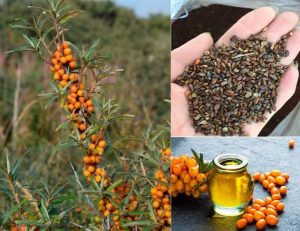
Spiti’s seabuckthorn has been granted the Geographical Indication (GI) status.
- Seabuckthorn is popularly known as the ‘Wonder Plant’, ‘Ladakh Gold’, ‘Golden Bush’, or ‘Gold Mine’ of cold deserts.
- It is an important plant of trans-Himalayan region that belongs to the family Elaegnaceae.
- Sea buckthorn (Hippophae rhamnoides) is a plant found throughout Europe and Asia.
- In India, it is found above the tree line in the Himalayan region, generally in dry areas such as the cold deserts of Ladakh and Spiti.
- It produces small orange or yellow-coloured berries that are sour in taste but rich in vitamins, especially vitamin C.
- Sea Buckthorn berries have a unique characteristic of remaining intact on the shrub throughout the winter months despite the subzero temperature.
- It is a temperate shrub.
- It can withstand a wide range of temperatures from -43 to 40°C. This unique feature enables the species to adapt very well in harsh climatic conditions.
- The dense and thorny bushes of sea buckthorn are salt tolerant and demand full sunlight for growth.
- The shrub develops an extensive root system having ability to fix atmospheric nitrogen.
- It is an ideal plant for soil erosion control, land reclamation, wildlife habitat enhancement and farm stand protection in temperate regions.
Medical Innovations Patent Mitra Platform:

The National Medical Commission (NMC) has asked all medical colleges and institutions to use the Indian Council of Medical Research’s (ICMR) ‘Medical Innovations Patent Mitra’ platform.
- Medical Innovations Patent Mitra Platform provides fully government-funded support for patent filing and technology transfer.
- It aims to support strategic and quality patent filings for innovative biomedical research with a vision to advance patent protection and facilitate seamless technology transfer for societal impact.
- It enables researchers and innovators to protect their intellectual property and translate research into healthcare products and technologies.
- Initiated by: Indian Council of Medical Research (ICMR).
- It was launched under the guidance of NITI Aayog, in partnership with the Department of Pharmaceuticals (DoP) and with support from the Department for Promotion of Industry and Internal Trade (DPIIT).
- The platform focuses on several areas, including:
- Supporting patent protection for healthcare innovations
- Helping researchers transfer technologies to industry partners
- Speeding up commercialisation of indigenous medical products
- Encouraging collaboration between scientists, startups, and companies
- Improving access to affordable healthcare technologies
Radio Telemetry:
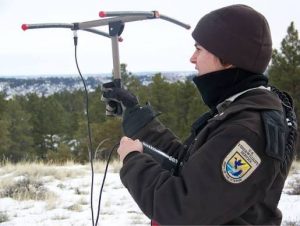
Radio telemetry data helped conservationists repeatedly protect the radio-tagged White-rumped vulture Z25, but the bird was ultimately killed in a collision with a power transmission line.
- Radio telemetry involves using radio waves to automatically transmit data from remote or inaccessible sources to a receiving station for monitoring and analysis.
- It is commonly used in wildlife tracking, weather monitoring, industrial process control, and medical monitoring to gather data without needing physical access to the source.
- Since the 1960s, scientists have been using radio telemetry to track wildlife, studying their migration patterns, behaviors, and habits.
- Radio telemetry uses radio signals, which are made up of invisible and silent electromagnetic waves, to determine location.
- A radio telemetry system is made up of three parts: a radio transmitter, a radio antenna, and a radio receiver.
- The transmitter can be attached or tagged to the subject using a collar, an ear tag, or a wing tag for birds in particular. It is the part that transmits, or sends, the radio signal.
- The operator uses an antenna, attached to a receiver, which is programmed to the transmitter’s frequency, to pick up the radio signals given off by the transmitter affixed to the target animal.
- Receiver antennas may be hand-held, mounted on an object, or affixed to towers to avoid interference from buildings and trees.
- They may also be fixed to a vehicle, boat, or aircraft to allow the operator to exploit larger areas.
- The radio signals are then transformed into a beeping sound by the receiver.
- As the receiver gets closer to the transmitter, the beeps get louder, meaning the animal wearing the transmitter is close by.
- The researcher can use this audible clue to locate and follow the animal wearing the transmitter.
- However, unlike GPS satellite tracking, radio telemetry requires researchers to remain within the signal range of the transmitter to locate the tagged animal.
- The other limitation is the size and lifespan of the battery required to power the transmitter.
Matcha Tea:
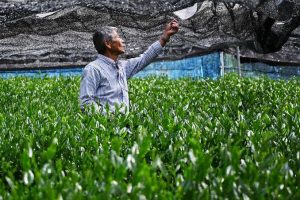
An Assam tea estate sold India’s first commercially-produced matcha tea, marking a significant shift from conventional teas.
- Matcha is a finely ground green tea powder made from specially processed, shade-grown tea leaves of Camellia sinensis.
- It originated through cultural exchanges between China and Japan during the premodern period.
- It developed from earlier powdered tea practices in China that were later introduced to Japan by Zen Buddhist monks.
- It is made after shading tea leaves for three to four weeks before harvest.
- Blocking 90% of sunlight from the leaves boosts their chlorophyll and amino acid levels, and gives them a distinct colour and flavour.
- The young leaves are harvested and steamed, then dried and de-stemmed into a flaky leaf called tencha.
- The tencha is slowly stone-ground into the fine powder we know as matcha.
- The shade-growing process gives matcha its characteristic bright green colour and rich umami flavour.
- Unlike regular green tea, where the leaves are steeped and discarded, matcha is whisked into water and consumed entirely, providing higher levels of antioxidants, amino acids, and natural caffeine.
Battery Management System (BMS):
The government has directed Apple and Google to remove three battery management applications—BAT-BMS, Lossigy, and Epoch Li-ion—from their app stores due to critical cybersecurity and passenger safety risks.A Battery Management System (BMS) is an electronic control circuit integrated into an electric vehicle (EV) or energy storage pack powered by large-capacity lithium-ion batteries. It acts as the “brain” of the battery pack, managing the physical and electrical parameters of individual cells to maintain uniform performance and safety.The aim of a BMS is to eliminate performance variations among individual battery cells, allowing them to charge and discharge uniformly inside a large battery pack.



