
Today’s Current Affairs: 3rd Aug 2026 for UPSC IAS exams, State PSC exams, SSC CGL, State SSC, RRB, Railways, Banking Exam & IBPS, etc
Table of Contents
Dhauladhar Wildlife Sanctuary:
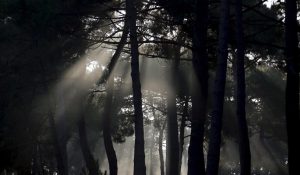
Snow leopard (Panthera uncia) has been photographed for the first time in the Dhauladhar Wildlife Sanctuary in Kangra district.
- It is located in Himachal Pradesh.
- It was established in 1994.
- The two significant features of this sanctuary are the Dhauladhar and the Bara Bhangal Range which occupies maximum part of the natural area and is famous for its diverse flora and fauna.
- It has bare huge rocks, mostly granite and the peaks laden with snow.
- This wildlife sanctuary is characterized by a predominantly high altitude forests.
- It consists of Western mixed coniferous forest type of vegetation.
- It consists of deodar, fir, spruce blue pine, oaks and alpine pastures.
- Musk Deer, Himalayan Black Bear, Serow, Himalayan Weasel, Himalayan Palm Civet; Cheer Pheasant, Western Tragopan, Speckled Wood-Pigeon etc.
Bagdara Wildlife Sanctuary:
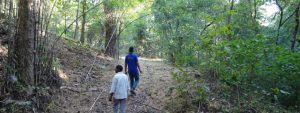
The Standing Committee of the National Board for Wildlife (SC-NBWL) recently told the Madhya Pradesh government to explore alternative areas for compensatory notification, while deliberating on the proposed denotification of the Bagdara Wildlife Sanctuary.
- It is situated in the Sidhi and Singrauli districts of Madhya Pradesh.
- The sanctuary was established in 1978 for the conservation of blackbuck and other wildlife species, including wild boar, jackal, fox, porcupine, hyena, and sambar.
- Son River makes the southern boundary of the sanctuary.
- Natural caves and rock shelters are part of the Sanctuary.
- The sanctuary hosts a very dense cover of dry deciduous mixed forest.
- The dominant trees include Gigantic Creepers, Mango Groves, Orchids, Teak Trees, and many more.
- Lendia, Khair, Dhawda, and Tendu are also common.
- It boasts a number of wild animals, including Tiger, Panther, Deer, Sambhar, Hyenas, Chinkara, Cheetal, Wild Boar, Black Buck, along with an incredible diversity of birds.
Republic of Naoero:
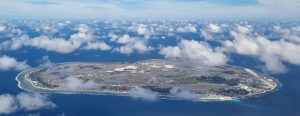
The Pacific island nation of Nauru has officially changed its name to the Republic of Naoero recently reverting to its traditional designation in a move it said was aimed at strengthening national identity and cultural heritage.
- Republic of Naoero is an island republic located in the southwestern Pacific Ocean.
- It is the world’s smallest independent republic.
- Its closest neighbor is the island of Banaba, in Kiribati.
- Nauru has no official capital.
- Nauruan is the national language.
- Currency: Australian dollar
- Historically one of the world’s wealthiest countries per capita because of phosphate mining.
- Phosphate reserves have been largely depleted, leading to economic challenges.
- Agriculture (with the exception of coffee and copra plantations along the coastal and lagoon perimeters), fishing, manufacturing, and tourism are of minor value to the overall economy.
Dhimsa Dance: Guinness World Records as the largest Dhimsa dance

A recent performance of the traditional Dhimsa dance by more than 13,000 tribal women and girl students at the Alluri Sitarama Raju International Airport in Bhogapuram was recognised by Guinness World Records as the “largest Dhimsa dance”.
- It is a popular tribal dance performed by tribes, including Bagata, Valmiki, Poraja, Khond, Gadaba, Kondadora, Mukadora, and Kotia in Andhra Pradesh.
- It is performed during festivals, weddings, and at the time of the “hunting festival” in April when men and women dance for hours together.
- There are 12 varieties of Dhimsa and the origin can be traced to the Koraput area, the home of the Ghond Tribe.
- Typically performed by a group of 15 to 20 women dressed in traditional, colorful ethnic sarees and ornaments, the dancers move in synchronous circles to the rhythm of native instruments played by male community members.
- The beauty of this dance centres on the movements of the dancers without much emphasis on expression or literary texts.
- The feet and the hand movements dominate the dance.
- It is accompanied by wind and percussion instruments; the dance changes with the music.
- Unique tribal musical instruments accompanying this dance form include the Mori (a wind instrument), Thudum (drum), and Dappu.
- Themes: Various themes of the Dhimsa, are woven around their mythologies, folktales, ethos, mores, economic activities, and kinship and marital life, etc.
Pseudolaguvia khairii:
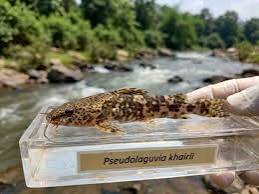
Researchers recently discovered a new species of freshwater catfish named Pseudolaguvia khairii in Odisha.
- Pseudolaguvia khairii is a new species of freshwater catfish.
- It was discovered in the Budhabalanga River in the Mayurbhanj district, Odisha.
- It was named in honour of the legendary tigress Khairi, who became the face of wildlife conservation and a unique human-animal bond in Odisha nearly five decades ago.
- It belongs to the genus Pseudolaguvia, a group of small hillstream catfishes inhabiting the clear, fast-flowing rivers of India, Bangladesh, Nepal, and Myanmar.
- Only a few centimetres long, Pseudolaguvia khairii can be distinguished from all its known relatives by a unique fleshy protuberance at the base of its dorsal fin, a feature not previously recorded in the genus.
Magellanic Bridge:

A team led by Inter-University Centre for Astronomy and Astrophysics (IUCAA) team has discovered the first known system of its kind in the Magellanic Bridge (MB) by using eROSITA X-ray telescope.
- It is a stream of stars and gas created by the close encounter of two nearby galaxies, the Large and Small Magellanic Clouds.
- It is mainly a gaseous feature connecting the two galaxies, with a small fraction of in situ formed young stars.
- The MB is believed to be composed of tidally stripped material from the SMC during its last encounter with the LMC, approximately 200-300 Myr ago.
- Magellanic Bridge can help us understand how close encounters between galaxies influence the way binary stars form, evolve and survive.
- Researchers will be able to compare stellar evolution in the Bridge with that in the Large and Small Magellanic Clouds, and gain a clearer picture of how interactions between neighbouring galaxies shape their stars over time.
Key Features of eROSITA X-ray Telescope:
- eROSITA (extended ROentgen Survey with an Imaging Telescope Array) is a wide-field X-ray telescope on-boarded the Russian-German “Spectrum-Roentgen-Gamma” (SRG) observatory.
- It was developed under the leadership of the Max-Planck Institute for extraterrestrial Physics (MPE) in Germany (DE).
- eROSITA is a sensitive X-ray telescope capable of delivering deep, sharp images over very large areas of the sky in the energy range ~0.2-8 keV.
- It is placed in a halo orbit around the L2 point.
- It has been performing an all-sky survey, in which the whole celestial sphere is mapped once every six months.
Xtreme Weather Grade Diesel:
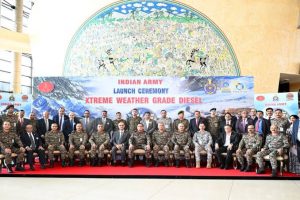
The Chief of the Army Staff (COAS) launched the indigenously developed Xtreme Weather Grade (XWG) Diesel in New Delhi.
- It is a specialised diesel fuel developed for operations in extremely low temperatures.
- It is designed to remain usable at temperatures as low as minus 42 degrees Celsius.
- It is developed jointly by the Indian Army and Oil Marketing Companies.
- It can withstand a wide temperature range, with a pour point of minus 42 degrees Celsius and a flash point of around 50 degrees Celsius.
- It is also compliant with BS-VI emission standards and IS 1460:2025 specifications.
- It allows it to be used in the Indian Army’s existing fleet without requiring engine modifications or re-homologation.
- It is the specialised fuel will enhance the mobility, safety and operational availability of combat and logistics vehicles in extreme climatic conditions.
- The technology also has wider civilian use in high-altitude and severe winter regions and represents a significant step towards Atmanirbhar Bharat.
Samudra Manthan Scheme:

The Union Cabinet has approved ‘Samudra Manthan’ – the National Offshore Exploration Scheme with total outlay of ₹84,084 crore
- It is also called a as the National Offshore Exploration Scheme.
- It is a Central Sector Scheme of the Ministry of Petroleum & Natural Gas.
- Implementation Period: Up to FY 2030–31.
- The scheme aims at unlocking India’s vast offshore energy potential.
- Features of Samudra Manthan Scheme:
- It encompasses a comprehensive set of interventions across the offshore exploration value chain.
- It provides for large-scale acquisition, processing and interpretation of high-quality seismic data, accelerated deep water and ultra-deep water exploratory drilling, scientific drilling in frontier basins.
- It involves development of common offshore production and evacuation infrastructure, and establishment of an integrated Oil & Gas Manufacturing and Services Zone.
- It also includes dedicated provisions for digital programme management, capacity building, technology adoption, stakeholder engagement and international outreach, creating an integrated ecosystem to accelerate offshore exploration and production in the country.
Pygmy Hog:
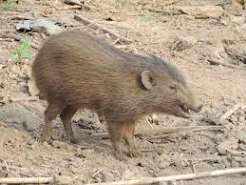
The Standing Committee of the National Board for Wildlife (SC-NBWL) has recommended the inclusion of the pygmy hog in the list of critically endangered species under Integrated Development of Wildlife Habitats (IDWH).
- Pygmy Hog is the smallest and rarest species of wild pig.
- It is one of the very few mammals that build its own home, or nest, complete with a ‘roof’.
- It is an indicator species as its presence reflects the health of its primary habitat.
- It prefers undisturbed patches of grassland dominated by early succession riverine communities, typically comprising dense tall grass intermixed with a wide variety of herbs, shrubs and young trees.
- Currently, they survive only in the grasslands of Assam’s Manas and Orang national parks.
- They feed on roots, tubers, shoots and ground vegetation, along with worms and other invertebrates.
- It digs for roots, tubers, wild fruits, termites, earthworms, eggs and other food sources found in grasslands which aerates the soil and enhances its quality.
- It also helps dispersing seeds through its dietary and foraging habits.
- Conservation Status:
- IUCN: Critically Endangered
- The Wildlife Protection Act, 1972: Schedule I.
Integrated Development of Wildlife Habitats Scheme:
- It is a centrally sponsored scheme provides financial assistance to states to protect certain species or wildlife areas through its recovery programme for critically endangered species and habitats.
- Components of the scheme:]
- Support to Protected Areas (National Parks, Wildlife Sanctuaries, Conservation Reserves and Community Reserves)
- Protection of Wildlife Outside Protected Areas
- Recovery programmes for saving critically endangered species and habitat.
Pradhan Mantri Surya Sarovar Yojana:
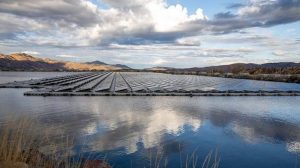
The Union Cabinet approved the ‘Pradhan Mantri Surya Sarovar Yojana (PM-SSY)’.
- Pradhan Mantri Surya Sarovar Yojana is a scheme for the development of Floating Solar Photovoltaic (FSPV) Projects with Energy Storage Systems (ESS).
- It envisages the development of 5,000 MW of Floating Solar Photovoltaic projects with co-located Energy Storage Systems.
- The projects will be sanctioned during FY 2026-27 to FY 2030-31, with disbursement of financial support continuing up to FY 2032-33.
- It would enhance the floating Solar PV capacity in the country by 5,000 MW, which is presently around 700 MW only.
- It would provide an opportunity to gainfully utilize existing reservoirs & industrial ponds, and eliminate competition for scarce land resources.
- The integration of an energy storage system will help strengthen grid reliability.
- It would help in the reduction of around 10 million tonnes of CO₂ emissions
- It would help in the generation of approximately 16,000–17,000 full-time equivalent employment opportunities across the project value chain.
- The scheme would also promote domestic manufacturing of floatation systems as well as the entire value chain of the projects.
Kh-101 Missile:

A suspected Russian Kh-101 missile landed in eastern Poland recently, creating security tensions on NATO’s eastern flank.
- The Kh-101 (NATO: AS-23A Kodiak) is a Russian-made advanced stealthy long-range subsonic cruise missile that is launched from a strategic bomber.
- The missile was developed in the late 1990s by Russia’s Tactical Missile Armament Corporation (KTRV).
- It is designed to destroy ground targets such as buildings, bunkers, and military installations.
- The Kh-101 is primarily carried by Russia’s strategic bombers, such as the Tu-95MS, Tu-160, and Tu-22M3, as well as the Tu-142 maritime surveillance aircraft.
- The missile has a streamlined airframe, which is optimized for low observability and minimal radar cross-section.
- It has a length of approximately 7.5 m and a wingspan of about 4.4 m.
- The missile is powered by a turbofan engine and is capable of flying at a maximum speed of Mach 0.76.
- It has a range of 2,500 km to 3,000 km.
- It can carry a variety of conventional warheads, including high explosive, penetrator, and cluster munitions.
- The Kh-101 features advanced guidance and control systems, including inertial navigation, satellite navigation, and terrain mapping, which enable it to navigate and strike targets with high precision.
- Over the years, the Kh-101 has undergone several upgrades and modifications to improve its performance and capabilities.
- For example, a newer version, the Kh-102, was introduced in 2015, which reportedly has a longer range and improved accuracy compared to the Kh-101. It is the nuclear-capable version of Kh-101.
Crete Island:

Thousands of people were evacuated recently as fires threatened a tourist resort on the Greek island of Crete and continued to rage, fanned by violent winds.
- Crete Island is the largest island of Greece.
- It is located in the southern part of the Aegean Sea.
- It is the fifth-largest Mediterranean Sea island.
- It is bordered by the Sea of Crete in the north, the Libyan Sea in the south, the Myrtoan Sea in the west, and the Karpathian Sea in the east.
- The island is characterized by a diverse landscape, including a mountain chain that runs the length of the island, sandy beaches, and fertile plains.
- Crete’s economy is primarily based on tourism, agriculture, and shipping.
- The island of Crete has been inhabited since the Paleolithic Age by early hominids.
- The earliest advanced European civilization, the Minoan Civilization, started on the island around 2700-1420 BCE.
- The Minoan civilization ended after a major earthquake, and thereafter, the island’s rule was taken over by the Mycenaean civilization.
- The island was then subsequently ruled by the Romans, the Byzantines, the Andalusians, the Venetians, and the Ottomans.
- After the island’s independence from Ottoman rule, Crete became a part of Greece.
- During the Second World War, the island was occupied by the Nazi German forces and also served as the battleground of the famous “Battle of Crete.”
Moken People:

Scientists recently confirmed that Moken sea nomad children living on the Andaman Sea can see underwater with twice the clarity of other children, constricting their pupils to dolphin-like precision through years of ocean training.
- Often called sea nomads or sea gypsies, the Moken are seafaring people who have been living off the coast of Thailand and Myanmar on the Andaman Sea.
- Their name, in their own language, means “sea drowned.”
- The Moken have lived across the Andaman Sea for centuries, moving between the roughly 800 islands that stretch along the coastlines of Myanmar and Thailand.
- They are one of the last sea nomad peoples in the world.
- Traditionally, they travel in wooden vessels called kabang, moving with the seasons and tides.
- Fishing, diving, and gathering shellfish form the backbone of their subsistence lifestyle, and from a very young age, Moken children are immersed in the marine environment.
- Possessing a rich knowledge of the reefs, the Moken have exceptional underwater skills such as free diving and spear hunting.
- They speak an Austronesian language, a language family widely distributed across Southeast Asia and Oceania.
- Most Moken are stateless as a result of their nomadic lifestyle. They have no citizenship in Thailand or Myanmar.
- They came into the international spotlight following the 2004 Indian Ocean tsunami because they managed to sense warning signs from nature in the form of the sea receding, allowing them to move to higher ground away from dangerous areas.



