
Today’s Current Affairs: 14th Oct 2026 for UPSC IAS exams, State PSC exams, SSC CGL, State SSC, RRB, Railways, Banking Exam & IBPS, etc
Table of Contents
Sarus Crane: In News
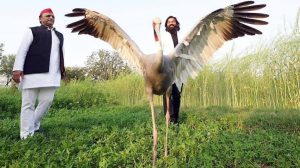
The Bombay Natural History Society (BNHS) has announced a nationwide survey to estimate the population of Sarus Cranes.
- Sarus Crane is the tallest flying bird in the world.
- They are mainly found in wetlands, marshes, shallow water bodies, grasslands and agricultural landscapes.
- They are found across Southeast Asia, northern India, and northern Australia.
- In India, most sarus cranes are distributed along the Gangetic plain and in eastern Rajasthan in the northern states of India. Population densities decrease going to the south.
- This species is not known to be migratory.
- It is a vital indicator of healthy wetlands and agricultural ecosystems.
- Features of Sarus Crane:
- Threats: Degradation of wetlands, changes in agricultural land use, usage of pesticides and agricultural chemicals, collision and electrocution in powerlines, human disturbance,
- Conservation Status of Sarus Crane
- IUCN Red List: Vulnerable
- CITES: Appendix II
- Wildlife (Protection) Act 1972: Schedule I
Bharat Tulip:
The Ministry of Social Justice & Empowerment has introduced BHARAT TULIP at the Mysuru Dasara Exhibition Grounds at Mysuru in Karnataka.
- Bharat Tulip (Traditional Artisans’ Upliftment Livelihood Programme)was launched in 2024.
- It is an initiative by the National Backward Classes Finance and Development Corporation (NBCFDC) under the Ministry of Social Justice and Empowerment.
- It is a transformative platform designed to empower marginalized artisans by integrating them into the global digital economy.
- Objectives:
- Empower artisans with access to digital marketplaces
- Enable artisans to participate in domestic/global trade fairs, exhibitions, and fashion shows
- Functions of Tulip:
- E-Commerce Integration: Tulip collaborates with leading e-commerce platforms to expand artisans’ reach and boost sales opportunities.
- Facilitating Sales: It enables artisans to sell high-quality products through digital marketplaces.
- Quality Assurance: Ensuring rigorous quality checks so that only premium products are delivered directly to customers.
- Skill Development: Providing essential training to artisans to improve craftsmanship and market readiness.
- Global Outreach: Expanding artisans’ presence on international B2C platforms to tap into global markets.
- Participation in Fair: Offering artisans opportunities to showcase and sell their products at national and international fairs, opening new revenue streams.
MY Bharat Platform:

MY Bharat organized neighbourhood youth parliaments and Yuva Melas Across 1,469 locations as part of the Nasha Mukt Yuva for Viksit Bharat Abhiyan.
- MY Bharat Platform is an autonomous body that has been set up by the Department of Youth Affairs, Ministry of Youth Affairs and Sport.
- It has been set up by the Government of India and registered as a society under Societies Registration Act XXI of 1860.
- MY Bharat’s digital platform provides equitable access to opportunities for youth to actualize their aspirations and build Viksit Bharat.
- Features of MY Bharat Platform:
- It is designed to cater to the needs of the dynamic youth demographic, aged between 15 and 29 years.
- It provides an over-arching institutional mechanism powered by technology for youth development and youth-led development.
- The platform connects youth with programs and learning opportunities in Businesses, Government Departments and Non-Profit Organisations.
- MY Bharat platform will create such an eco-system and empower young individuals to become catalysts for community transformation.
- The platform allows youth to generate their individual profiles listing their skill-sets and activities.
- The platform would allow youth to network with each other and also potential mentors.
- This platform offers a wealth of resources, mentorship programs, experiential learning opportunities, networks and invaluable industry connections.
Namdapha Tiger Reserve:
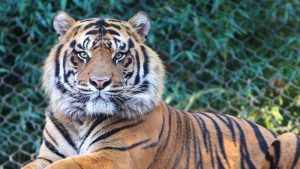
Employees of Namdapha National Park and Tiger Reserve in Arunachal Pradesh engaged under the Centre’s Project Tiger have raised wage issue.
- Namdapha Tiger Reserve is located in Arunachal Pradesh.
- It is named after the river Namdapha originating from Daphabum, the highest mountain peak in the reserve.
- This area was originally Reserved Forests and was declared as Wildlife Sanctuary in 1972
- It was declared as a Tiger Reserve in 1983 under Project Tiger scheme.
- It has a dense cover of vegetation with high hills, and numerous rivers and seasonal streams.
- The vegetation of the reserve is mainly tropical evergreen rainforest, with very dense and multi-layered forest structure.
- The forests include thick growth of bamboo, cane, wild banana, and other undergrowth, making them almost impenetrable in some areas.
- It is home to four big cats viz. tiger, leopard, clouded leopard and snow leopard
- Other animals like Hoolock Gibbon, Golden Cat, Marbled Cat, Mishmi Takin, Red Panda, Namdapha Flying Squirrels are found here.
Coronary Thrombosis:
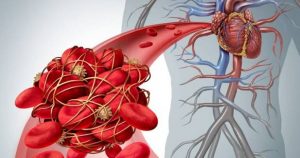
Recent death of famous Indian actor has drawn attention to coronary thrombosis.
- Coronary Thrombosis occurs when a blood clot forms in one of the arteries that supply blood to the heart muscle.
- These arteries carry oxygen and nutrients that the heart needs to function.
- When a clot partly or completely blocks an artery, less blood reaches the heart muscle.
- If the blood supply is cut off for too long, the heart muscle can become damaged, leading to a heart attack.
- This form of thrombosis is often associated with atherosclerosis, in which fatty deposits, cholesterol and other substances build up in the artery walls.
- Smoking is a major risk factor for coronary thrombosis as it can damage the blood vessels and promote the formation of blood clots.
- High cholesterol levels can lead to the buildup of plaque in the arteries, increasing the risk of atherosclerosis and coronary thrombosis.
- Hypertension can cause the arteries to become narrowed and damaged.
- Obesity and a sedentary lifestyle are associated with an increased risk of coronary thrombosis.
- It may include medications like blood thinners, clot-busting drugs, and antiplatelet agents. Procedures such as angioplasty with stent placement or coronary artery bypass surgery may be necessary to restore blood flow to the heart.
World Economic Outlook Report 2026:

The International Monetary Fund (IMF) raised India’s economic growth forecast to 7 per cent for 2026 in its World Economic Outlook (WEO) report.
Key Highlights of World Economic Outlook Report 2026:
- The IMF projected India’s growth at 7.4 per cent in 2026 and 7 per cent in 2027.
- On inflation, the IMF projected India’s consumer prices to rise by 5 per cent in 2026, compared with 2 per cent in 2025.
- The country’s current account deficit is expected to widen to 1.5 per cent of GDP in 2026.
- Globally, economic growth is forecast at 3.1 per cent in 2026 and 3.4 per cent in 2027, while emerging and developing Asia is expected to grow by 5.1 per cent in 2026.
- The Middle East and Central Asia region is projected to contract by 0.3 per cent in 2026.
World Economic Outlook Report:
- It is a comprehensive report published twice a year by the International Monetary Fund (IMF).
- The WEO is usually published in April and October, followed by the less comprehensive WEO updates in July and January.
- It includes the IMF’s estimates and forecasts for global output growth and inflation as well as for real gross domestic product (GDP) growth, consumer prices, current account balances, and unemployment in the IMF’s member countries,
- The data is drawn from IMF representatives’ consultations with member countries, and is included in the WEO database.
Research Development and Innovation Fund:
The Research, Development and Innovation Fund (RDIF) has announced the first cohort of 19 Second Level Fund Managers (SLFMs).
- Research Development and Innovation Fund is a flagship initiative of the Government of India.
- It aims to provide long-term financing or refinancing with long tenors at low or nil interest rates to spur private sector investment in Research Development and Innovation.
- Nodal Department: The Department of Science & Technology (DST).
Key Objectives of the Research Development and Innovation Fund:
- Encourage the private sector to scale up research, development, and innovation (RDI) in sunrise domains and in other sectors relevant for economic security, strategic purpose, and self-reliance;
- Finance transformative projects at higher levels of Technology Readiness Levels (TRL)
- The Governing Board of Anusandhan National Research Foundation (ANRF), chaired by the Prime Minister, will provide overarching strategic direction to the RDI Scheme.
- Funding Mechanism of Research Development and Innovation Fund:
- Implementation Structure:
- Special Purpose Fund (SPF): It will be established within the Anusandhan National Research Foundation (ANRF), which will serve as the custodian of the ₹1 lakh crore corpus. (Fund will not directly invest in industries and startups but will channel capital to Second-level fund managers)
- Second-level fund managers: Who can be Alternative Investment Funds (AIF), Development Finance Institutions (DFI), Non-banking Finance Companies (NBFCs).
- Modes of Financing:
- Long-term loan at low or nil interest rates.
- Financing in the form of equity may also be done, especially in case of startups.
- Implementation Structure:
Exercise IBSAMAR IX:
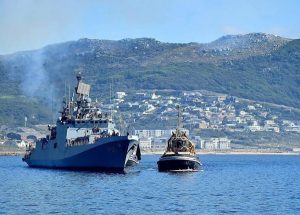
Indian Naval Ship (INS) Tarkash deployed in South Africa to participate in the ninth edition of the India-Brazil-South Africa Maritime (IBSAMAR) Exercise 2026.
- Exercise IBSAMAR IX is a joint multinational maritime exercise conducted between Indian, Brazilian, and South African Navy.
- IBSAMAR has been conducted biennially since 2008 under the India-Brazil-South Africa (IBSA) framework.
- The theme of IBSAMAR IX is Stronger Together Towards a Shared Future in the Maritime Domain.
- It aims to promote collective maritime security and preparedness to address maritime challenges.
- The Indian Navy is participating with INS Tarkash, accompanied by an integral Chetak helicopter.
- The exercise will cover a broad spectrum of maritime operations, including surface warfare, anti-air warfare, anti-submarine warfare, naval air operations, maritime interdiction, Visit Board Search and Seizure (VBSS), anti-piracy operations, search and rescue, damage control and firefighting.
INS Tarkash:
- It is a frontline guided-missile stealth frigate of the Indian Navy.
- It is the second of three Talwar-class guided missile frigates.
- It is designed and built in Russia, the Talwar-class guided missile frigates are modified version of the Krivak III-class frigate.
- It was built by the Yantar shipyard in Kaliningrad, Russia.
- It was commissioned into Indian Navy service in 2012 at Kaliningrad.
- Speed: With maximum speed in excess of 30 knots, a range of 4,500 miles or 30 days.
Mount Mukut:
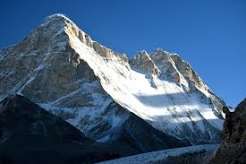
A 17-member Indian Coast Guard (ICG) mountaineering team has successfully scaled Mount Mukut (7,045-metre).
- Mount Mukut is a high-altitude peak located in the Garhwal Himalaya of Uttarakhand, India, in the Zaskar Range near Mount Kamet.
- It is part of the Gangotri Group of peaks and lies in the western Garhwal Himalayas, within the Nanda Devi Sanctuary.
- The peak is notable for its distinctive crown-like shape, which gives it the name “Mukut,” meaning crown in Hindi.
- It occupies a transition zone between the greener, monsoon-influenced valleys of Garhwal and the dry, elevated landscape of the Tibetan Plateau.
- The peak was first climbed in 1951 by a team from New Zealand which included Edmund Hillary and George Lowe.
- Its upper slopes consist almost entirely of exposed rock, permanent snow, glacier ice, and wind-scoured ridges.
Garhwal Himalaya
- It forms the western part of the Central Himalayas and lies mainly in the Garhwal region of Uttarakhand.
- It stretches from the Tons River in the west to the Kali River in the east.
- The region shares its northern boundary with Tibet (China) and the southern boundary with the Shivalik Hills.
- It has numerous rivers including the Bhagirathi, Alaknanda, Mandakini, and Yamuna.
- Flora: Dense forests of pine, oak, deodar, fir, and rhododendron.
Nobel Prize in Economic Sciences 2026:

The Royal Swedish Academy of Sciences awarded the 2026 Sveriges Riksbank Prize in Economic Sciences in Memory of Alfred Nobel (commonly known as the Nobel Prize in Economic Sciences) to two American economists – Robert E. Hall (Stanford University) and Michael Woodford (Columbia University).
- They were honoured “for microeconomic foundations of macroeconomic stabilisation”, demonstrating how individual household consumption trends and business pricing expectations shape broader macroeconomic policies (fiscal and monetary policy).
- Traditional Keynesian models assumed that relationships between macroeconomic variables (like inflation and unemployment) were stable. However, this failed during the 1970s oil shocks, leading to stagflation (stagnant growth, high unemployment, and persistent inflation).
- Economist Robert Lucas (in 1976) argued that human behaviour is not a fixed system.
- When central banks implement policies based on past data, consumers and businesses adapt their behaviour based on the new policies, thereby weakening or altering the intended economic effects.
Indian Navy Commissions INS Mangrol:
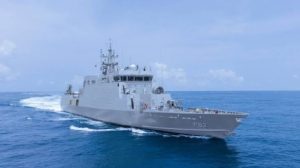
The Indian Navy recently commissioned INS Mangrol (P82), the third Mahe-class Anti-Submarine Warfare Shallow Water Craft (ASW-SWC), at the Naval Dockyard, Mumbai, following the commissioning of INS Mahe (P80) in November 2025 and INS Malvan (P81) in July 2026.
- Designed and built by Cochin Shipyard Limited (CSL), Kochi, INS Mangrol has over 80% indigenous content, supporting Aatmanirbhar Bharat and indigenous warship construction.
- The vessel is designed for Anti-Submarine Warfare (ASW), underwater surveillance, Low-Intensity Maritime Operations (LIMO) and mine warfare-related tasks in coastal and shallow waters.
- INS Mangrol is equipped with Abhay hull-mounted sonar, lightweight torpedoes, an indigenous anti-submarine rocket launcher and the Mareech Advanced Torpedo Decoy System to detect, track and counter underwater threats.
- It is powered by three diesel engine-driven waterjet propulsion units, providing high manoeuvrability and rapid response in shallow and confined waters.
- It is named after the coastal town and fishing harbour of Mangrol in Junagadh district, Gujarat, and carries forward the legacy of the earlier INS Mangrol (M85), a minesweeper that served until April 2004.
- The vessel strengthens India’s coastal defence, maritime domain awareness and anti-submarine warfare capabilities, particularly in shallow waters where larger warships face operational limitations. It enhances the protection of ports, harbours and coastal approaches in the Indian Ocean Region.