
Ranganathittu Bird Sanctuary:
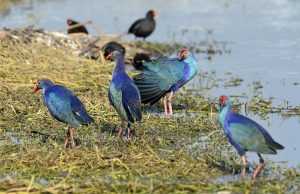
Migratory birds that usually visit Ranganathittu Bird Sanctuary in Srirangapatna taluk, Mandya district, in the first week of December have started arriving two weeks early to breed.
- Ranganathittu Bird Sanctuary is located in the Mandya district near Srirangapatna, Karnataka.
- Situated on a cluster of small islands along the Kaveri River.
- It is also known as the “Pakshi Kashi of Karnataka”
- It was designated on 15 February 2022 as a protected Ramsar site, making it the first Ramsar site in Karnataka.
- Ranganathittu’s islets were formed when an embankment across the Cauvery River was built between 1645 and 1648 by the then-king of Mysore, Kanteerava Narasimharaja Wadiyar.
- These islets, originally numbering 25, soon started attracting birds.
- The ornithologist Salim Ali observed that the islets formed an important nesting ground for a large variety of birds and persuaded the king of Mysore to declare the area a protected area in 1940.
- It is covered with dense broadleaf forests, consisting of Arjun trees (Terminalia arjuna), bamboo groves, and Pandanus trees.
- It is home to approximately 170 bird species, making it a significant breeding and nesting ground.
- Some of the regularly breeding birds include the painted stork, Asian openbill stork, common spoonbill, woolly-necked stork, black-headed ibis, lesser whistling duck, Indian shag, stork-billed kingfisher, egrets, cormorants, Oriental darter, spot-billed pelican, and various herons.
- The islands are host to numerous small mammals, including bonnet macaque, smooth-coated otter, colonies of flying foxes, and common small mammals such as common palm civet and Indian grey mongoose.
- Additionally, there is a population of monitor lizards.
- The mugger crocodile, or marsh crocodile, is a common inhabitant of the riverine reed beds, and Ranganathittu has the largest freshwater crocodile population in Karnataka state.