
Bengal Florican:
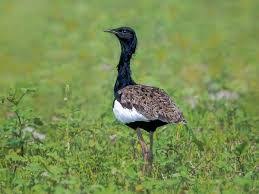
Fewer than 1,000 Bengal floricans remain worldwide, with small, fragmented populations restricted to remnant alluvial grasslands.
- Bengal Florican is a grassland indicator species.
- It is a bustard mostly found in the seasonally inundated alluvial grasslands of the Gangetic-Brahmaputra plains.
- It is distributed in Uttar Pradesh, Assam and Arunachal Pradesh in India, in the terai of Nepal and in Bangladesh
- The male bird shows black plumage, with a crest and elongated display feathers that are raised during courtship, and white wing patches become visible in flight.
- It makes vertical leaps, wing movements and vocalisations along with other males, a behaviour known as “lekking”, to establish territories and attract females.
- It shows reverse sexual dimorphism and colour dichromatism (male and female are differently coloured).
- They are omnivorous birds. They eat various insects, fruits, seeds, and flowers and also feed on small snakes and lizards.
- Threats: Land conversion, expansion of agriculture, annual grassland burning, overgrazing, encroachment, change of river course, invasive plant species and fire mismanagement have altered their habitat.
- Conservation Status:
- IUCN: Critically Endangered
- Wild Life Protection Act 1972: Schedule I



