
Today’s Current Affairs: 12th March 2026 for UPSC IAS exams, State PSC exams, SSC CGL, State SSC, RRB, Railways, Banking Exam & IBPS, etc
Table of Contents
DART Mission:
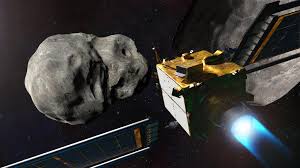
A groundbreaking study has revealed that NASA’s DART Mission not only altered the motion of a small asteroid within its system but also slightly changed the orbit of the entire asteroid pair around the Sun.
- DART (Double Asteroid Redirection Test) was a NASA space probe dedicated to investigating and demonstrating one method of asteroid deflection by changing an asteroid’s motion in space through kinetic impact.
- It was launched in 2021.
- It was the first-ever space mission to demonstrate asteroid deflection by a kinetic impactor.
- It was the world’s first planetary defense technology demonstration.
- It was aimed at finding out whether or not we could redirect the trajectory of a near-Earth object simply by crashing into it.
- The target of DART was a binary asteroid system consisting of a smaller moonlet, Dimorphos, orbiting around a larger asteroid, Didymos.
- Because the two were linked by gravity, the theory went, knocking little Dimorphos off-kilter would affect both objects.
- DART spacecraft successfully collided with Dimorphos in 2022.
- The mission was a success. For the first time, humans have successfully demonstrated the ability to change the motion of an asteroid in space.
Sinhagad Fort:
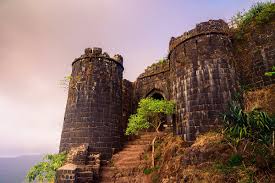
At least 25 people were injured after a swarm of bees attacked visitors at Sinhagad Fort recently.
- Sinhagad, earlier known as ‘Kondhana’, is a fortress located near Pune, Maharashtra.
- According to history, the fort was built 2,000 years ago and it is said that the name Kondana was derived from sage Kaundinya.
- Early inscriptions and carvings suggest it served as a spiritual retreat and strategic outpost for ancient dynasties.
- Mohammed bin Tughalak captured the fort from the Koli tribal chieftain, Nag Naik in 1340 CE.
- In 1496 CE, Malik Ahmad, the founder of the Nizam Shahi dynasty took control of the fort.
- Nearly 200 years later, the Maratha leader Shahaji Bhonsale captured the fort.
- In 1647 CE, Shivaji held the stronghold.
- In 1665 CE, as per the Treaty of Purandar, Shivaji handed over Sinhagad to the Mughals and again captured it in 1670 CE, under the direction of Tanaji Malusare who was Shivaji’s favorite general.
- It has witnessed epic battles, including the legendary Battle of Sinhagad in 1670, where valor, sacrifice, and strategy led to an unforgettable victory for the Marathas over the Mughal Army.
- While recouping the fort during Battle of Sinhagad, Malusare lost his life for which Shivaji Maharaj honoured the fort with the name Sinhagad Fort or Lion’s Fort.
- Aurangzeb laid siege to Sinhagad in 1701- 03 CE, but could not hold it for long.
- Finally the British seized the fort from the Marathas in 1818 AD. The fort was later used as a retreat for many European residents of Pune.
- It is a marvel of Maratha architecture and engineering.
- The fort features two main entrances—the Pune Darwaza, facing Pune, and the Kalyan Darwaza, opening towards the Konkan region—both showcasing intricate stonework and strategic placement for enhanced security.
- It has an advanced water storage system, which includes ancient rainwater harvesting techniques and natural reservoirs that ensure a continuous water supply.
- The fort has several bastions, ramparts, walls, and gates that enclose its premises.
- The fort also houses a temple dedicated to Goddess Kali, a brewery, some military sheds and the tombs of Rajaram Chhatrapati (Shivaji’s youngest son) and Tanaji Malusare.
Gurudongmar Lake:

Tourism to the high-altitude Gurudongmar Lake in North Sikkim has begun to revive after more than two years of disruption following the devastating South Lhonak Lake GLOF, which severely damaged road infrastructure.
- It is located on the northern-most edge of Sikkim, very close to the Chinese Tibetan border.
- It is one of the highest lakes in the world and in India.
- It is surrounded by snow-covered mountain ranges all around.
- The lake is primarily fed by glaciers and is a source stream for the Tso Lahmu Lake that later forms the source of the Teesta
- It is considered sacred by Buddhists, Sikhs, and Hindus.
- The lake is named after Guru Padmasambhava—also known as Guru Rinpoche—founder of Tibetan Buddhism.
- Guru Padmasambhava visited the lake in the 8th century on the way back from Tibet.
- Even in extreme winters, a part of this lake never freezes.
- The myth behind this is that Guru Padmasambhava had once touched and consecrated this lake and made it partially frozen throughout the year.
What is the Doomsday Fish?
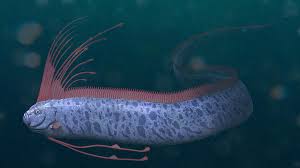
Two giant oarfish, rarely seen deep-sea creatures sometimes called “doomsday fish,” were recently spotted near the shore in Cabo San Lucas, Mexico, in an extremely rare sighting.
- The oarfish is commonly known as the “doomsday fish”.
- It is a deep-sea dweller that rarely comes near the surface.
- Scientific Name: Regalecus glesne
- They are deep-sea dwellers, thriving most often in the zone least explored by scientists to date: the mesopelagic zone (waters down to 1,000 meters).
- It is known for its long, ribbon-like body that enables the species to float inconspicuously throughout the water column.
- It also boasts large eyes and foreboding red spines that stick out to form a crown-like cluster.
- Oarfish is the longest bony fish known to exist in the ocean.
- They float vertically and use their reflective bodies as a type of camouflage.
- It is a filter feeder and primarily eats krill, plankton, and other small crustaceans.
- Folklore Related to Doomsday Fish some areas of the world, these creatures are seen as being harbingers of bad news, particularly disasters or destruction.
- The oarfish has the nickname of “Ryugu no tsukai,” or “sea god’s palace messenger,” in Japanese folklore.
- This myth traces back to the 17th century and says that the surfacing of the oarfish is a harbinger of future natural disasters.
Silent Valley National Park : Bird Survey
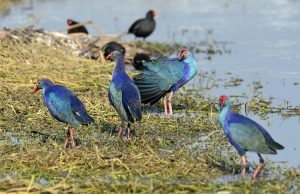
A comprehensive bird survey conducted in Silent Valley National Park documented 192 bird species.
- It is located along the southwest corner of the Nilgiris in South India, in Kerala.
- It is one of the last undisturbed tracts of tropical rainforest in India.
- It constitutes the centerpiece of the Nilgiri Biosphere Reserve, sanctified as a World Heritage Site by UNESCO in 2012.
- It is nourished by the Kunthipuzha River.
- It has four types of vegetation “West Coast tropical evergreen forest, southern sub-tropical broad-leaved hill forest, montane wet temperature forest, and grasslands.
- The flora of the valley includes many species of flowering plants, orchids, ferns and fern allies, liverworts, lichens, and algae.
- Plants of high medicinal value as well as the towering Culinea trees are also found here.
- It is famous for its population of lion-tailed macaques, Nilgiri langur, Malabar giant squirrel, Indian elephant, tiger, leopard, and gaur (Indian bison).
Sheshnaag-150:

India is developing the Sheshnaag-150, a long-range swarm attack drone that can fly over 1,000 km, carry powerful warheads and strike targets.
- Sheshnaag-150 is a long-range collaborative attack swarm drone, with autonomous systems capable of deep strikes and saturation attacks.
- It is being developed by NewSpace Research and Technologies (NRT), a Bengaluru-based aerospace startup focusing on AI-driven unmanned systems and swarm robotics.
- It can carry 25-40 kg payload which is sufficient to damage infrastructure, military vehicles or personnel.
- It has an operational range of over 1,000 km.
- It can stay airborne for over five hours, enabling it to loiter over target areas before executing an attack.
- It is equipped with real-time surveillance, autonomous target identification, and strike capabilities.
- It has the ability to operate in GPS-denied environments using visual navigation systems.
- This ensures that the drone can still reach targets even if satellite navigation signals are jammed during warfare.
National Highways Green Cover Index:
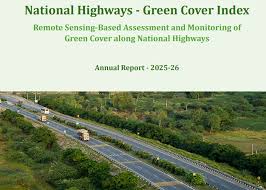
The National Highways Authority of India (NHAI) released the first National Highways Green Cover Index (NH-GCI).
- It is an initiative of National Highways Authority of India.
- It has been prepared in coordination with the National Remote Sensing Centre (NRSC) of the Indian Space Research Organisation (ISRO).
- The initiative aims to provide a scientific and quantitative assessment of green cover within the Right of Way (RoW) along the National Highways network by leveraging advanced space-based technologies.
- The assessment is derived from chlorophyll content detected through high-resolution satellite sensors, enabling an objective, technology-driven measure of vegetation presence along the left and right sides of the highways.
- It measures the percentage of land covered with vegetation along highway corridors, including plantations on the left and right sides of the road, as well as in the median wherever feasible.
- The analysis is conducted for every one-kilometre highway segment using the Normalized Difference Vegetation Index (NDVI) derived from satellite imagery.
- It offers a robust, reliable, cost-effective, and time-efficient mechanism for macro-level estimation of the green cover along the National Highways.
- It will enable comparison, ranking, and targeted interventions for improved plantation management.
Anavaran Portal:
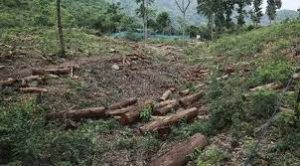
The Forest Survey of India stopped its Anavaran-Deforestation Alert System to states on deforestation.
- Anavaran Portal has been operational since 2024.
- It has been using satellite data and machine learning to enable Forest Survey of India to issue location alerts on the loss of forest cover to states every 15 days so that targeted field inspections can be carried out.
- The Anavaran alert system is based on the Google Earth Engine (GEE) platform.
- It uses Sentinel-2 satellite images as input data.
- For continuous monitoring during cloudy and monsoon seasons, this is further integrated with Sentinel-1 Synthetic Aperture Radar (SAR) data.
- Forest Survey of India (FSI) is a premier national organization under the union Ministry of Environment, Forests and Climate Change.
- It is responsible for assessment and monitoring of the forest resources of the country regularly. In addition, it is also engaged in providing the services of training, research and extension.
- Established on June 1, 1981, the Forest Survey of India succeeded the “Preinvestment Survey of Forest Resources” (PISFR), a project initiated in 1965 by Government of India with the sponsorship of FAO and UNDP.
- It has been publishing the State of Forest Report on a biennial basis since 1987.
- State of Forest Report carries out an in-depth assessment of the forest and tree resources of the country based on interpretation of Remote Sensing satellite data and field based National Forest Inventory (NFI).
Hybrid Electric Vehicles:

Delhi’s upcoming Electric Vehicle (HEV) policy plans to extend road tax and registration fee exemptions, currently available for battery electric vehicles (BEVs), to hybrid electric vehicles (HEVs) as well.
- A Hybrid Electric Vehicle (HEV) is an automobile that combines a conventional internal combustion engine (ICE) with an electric propulsion system to achieve better fuel efficiency and lower emissions, operating without the need for external charging.
- It seamlessly switches between or combines these power sources to optimize efficiency, leveraging the engine for extra range, and the motor for instant acceleration and noise-free driving.
- Unlike pure electric vehicles (EVs), a standard hybrid’s battery is self-charging. It does not need to be plugged in; it is replenished automatically through regenerative braking and, in some designs, by the gasoline engine acting as a generator.
- During braking, the electric motor acts as a generator, converting the vehicle’s kinetic energy (which would otherwise be lost as heat) into electricity to recharge the battery.
Types of Hybrid Configurations:
- Parallel Hybrid: Both the engine and the electric motor are mechanically connected to the wheels, allowing them to power the vehicle either independently or simultaneously. While some short electric-only driving is possible, the motor typically acts as an assist to the engine.
- Series-Parallel (Power-Split) Hybrid: It can intelligently switch between modes—running on electric power alone, using the engine to generate electricity for the motor (series mode), or having both power sources drive the wheels directly (parallel mode).
- Plug-in Hybrid Electric Vehicle (PHEV): Its defining characteristic is the ability to be recharged externally via a plug, in addition to being charged by the engine and regenerative braking. PHEVs can use any hybrid architecture (parallel, series, or series-parallel) and offer the dual benefit of electric commuting and unlimited hybrid range for longer trips.
Advantages:
- Hybrids deliver excellent fuel economy—especially in city driving—and lower emissions through features like regenerative braking, while eliminating the range anxiety associated with pure electric vehicles. Additional benefits include reduced brake wear and, depending on the type and location, potential eligibility for government incentives such as tax credits.
MHA Revises Guidelines for Look Out Circulars:
The Ministry of Home Affairs (MHA) has modified the guidelines for issuance of Look Out Circulars (LOCs), restricting the power to directly instruct the Bureau of Immigration (BoI) to block a person’s departure.
- The MHA has explicitly barred statutory bodies like the National Commission for Women (NCW), National Human Rights Commission (NHRC), National Commission for Protection of Child Rights (NCPCR), and the National Company Law Tribunal (NCLT) from directly requesting the BoI to open an LOC.
- All LOC requests from such bodies must now be routed through a law enforcement agency with criminal jurisdiction (e.g., Police, CBI).
- The LOC proforma has been updated to include 3 standardized options for action, i.e.,
- Detain and inform the originator (agency that sought the LOC)
- Prevent departure and inform the originator
- See remarks for action.
- The “see remarks” category may be used by intelligence agencies such as IB, R&AW, CBI, NIA and State Anti-Terrorism Squad units only for counter-terrorism purposes.
- The “See remarks” category allows flexible or non-standardized response in sensitive national security contexts where predefined actions may not suffice.
- When immigration receives a court order, it must immediately inform the agency that issued the original LOC. That agency must respond within 7 working days.
- The person cannot leave India until the Bureau of Immigration updates the LOC status as directed by the court.
- Strict timelines have been imposed for enforcement. If a person is detained under an LOC, the originating agency must take custody within 3 hours, failing which the individual will be handed over to local police.
- The originator then has 24 hours to assume formal custody.
Look-Out Circular (LOC):
- An LOC is issued to make sure that an individual who is absconding or wanted by law enforcement agencies is not able to leave the country.
- It is mostly used at immigration checkpoints at international airports and seaports by the immigration branch.
- BoI, functioning under MHA, is responsible for enforcing such notices by stopping the movement of individuals against whom an LOC has been issued.
Death Anniversary of Savitribai Phule:

Union Home Minister paid tribute to Savitribai Phule on her death anniversary (10th March, highlighting her role in bringing women into the fold of education during an era marked by deep-rooted social evils.
- Savitribai Phule was a social reformer from 19th-century Maharashtra who fundamentally transformed Indian society by challenging patriarchal and caste hierarchies.
- She was born on 3rd January 1831 in Satara (Maharashtra) into the Mali community and married at the age of 9 to Jyotiba Phule.
- In 1848, she made history by founding India’s first Indian-run girls’ school in Pune, alongside her husband. The couple collectively established and ran 18 schools.
- She helped establish trusts like the Native Female School, Pune and the Society for Promoting the Education of Mahars, Mangs and Etceteras, directly challenging caste-based discrimination.
- In 1852, she founded the Mahila Seva Mandal to raise awareness for women’s rights, campaigning against child marriage and advocating for widow remarriage.
- In 1863, the couple, founded the Balhatya Pratibandhak Griha, recognized as India’s first home to combat female infanticide and provide shelter to pregnant Brahmin widows and rape victims.
- She institutionalized social equality by initiating the first Satyashodhak marriage—a dowry-free, priest-free, and non-Brahminical ceremony—to subvert caste and patriarchal norms.
- A poet and author, her notable works include Kavya Phule (1854) and Bavan Kashi Subodh Ratnakar (1892). Her famous poem, “Go, Get Education,” encouraged the oppressed castes to break the shackles of slavery.
- She faced extreme orthodox opposition, enduring social assaults and being stoned. She died in 1897 after contracting the bubonic plague while selflessly caring for a patient.
LIGO-India’s 1st Gravitational Wave Observatory:
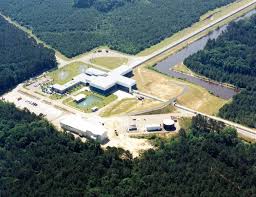
India’s ambitious Laser Interferometer Gravitational Wave Observatory (LIGO) project in Hingoli district, Maharashtra, is facing significant implementation delays, raising concerns over its timeline despite official assurances that it will be completed by 2030.
- LIGO-India is India’s first major gravitational-wave observatory and represents the country’s contribution to the global gravitational-wave detection network.
- The Indian observatory will feature an advanced LIGO-style interferometer, becoming the 5th node in the global network alongside the US facilities at Hanford and Livingston, Virgo in Italy, and KAGRA in Japan.
- It is jointly led by the Department of Atomic Energy (DAE) and Department of Science and Technology (DST), in collaboration with the US LIGO Laboratory, and other premier Indian institutions like Inter-University Centre for Astronomy and Astrophysics (IUCAA), Pune.
- As a “mega-science” project, it aims to enhance sky coverage, improve source localization (particularly in the southern hemisphere), and boost detection sensitivity for the international gravitational-wave network.
- LIGO observatories have two 4-km-long arms built at 90-degrees to each other. These are vacuum chambers with reflective mirrors at their ends. Beams of lasers are reflected off these mirrors and are used to detect gravitational waves.
- The first such wave was detected in 2015, which was caused by the merger of two black holes 1.3 billion light-years away.
Asteroid 2024 YR4:
NASA has officially ruled out the possibility of asteroid 2024 YR4 colliding with the Moon on December 22, 2032. Refined calculations using the James Webb Space Telescope (JWST) have confirmed the object will pass at a safe distance of 21,200 km.2024 YR4 is a Near-Earth Object (NEO) classified as an Apollo-type asteroid (Earth-crossing). Discovered in December 2024 by the ATLAS survey in Chile, it briefly gained international attention as one of the most hazardous objects found in recent decades, reaching a Torino Scale rating of 3—the highest since the infamous asteroid Apophis in 2004.Recent studies link its origin to the central region of the Main Asteroid Belt between Mars and Jupiter.The Yarkovsky Effect: Scientists believe it was nudged toward Earth by the Yarkovsky effect, where uneven heating from the Sun acts as a mini-thruster, gradually shifting its orbit over millions of years.
Former Boulder: Its size and solid composition suggest it may have once been a large boulder perched on the surface of a much larger rubble-pile asteroid before being chipped off by a collision.
Lake and Air Watch initiative:
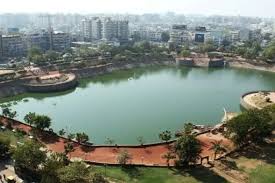
The Gujarat government has launched the ‘Lake and Air Watch’ initiative to monitor and improve lake health and air quality across cities using satellite and real-time monitoring systems.
- The ‘Lake and Air Watch’ initiative is a technology-driven environmental monitoring programme launched by the Gujarat Urban Development Mission (GUDM) under the Urban Development and Urban Housing Department of Gujarat.
Key Features:
- Satellite-based Lake Monitoring: Satellite technology will track lake area changes, algae growth, waste accumulation and water quality indicators.
- Real-Time AQI Monitoring: Installation of air quality monitoring stations across 17 municipal corporations and 152 municipal areas.
- Automated Alert System: The platform will generate automatic alerts if air pollution levels rise or lake conditions deteriorate, enabling timely intervention.
- Integrated Digital Dashboard: Data from multiple departments will be consolidated into a centralized dashboard displaying maps, trends and alerts.
- Citizen Transparency: Environmental data will be shared with the public to promote awareness and community participation.
- Budget Allocation: The initiative has an estimated allocation of ₹10 crore for implementation.
ICC Women’s ODI Rankings:
Indian opener Smriti Mandhana has retained the No.1 position in the latest ICC Women’s ODI batting rankings, reaffirming her status as one of the most consistent performers in international women’s cricket. The rankings were released by the International Cricket Council.Mandhana continues to dominate the ODI format with her elegant stroke play and ability to anchor innings at the top of the order. Her consistent performances have kept her ahead of other top batters in women’s international cricket.Meanwhile, Harmanpreet Kaur, captain of the India women’s national cricket team, remained unchanged at eighth place in the latest ODI batting rankings.



