
Today’s Current Affairs: 17th March 2026 for UPSC IAS exams, State PSC exams, SSC CGL, State SSC, RRB, Railways, Banking Exam & IBPS, etc
Table of Contents
Jnanpith Award 2025:

Tamil lyricist and author R. Vairamuthu has been selected for the Jnanpith Award for the year 2025.
- Jnanpith Award is the highest literary honour of India, given to writers who have excelled in literature in different Indian languages.
- It was instituted in 1961.
- The prize carries a cash prize of Rs 11 lakh, a bronze statuette of Vagdevi (Goddess Saraswati), and a citation.
- It is sponsored by the cultural organization Bharatiya Jnanpith.
- It is given every year to an author for his/her outstanding contribution towards Indian literature through creative writing in any of the Indian languages mentioned in Schedule VIII of the Indian Constitution and English.
- Only those creative writers who are alive and are Indian citizens, can be proposed for the Award.
- A language which receives the award in a particular year is not eligible for consideration for the next two years.
- A writer who receives the Award once will not be considered again.
- The Award may not be given in a particular year if the Jnanpith Award Selection Board feels that there is no suitable name which comes up to the expected standard of the Award.
- The first recipient of the award was Malayalam poet G. Sankara Kurup, who received the award in 1965 for his collection of poems Odakkuzhal.
Sharansthli Initiative:
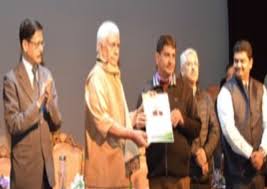
The Lieutenant Governor of Jammu & Kashmir, distributed compassionate appointment letters to 50 next of kin of terrorism victims under the Sharansthli initiative in Srinagar.
- Sharansthli is a rehabilitation initiative of the Jammu & Kashmir administration aimed at supporting families of victims who lost their lives due to terrorism.
- Under the programme, compassionate government employment is provided to the next of kin of terror victims to help them rebuild their livelihoods and restore dignity.
- Aim:
- Provide stable government employment to families affected by terrorism.
- Acknowledge the suffering of terror victims and ensure institutional support.
- Key Features:
- Eligible family members of terror victims receive government jobs under compassionate appointment rules to ensure long-term livelihood security.
- Cases are processed through coordination between police and civil administration to verify victims and ensure legitimate appointments.
- The government is reviewing additional cases of terror victim families, ensuring more beneficiaries receive employment assistance.
India’s Defence Forces Vision 2047:
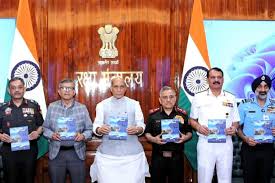
The Defence Minister of India unveiled the “Defence Forces Vision 2047: A Roadmap for a Future-Ready Indian Military”. Prepared by the Headquarters Integrated Defence Staff, this vision document outlines a comprehensive strategy to transform the Indian military into an integrated, agile, and multi-domain force by the centenary of India’s independence.
- Defence Forces Vision 2047 is a long-term roadmap to transform India’s military into a technologically advanced, integrated, and multi-domain force through AI, drones, cyber, and space capabilities while strengthening jointness among the Army, Navy, and Air Force.
- The strategy links military modernisation with defence indigenisation and economic growth, aiming to reduce import dependence, strengthen domestic defence manufacturing, and build a self-reliant world-class military by 2047.
- The document acts as a “meta-strategy,” explicitly acknowledging that national security in the 21st century relies as heavily on industrial capacity and technological ecosystems as on direct battlefield capabilities.
- The Three Core Pillars:
- Technological Advancement: Leveraging Artificial Intelligence (AI), autonomous systems, quantum sensing, and advanced surveillance to maintain an edge.
- Jointness and Synergy: Deepening operational synergy across the Army, Navy, and Air Force to avoid duplication and optimize resources.
- Multi-Domain Capability: Operating seamlessly across traditional (land, sea, air) and emerging (cyber, space, cognitive) domains.
- The roadmap proposes the creation of dedicated structures including a Space Command, Cyber Command, Data Force, Drone Force, and a Cognitive Warfare Action Force.
- Proposes transition from net-centric warfare to data-centric warfare. The goal is to move from “information superiority” to “decision superiority” in the battlefield.
- Under Mission Sudarshan Chakra, the vision proposes expanding ballistic missile and air defence systems to protect India’s strategic, economic, and civilian assets from evolving aerial threats.
- The vision outlines a three-phase transition identifying short-term, mid-term, and long-term priorities culminating in a “world-class military” between 2040 and 2047.
The Pinaka Multi-Barrel Rocket Launcher (MBRL) System:
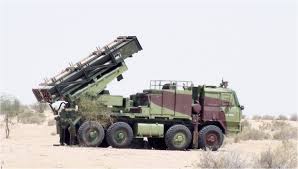
The Indian Army has operationalized its seventh Pinaka regiment and is currently raising an eighth, with plans to reach ten regiments by next year.
- Pinaka is an indigenous, multi-barrel rocket launcher (MBRL) system capable of firing a salvo of 12 rockets in under 44 seconds. It is a high-volume, area-saturation weapon designed to neutralize enemy troop concentrations and infrastructure over large areas.
- Developed By: the Armament Research and Development Establishment (ARDE).
- The primary objective of the Pinaka system is to provide the Indian Army with deep-strike capability, allowing it to destroy enemy communication hubs, logistics depots, and artillery gun positions well behind the front lines.
- Key Features of the System:
- Rapid Fire Capability: A single battery of six launchers can fire 72 rockets in just 44 seconds, covering an area of roughly 1,000 by 800 meters.
- Range Variants: The system is versatile, featuring Mk-I (38 km), Mk-II Extended Range (60 km), and Guided variants (75–90 km).
- High Precision: Guided Pinaka rockets utilize an Integrated Navigation System (INS) combined with GPS/NavIC for pinpoint accuracy.
- Mobility: The launchers are mounted on high-mobility Tatra trucks, allowing for shoot-and-scoot tactics to avoid enemy counter-fire.
- Automation: Equipped with an Automated Gun Aiming and Positioning System (AGAPS) and a computerized fire control system for quick deployment.
- Extreme Weather Resilience: The system is designed to operate in diverse Indian terrains, from the high-altitude cold of Ladakh to the intense heat of the Thar Desert.
NavIC’s Atomic Clock Failure:
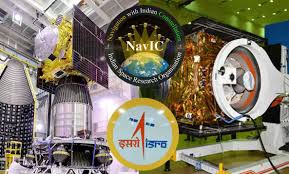
ISRO recently reported that the atomic clock on the IRNSS-1F satellite has failed, reducing the number of functional positioning satellites in the NavIC constellation.
- An atomic clock is an ultra-precise timekeeping device that uses the vibrations of atoms (usually Rubidium or Cesium) to measure time. In navigation satellites, these clocks are essential because even a billionth of a second of error can lead to a location inaccuracy of several meters on the ground.
- The clock measures the precise frequency of electromagnetic radiation emitted or absorbed by electrons when they change energy levels within an atom.
- Unlike mechanical or quartz clocks, atoms vibrate at a perfectly constant rate, providing a stable frequency that does not drift over time.
- The satellite sends a signal with a timestamp. By comparing when the signal was sent to when it was received, the receiver calculates the distance.
- By calculating distances from at least four different satellites simultaneously, a receiver can pin-point a user’s exact latitude, longitude, and altitude.
- They are accurate to within one second every few million years.
- Satellites usually carry multiple clocks (often three or four) in case one fails.
- While earlier NavIC clocks were imported, the new generation (NVS series) features India-developed Rubidium atomic clocks.
Section 301 of the Trade Act of 1974:

The U.S. government has launched two major Section 301 investigations against India and several other nations to probe allegations of excess manufacturing capacity and forced labor.
- Section 301 is a powerful U.S. trade law that grants the Office of the United States Trade Representative (USTR) the authority to investigate and respond to unreasonable, discriminatory, or unjustifiable trade practices by foreign countries that burden or restrict U.S. commerce.
- Nations Involved:
- Investigation 1 (Excess Capacity): Involves 16 major economies, including India, China, the EU, Japan, Mexico, and Vietnam.
- Investigation 2 (Forced Labor): A much broader probe involving 60 countries, with India again being a primary focus.
- Aim:
- The primary goal is to enforce U.S. rights under trade agreements and eliminate unfair foreign barriers. In the current context, the aim is to determine if foreign surpluses (like India’s solar modules) or labor practices (forced labor) are harming American workers and businesses.
The Sejjil Ballistic Missile:
Iran officially deployed the Sejjil ballistic missile for the first time in active combat during Wave 54 of its military operations against US and Israeli positions.The missile, nicknamed the dancing missile for its evasive maneuvers, reportedly struck strategic infrastructure.The Sejjil (also known as Sajjil or Ashura) is an indigenous, two-stage, medium-range ballistic missile (MRBM). It represents a major leap in Iranian missile technology, moving away from older liquid-fueled designs to more reliable and faster-launching solid-fuel systems.Developed By: The missile was indigenously developed by Iran’s aerospace industries.The primary objective of the Sejjil is to provide Iran with a rapid-response deterrent capable of striking targets across the Middle East and Southeastern Europe, specifically designed to bypass sophisticated missile defense shields like Israel’s Iron Dome and Arrow systems.
Sujal Gaon ID:

The Union Ministry of Jal Shakti has launched Sujal Gaon ID, a unique digital identifier for mapping rural piped water supply schemes across India.
- Sujal Gaon ID is a scheme-based unique digital identifier assigned to each rural piped drinking water supply scheme in India.
- It enables digital mapping of rural water supply assets and service areas, integrating them into a unified national water management platform.
- It has been introduced under Jal Jeevan Mission 2.0, the flagship programme aimed at providing Functional Household Tap Connections (FHTCs) to all rural households.
- Aim is to digitally map and monitor rural drinking water infrastructure across India,o strengthen transparency, service delivery, and evidence-based decision making in rural water governance.
- Key Features:
- Every rural drinking water scheme is assigned a distinct Sujal Gaon ID, ensuring traceability of assets and services
- The ID is linked with Sujalam Bharat IDs, combining infrastructure ID and service-area ID for complete mapping of water supply systems.
- Creates a source-to-tap digital monitoring system for rural water supply schemes across the country.
- Enables governments to track scheme performance, infrastructure status, and service delivery outcomes in real time.
- Around 1.64 lakh Sujal Gaon IDs across 31 States and UTs have already been generated and linked with 67,000 Sujalam Bharat IDs.
Chandrika Pujari Wins Gold at World Boxing Futures Cup 2026:
India secured five medals at the World Boxing Futures Cup 2026 in Bangkok, led by Chandrika Pujari’s gold in the women’s 51kg category. Indian boxers also won three silver and one bronze, strengthening the country’s youth boxing presence ahead of the Dakar 2026 Youth Olympic Games.The main highlight for India at the World Boxing Futures Cup 2026 was the outstanding performance of Chandrika Pujari.She has claimed the gold medal in the women’s 51kg boxing division after defeating Mardonova Nazokat of Uzbekistan in the final.Chandrika Pujari had secured the victory with a unanimous decision.And which is showcasing strong technical skills and control throughout the bout.
Oscars 2026:
The 98th Academy Awards (Oscars 2026) celebrated the best films of 2025 and were held on March 15, 2026, at the famous Dolby Theatre. The ceremony was hosted by comedian Conan O’Brien and featured awards in 24 categories. The film One Battle After Another was the biggest winner with six awards, including Best Picture and Best Director. Another major winner was Sinners, which earned four awards, including Best Actor for Michael B. Jordan. The event highlighted outstanding achievements in global cinema.
China’s rapid construction of 628 “Xiaokang” villages along the Line of Actual Control:
India’s Military leadership warned that China’s rapid construction of 628 “Xiaokang” villages along the Line of Actual Control (LAC), particularly the 90% cluster facing Arunachal Pradesh, is a strategic move to solidify territorial claims through civilian settlement.These dual-use villages in contested areas essentially function as permanent, fortified outposts, creating a significant long-term security and sovereignty challenge for India.China is constructing 628 dual-use Xiaokang villages to strengthen territorial claims through “salami-slicing” tactics along the LAC.These settlements facilitate military-civil fusion and constant surveillance, pressuring India’s northeastern borders.Consequently, India is accelerating the Vibrant Villages Programme and Arunachal Frontier Highway to bolster strategic deterrence. Chinese ‘Xiaokang’ Villages refer to a specific category of border settlements constructed or upgraded, primarily in the Tibet Autonomous Region (TAR) along its disputed frontiers.
Balirajgarh Fort:
The Archaeological Survey of India (ASI) has granted fresh approval for renewed scientific excavation at Balirajgarh Fort (officially the “Remains of Ancient Fort of Garh”) in Madhubani district, Bihar.It is a centrally protected national monument dating to around 200 BCE, offering insights into the Mithila region’s early civilisation and its legendary links to King Bali (benevolent asura ruler from Hindu mythology).Part of the ASI’s Patna Circle, it is one of Bihar’s 71 protected sites of national importance.The fortification dates primarily to circa 200 BCE during the Shunga period, with evidence suggesting earlier Iron Age origins.Excavations have revealed a 5-fold cultural sequence spanning the Northern Black Polished Ware (NBPW) phase (circa 700–200 BCE), followed by the Shunga, Kushan, Gupta, and Pala periods (up to the 12th century CE), indicating continuous habitation from early historic to early medieval times.Previous excavations revealed structural remains, NBPW pottery, and artefacts, confirming the site as a major urban centre with massive boundary walls, elevated mounds, and defensive features.The site was first identified in 1884 by George Abraham Grierson, then Madhubani Sub-Divisional Magistrate.Systematic excavations occurred in 1962-63, 1972-73, and 2013-14, though the last was abandoned midway due to “environmental constraints and a high water table.



