
Today’s Current Affairs: 21st February 2026 for UPSC IAS exams, State PSC exams, SSC CGL, State SSC, RRB, Railways, Banking Exam & IBPS, etc
Table of Contents
Merchandise Trade Indices:
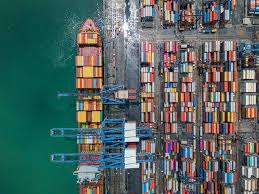
Directorate General of Commercial Intelligence and Statistics revised base year of Merchandise Trade Indices to FY 2022–23 to reflect current trade structure and global patterns.
- It is compiled and published by the Directorate General of Commercial Intelligence and Statistics (DGCI&S), Ministry of Commerce & Industry.
- It measures changes in the unit values (prices) of India’s exports and imports over time.
- Base Year: It was revised from FY 2012–13 to FY 2022–23.
- The Revised Series includes:
- Monthly, Quarterly and Annual Indices (Export Unit Value Index, Import Unit Value Index)
- Principal Commodity (PC) Classification wise Trade Indices (Export/Import)
- Standard International Trade Classification-wise (SITC) Trade Indices
- Broad economic categories-wise (BEC) Trade Indices
- Bilateral and Region-wise Trade Indices of Top 20 Export and Import partner nations of India
- Terms of Trade (Gross terms of trade, Net terms of trade and Income terms of trade)
- These indices serve as important indicators of external sector price movements and are widely used for economic analysis, including national accounts compilation and assessment of terms of trade.
Black-Necked Crane:
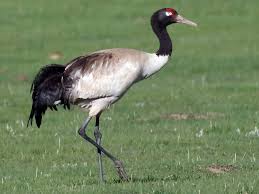
Black-Necked Crane which is threatened by the loss of habitat and its safeguarding requires urgent, coordinated action.
- The Black-Necked Crane (Grus nigricollis) is classed as a medium-sized member of the crane family.
- It is locally is known as “cha thung-thung” in Ladakh and “thungdung karma” in Arunachal Pradesh.
- High altitude marshes and lakes of Tibetan Plateau and eastern Ladakh (India).
- A small wintering population is also found in Sangti and Zimithang valleys of Arunachal Pradesh in India.
- These are carnivores and herbivores.
- Conservation Status:
- IUCN: Near Threatened
- CITES: Appendices I
- Wild Life (Protection) Act, 1972: Schedule I
- It is also protected under the Convention on the Conservation of Migratory Species of Wild Animals.
- Habitat loss is severe, driven by expanding human settlements, encroaching agriculture and unregulated construction.
Rwanda:
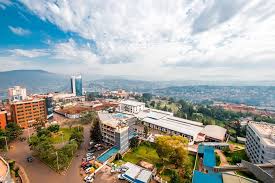
The Union Minister of State (Independent Charge) for Science & Technology said India is ready to deepen its engagement with Rwanda in emerging technologies, innovation ecosystems and next-generation sectors including AI, biotechnology, and nuclear energy.
- It is a landlocked country located south of the equator in east-central Africa.
- It is part of the Great Rift Valley region of Africa.
- It is often referred to as the “land of a thousand hills”, Rwanda’s landscape is mostly hilly and mountainous.
- It shares a border with the four countries: Burundi, Tanzania, Uganda, and the Democratic Republic of the Congo.
- Capital: Kigali
- The Hutu and Tutsi ethnic groups make up most of the country’s population.
- Major Moutain Ranges: Albertine Rift and Virunga.
- Highest Peak: Mount Karisimbi
- Major Rivers: Two major African rivers, the Nile and the Congo, flow through Rwanda.
- Other major rivers are Kagera, Nyabarongo, Ruzizi, Luhwa, and Akanyaru.
- Lake: Lake Kivu
- Natural Resources: Rwanda has a few deposits of gold, tin ore, tungsten ore, and methane.
Red Sanders:
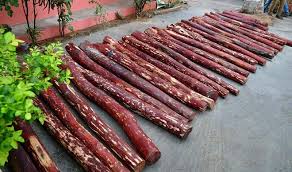
It is observed that busy Tirupati pilgrimage route makes Red Sanders smuggling easy in south Andhra Pradesh.
- Red Sanders Pterocarpus santalinus, or Red Sandalwood, is an endemic tree species with distribution restricted to the Eastern Ghats of India.
- It usually grows in rocky, degraded and fallow lands with Red Soil and a hot and dry climate.
- ‘Santalin’ is a natural dye obtained from its heartwood and is used in pharmaceutical preparations, food articles, leather, and textile industries.
- Wood can be used for the perfume industry, medicinal purposes.
- It has been under heavy threat due to its high commercial value, leading to rampant smuggling.
- Conservation Status:
- IUCN: Endangered
- CITES: Appendix II
- The Wildlife (Protection) Act 1972: Schedule IV
Floreana Island:
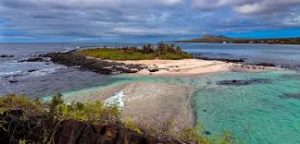
More than 150 giant tortoises have been recently reintroduced to Floreana Island in Ecuador’s famed Galapagos archipelago, where they disappeared more than a century ago.
- Floreana, officially “Santa Maria,” is located on the southern end of the Galápagos Archipelago off the west coast of continental Ecuador.
- It is a volcanic landmass.
- It is situated in the middle of the Pacific Ocean and remains a remote and vital ecological site.
- It supports a range of habitats, including coastal lagoons, volcanic highlands, and offshore reefs.
- It is known for the historic Post Office Bay, where a barrel mail system (dating to the 18th century) is still used by visitors.
- Of all the Galápagos Islands, Floreana is the one most affected by the presence of humans and their introduction of goats, which ended up roaming loose on the island for many years.
- The goats and some other non-native species were completely removed by the Galápagos National Park in 2007.
- It has the highest concentration of species threatened by invasive mammals of any Galápagos Island.
Taftan Volcano:
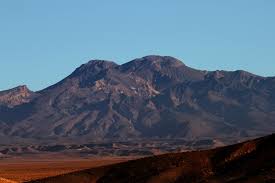
Taftan Volcano in southeastern Iran has nudged upward by about 3.5 inches (9 centimeters) in 10 months.
- It is a stratovolcano located in southeastern Iran, close to the border with Pakistan.
- It is the tallest mountain in southeastern Iran.
- The volcano contains two summits (Narkuh and Matherkuh).
- It hosts an active hydrothermal system.
- It is the only active volcano in the Makran continental volcanic arc formed by the subduction of the Arabian Plate beneath the Eurasian Plate.
SANKALP Scheme:
The Public Accounts Committee (PAC) of Parliament has expressed concern over gaps in planning and the slow pace of implementation of the Skill Acquisition and Knowledge Awareness for Livelihood Promotion (SANKALP) scheme.The observations were based on a report by the Comptroller and Auditor General (CAG) of India, which found that the SANKALP scheme utilised only 44% of its allocated funds, with significant World Bank assistance remaining unspent, indicating weak financial planning and absorption capacity.Launched in January 2018 by the Ministry of Skill Development and Entrepreneurship (MSDE), the SANKALP scheme is a Centrally Sponsored Scheme aimed at operationalizing the National Skill Development Mission (NSDM).It focuses on strengthening institutional mechanisms for short-term skill training and expanding access to quality training for marginalised communities.The scheme was approved with a total budget of Rs 4,455 crore. It is primarily supported by a World Bank loan of Rs 3,300 crore, supplemented by state leverage and industry contribution.



