
Today’s Current Affairs: 24th March 2026 for UPSC IAS exams, State PSC exams, SSC CGL, State SSC, RRB, Railways, Banking Exam & IBPS, etc
Table of Contents
World Water Day 2026:
The Prime Minister of India conveyed his greetings to the people on the occasion of World Water Day.
- World Water Day held on March 22 every year since 1993.
- It is an annual United Nations Observance focusing on the importance of fresh water.
- The idea of World Water Day was first introduced in 1992 during the United Nations Conference on Environment and Development held in Rio de Janeiro.
- Following the conference, the United Nations declared March 22 as the official day to focus on water-related issues worldwide.
- A core focus of World Water Day is to support the achievement of Sustainable Development Goal 6: water and sanitation for all by 2030.
- Theme (2026): Water and Gender.
- This theme highlights the important role of women and girls in water management.
- World Water Day raises awareness about serious water challenges such as water scarcity, pollution, and lack of sanitation facilities.
Mutual Credit Guarantee Scheme:

The Government has modified the Mutual Credit Guarantee Scheme (MCGS) to support Micro, Small and Medium Enterprises (MSME) Manufacturers and Exporters in line with Budget 2025-26.
- It provides 60 % guarantee coverage by National Credit Guarantee Trustee Company Limited (NCGTC) to Member Lending Institutions for credit facilities up to 100 crore rupees sanctioned to eligible MSMEs under MCGS-MSME for purchase of equipment and machinery.
- Salient Features of Mutual Credit Guarantee Scheme:
- Target: Borrower should be an MSME with valid Udyam Registration Number.
- The eligibility criteria have also been expanded to service sector MSMEs.
- The minimum project cost requirement towards machinery and equipment has been reduced to 60 per cent from the earlier 75 per cent.
- The 5% upfront contribution has been made refundable, with one per cent returned each year from the fourth year onwards, subject to satisfactory loan performance.
- The credit guarantee would expire after 10 years, as compared to the unspecified period in the earlier scheme.
- It is applicable to all loans sanctioned under MCGS-MSME during the period of 4 years or till cumulative guarantee of 7 lakh crore are issued, whichever is earlier.
- Eligible exporters:
- Profitable units having exported at least 25% of their sales turnover in each of previous 3 financial years
- Guaranteed loan amount is pegged at ₹20 crore, and upfront contribution is 2% of the loan amount, a maximum of ₹40 lakh, with 1% each refundable in the 4th and 5th year of the guarantee period.
PRARAMBH 2026:
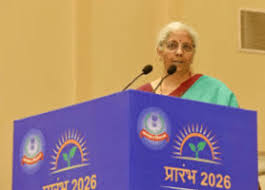
The Union Minister for Finance launched ‘PRARAMBH 2026’ initiative.
- PRARAMBH (Policy Reform and Responsible Action for Mission Viksit Bharat) is a nationwide awareness campaign on Income Tax Act, 2025.
- It is aimed at familiarising citizens with the provisions of the Income Tax Act, 2025, set to come into effect from April 1, 2026.
- It has been designed as an extensive, multi-channel initiative spanning print, television, radio, outdoor advertising, digital platforms, and social media.
- Ministry Involved: Ministry of Finance
Key Features of PRARAMBH: - It includes a wide range of taxpayer-centric resources such as, guidance notes and brochures, tutorial videos, FAQs and educational content and Public engagement initiatives like the MyGov Quiz.
- Brochures containing detailed information were also launched in 10 regional languages beside English and Hindi for wider outreach and awareness
- AI-enabled chatbot ‘Kar Saathi’, designed to assist taxpayers with queries related to the new Act, rules, and procedures.
- Income Tax Website 2.0 the upgraded platform is designed to offer improved usability, simpler navigation, and more efficient service delivery for taxpayers.
Sarhul Festival 2026:
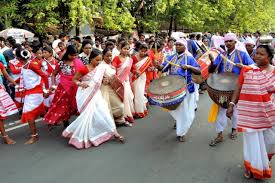
The President of India extended greetings to the countrymen on the occasion of the Sarhul festival.
- Sarhul, literally “worship of the Sal tree”, is among the most revered Adivasi festivals.
- It is rooted in nature worship and celebrates the symbolic union of the Sun and the Earth.
- Sarhul marks the renewal of life.
- The Sal tree is revered as the abode of Sama Maa, the village-protecting deity.
- It is celebrated by various tribes, including the Oraon, Munda, Santal, Khadia, and Ho, each with unique names and traditions associated with the festival.
- A pahan (male priest) represents the Sun, while his wife (pahen) symbolizes the Earth, signifying the essential connection between sunlight and soil for sustaining life.
- Sarhul is celebrated in Jharkhand and parts of Odisha, West Bengal, and Chhattisgarh.
- Three-Day Festival:
- Day 1 – Preparations begin, with homes and Sarna Sthals cleaned, Sal flowers gathered, and the village priest (pahan) observing a strict fast.
- Day 2 – Main rituals are performed at Sarna Sthals (Sacred Groves), including sacrifices, prayers for prosperity, and cultural performances.
- Day 3 – Concludes with a community feast, featuring Handia (rice beer), ceremonial fishing, and traditional Adivasi cuisine.
- Only after its rituals are completed do Adivasis begin agricultural activities like ploughing, sowing, and forest gathering, emphasizing the festival’s deep ties to nature and sustenance.
Actinidia Indica : New Species Of Wild Kiwi

Scientists from the Botanical Survey of India (BSI) have identified a new species of wild kiwi, Actinidia indica (Actinidiaceae), in Arunachal Pradesh.
- Actinidia Indica is a new species of wild kiwi.
- The species has been recorded only from a narrow stretch near Ziro Valley.
- It thrives in a biologically rich transition zone between temperate and subtropical forests.
- Actinidia indica is a perennial climbing shrub.
- It features densely hairy young branches, large ovate leaves, and white to creamy flowers.
- The plant bears globose, olive-green fruits with a distinctive reticulate lenticel pattern, a key identifying trait.
- The discovery increases the global count of Actinidia species, only a few of which occur in India.
Global Terrorism Index 2026:
The Global Terrorism Index, 2026 was published by the Institute for Economics and Peace (IEP).
Highlights of Global Terrorism Index 2026:
- Deaths from terrorism fell by 28 per cent and incidents decreased by 22 per cent
- Six of the ten countries most impacted by terrorism are in sub-Saharan Africa, maintaining its position as the epicenter.
- For the first time, Pakistan leads the Index as the country most impacted by terrorism.
- India is placed 13th on the list.
- Deadliest terror outfits (2025): IS, Jamaat Nusrat Al-Islam wal Muslimeen (JNIM), Tehrik-e-Taliban Pakistan (TTP), and alShabaab.
Global Terrorism Index:
- It is published by the Institute for Economics and Peace (IEP), a Sydney-based independent, non-profit think tank.
- It is a comprehensive study analysing the impact of terrorism for 163 countries covering 99.7 per cent of the world’s population.
Methodology - The GTI scores each country on a scale from 0 to 10; where 0 represents no impact from terrorism and 10 represents the highest measurable impact of terrorism.
- This produces a composite score so as to provide an ordinal ranking of countries on the impact of terrorism.
INS Taragiri:
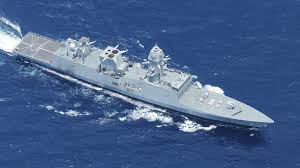
The Indian Navy is preparing to commission its latest stealth Frigate, Taragiri (F41), on 03 Apr 2026.
- It is the fourth ship of Nilgiri Class (Project 17A) built by Mazagon Dock Shipbuilding Ltd (MDL).
- It is a reincarnation of the erstwhile INS Taragiri, a Leander-class frigate that was part of the Indian Naval fleet.
- It is designed by the Warship Design Bureau (WDB).
- It is fitted with an advanced weapon and sensor suite compared to the P17 (Shivalik) class.
- It is designed for ‘High-Speed – High Endurance’ versatility and multi-dimensional maritime operations.
- The ship’s weapon suite is featuring supersonic Surface-to-Surface Missiles, Medium Range Surface-to-Air Missiles, and a specialised Anti-Submarine Warfare suite.
- It is configured with Combined Diesel or Gas (CODOG) propulsion plants, comprising a diesel engine and a gas turbine that drive a
- Controllable Pitch Propeller (CPP) on each shaft, and state-of-the-art Integrated Platform Management System (IPMS).
- The potent weapon and sensors suite comprises BrahMos SSM, MFSTAR and MRSAM complex, 76mm SRGM, and a combination of close-in weapon systems, along with rockets and torpedoes for anti-submarine warfare.
Credit Guarantee Scheme for Microfinance Institutions-2.0:

The Government of India has introduced Credit Guarantee Scheme for Microfinance Institutions-2.0 (CGSMFI-2.0).
- It aims to provide guarantee cover to Banks/ FIs through National Credit Guarantee Trustee Company Limited (NCGTC).
- It provides guarantee against expected losses on the financial assistance extended by them to Non-Banking Financial Company-Microfinance Institutions (NBFC-MFIs) and MFIs for on lending to small borrowers.
- Features of the scheme:
- Eligible borrowers: Existing or new small borrowers within the regulatory definition of micro finance as prescribed by RBI from time to time.
- Guarantee coverage: 80% of amount in default for small, 75% for medium and 70% for large NBFC-MFIs/ MFIs.
- Guarantee Fee:50% p.a., on sanctioned amount (1st year) & outstanding amount (thereafter).
- The scheme will facilitate increased credit flow to the MFI sector.
- It is estimated that the scheme will facilitate on-lending by NBFC-MFIs/ MFIs to approximately 36 lakh small borrowers.
Shaheen Falcon:
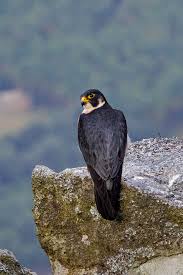
A pair of Shaheen falcons found nesting in a multi-storey residential complex under construction in Kochi.
- The Shaheen falcon (Falco peregrinus peregrinator) is a non-migratory subspecies of the Peregrine falcon.
- The face is characterised by a dark vertical stripe from the eye to the side of the face, which often gives the bird a severe appearance.
- The bird has a muscular body — with the female being larger than the male.
- It is found on rocky and hilly regions on cliffs and rock pinnacles.
- This small but powerful-looking falcon is found mainly in the Indian subcontinent.
- These birds have also been reported from the Andaman and Nicobar Islands in the Bay of Bengal.
- It eats chiefly birds; occasionally mammals, including bats, rats, rabbits and voles; also insects, reptiles and exceptionally fish.
- Peregrines are masters of the stoop.
- Their bodies are shaped to generate high speeds and turn into a weapon when they go into hunt mode.
- Conservation Status
- IUCN: Least Concern
BRICS Presidency 2026:
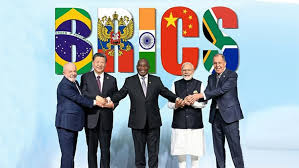
India assumed the BRICS Presidency in 2026 under the theme “Building for Resilience, Innovation, Cooperation and Sustainability”, bringing Science, Technology, and Innovation (STI) to the forefront of the bloc’s agenda.
- The expansion into BRICS+ and the 2025 BRICS Rio de Janeiro Declaration further highlight a shift towards deep-tech collaboration, governance, and technology transfer.
- In 2011 during 3rd BRICS Summit at Sanya, China, the S&T cooperation was formally recognized and injected into the BRICS agenda, reflecting the need to explore joint research to address developmental challenges.
- BRICS Memorandum of Understanding (MoU) on Cooperation in the field of Science, Technology and Innovation was signed in 2015.
- Also, the BRICS Young Scientist Forum (YSF) was established in 2015 to promote collaboration and networking among young scientists.
- BRICS Action Plan for Innovation Cooperation (2017-2020) marked an expansion from purely academic research to entrepreneurship and technology transfer.
- BRICS Technology Transfer Centre (TTC) was established to connect science parks, incubators, and startups, facilitating the cross-border commercialization of emerging technologies.
- BRICS Science & Technology Ministers meeting held annually to set priorities, with national agencies like Council of Scientific and Industrial Research (CSIR) and the Department of Biotechnology (DBT) (India) coordinating projects and proposals.
- India spearheaded the BRICS Innovation Action Plan (2021-2024).
- Crucially, a landmark intergovernmental agreement was signed to share data from a BRICS Remote Sensing Satellite Constellation, bypassing reliance on Western space agencies for earth observation data.
- The Kazan and Rio Declarations marked a major shift towards frontier technologies.
- Artificial Intelligence (AI) was elevated from a sub-theme to a central governance pillar to ensure equitable, development-oriented AI standards.
- Simultaneously, the bloc expanded into BRICS+ bringing new capital and diverse technological capacities.
- India assumes the chair in 2026 with a strong mandate to leverage Digital Public Infrastructure (DPI) and scale tech collaboration across the expanded Global South.
Variable Rate Repo:
The Reserve Bank of India (RBI) infused over Rs 25,000 crore of liquidity in the banking system through a 3-day variable rate repo (VRR) auction.
- The RBI has infused Rs 3.50 lakh crore of liquidity into the banking system through open market purchase (OMO) of government securities since January 2026.
- Variable Rate Repo (VRR) is a market-driven monetary policy tool used by the RBI to inject short-term liquidity into the banking system.
- Unlike the standard “Fixed Repo Rate,” where the interest rate is pre-set by the RBI (currently 5.25%), the interest rate in a VRR is determined through an auction process.
- VRR is a liquidity injection tool under the Liquidity Adjustment Facility (LAF). Banks bid competitively for funds, and the cut-off rate is determined by the highest accepted bid, reflecting real-time market demand.
- The RBI allots funds starting from the highest bids until the notified amount is exhausted.
- Auctions typically range from 1 to 14 days and require banks to provide eligible government securities as collateral for the borrowed funds.
- When the RBI observes a liquidity deficit in the banking system (e.g., due to advance tax outflows or festive season cash withdrawals), it announces a VRR auction.
- It helps keep the Weighted Average Call Rate (WACR), the operating target of monetary policy, aligned with the Repo rate.
- It prevents the RBI from “guessing” the right interest rate, allowing banks to signal the actual cost of funds based on their immediate needs.
Anti-Dumping Probe into Ethyl Chloroformate:
The Directorate General of Trade Remedies (DGTR), under the Ministry of Commerce and Industry, has launched an anti-dumping investigation into the alleged dumping of ethyl chloroformate from China to protect the domestic chemical industry.
- The DGTR has also opened a separate anti-dumping investigation into imports of hexamine, another chemical intermediate, from China, Russia, and the United Arab Emirates.
- Ethyl chloroformate is a highly reactive organic compound. It is the ethyl ester of chloroformic acid and is primarily used as a versatile reagent in organic synthesis, particularly in the pharmaceutical and agrochemical industries.
- When it reacts with water (hydrolysis), it decomposes into ethanol, carbon dioxide, and hydrochloric acid.
- It is a critical intermediate in the production of various drugs, including modified penicillins and ore flotation agents.
- It serves as a stabilizer for PVC and is used in the synthesis of agricultural chemicals like herbicides and insecticides.
- It reacts with carboxylic acids to form mixed anhydrides, which are highly reactive intermediates used to create esters or amides.
- It is highly toxic by inhalation and harmful if swallowed. Short-term exposure can cause pulmonary edema (fluid in the lungs).
- It is a strong lachrymator (causes severe eye watering) and causes acid-type burns to the skin, eyes, and mucous membranes.
- It is a highly flammable liquid and can form explosive mixtures with air.
Anti-Dumping Duty (ADD)
- It is a protectionist tariff imposed by a government on foreign imports that it believes are priced below fair market value (a practice known as “dumping”).
- There are also countervailing duties, which are imposed to neutralize the impact of subsidies provided by exporting countries, together ensuring a level playing field in international trade.
RELIEF Scheme:
The Union Government has introduced the Rs 497 crore Resilience & Logistics Intervention for Export Facilitation (RELIEF) scheme to provide credit insurance cover at pre-conflict rates for Indian exporters, particularly MSMEs, whose goods are stranded or at risk due to the ongoing West Asia crisis.
- Apart from this, India is also exploring the creation of a domestic Protection & Indemnity (P&I) club to safeguard its shipping operations amid rising risks in the Strait of Hormuz.
- RELIEF Scheme has been launched by the Ministry of Commerce and Industry to provide financial surety and alleviate hardships for Indian exporters facing rising maritime risks due to geopolitical instability in the Gulf and wider West Asia maritime corridor.
- Three-Part Framework:
- Component 1: Supports exporters already holding ECGC Ltd. (Export Credit Guarantee Corporation) cover by maintaining pre-disruption premium rates for consignments issued between 14th February and 15th March, 2026. It will provide enhanced cover up to 100% of loss for war-related risks.
- Component 2: Encourages new exporters (excluding energy shipments) to opt for ECGC insurance for the next three months (16th March and 15th June 2026), providing up to 95% loss coverage.
- Component 3: Specifically targets MSME exporters who lacked prior insurance, offering a cap of Rs 50 lakh per exporter for affected shipments.
- Applies to exports bound for UAE, Saudi Arabia, Kuwait, Qatar, Oman, Bahrain, Iraq, Iran, Israel, and Yemen.
- P&I Club Initiative:
- Protection & Indemnity (P&I) Clubs are mutual, non-profit associations formed by shipowners to insure against third-party maritime liabilities.
- Unlike standard marine insurance, they cover risks like personal injury to crew members, pollution, cargo damage, collisions, and legal liabilities.
- Most global shipping risks are covered by the International Group of P&I Clubs, which insure about 90% of the world’s ocean-going fleet.
Abortion Law in India:

The Supreme Court of India delivered a landmark judgment permitting a woman to terminate her 30-week pregnancy, prioritizing reproductive autonomy over fetal viability.
- The ruling, led by Justice B.V. Nagarathna, sets a significant precedent by allowing termination well beyond the 24-week statutory limit for a woman who was a minor at the time of conception.
- Abortion in India is not an absolute right but a qualified legal right governed by the Medical Termination of Pregnancy (MTP) Act, 1971, and its subsequent amendments.
- It was enacted to provide a legal exception to the Indian Penal Code (IPC), which otherwise criminalizes voluntary termination of pregnancy.
- MTP Amendment Act 2021 is major update increased the upper gestation limit from 20 to 24 weeks for special categories of women.
- Unsafe abortions remain a leading cause of maternal deaths in India; the MTP Act was originally designed as a public health measure to provide safe, regulated services.
- Since 2021, over 1,100 cases have reached High Courts and the Supreme Court as women seek permission for abortions beyond the statutory limits.
- The 2026 judgment is one of the highest gestational ages (30 weeks) ever permitted for termination by the Indian apex court.
- In 2022 (X v. Principal Secretary, Delhi), the SC ruled that unmarried women are equally eligible for abortions up to 24 weeks, ending a long-standing legal discrimination.
Smog-eating Photocatalytic Coating:
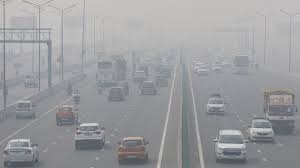
The Delhi government and Indian Institute of Technology (IIT) Madras collaborated to study “smog-eating” photocatalytic coatings on roads.
- Smog-eating Photocatalytic Coating is designed to neutralize harmful gases like nitrogen dioxide and volatile hydrocarbons that contribute to toxic air.
- It usually uses titanium dioxide as a coating which has advantages for being low-cost and chemically stable.
- Titanium dioxide is also known for its compatibility with traditional construction materials.
- It has been “demonstrated that TiO₂-based photocatalytically active construction materials can be useful for gaseous depollution and environmental cleaning processes.
- Photocatalytic activity helps fight pollution by breaking down harmful substances and organic waste into less toxic or harmless matters using light energy, thereby making air and water cleaner.
- Smog is used to refer to a type of air pollution caused by a combination of smoke (and other pollutants) and fog.
- Smog encompasses a broad category of air pollutants created through a multitude of processes that relate specifically to the atmospheric conditions of the formation region.
- Two distinct types of smog are recognized:
- Sulfurous smog: It results from a high concentration of sulfur oxides in the air and is caused by the use of sulfur-bearing fossil fuels, particularly coal.
- Photochemical smog: It occurs most prominently in urban areas that have large numbers of automobiles.
Agri-photovoltaics (agriPV):
In the 2026-27 Budget, the outlay for the PM-KUSUM scheme nearly doubled to ₹5,000 crore, with the government considering a National Agri-photovoltaics Mission to achieve 10 GW of capacity.This move positions Agri-photovoltaics (agriPV) as a primary solution to India’s land-use conflict between food security and the 300 GW solar target for 2030.AgriPV is a dual-use land technology that integrates solar power generation with agricultural cultivation on the same parcel of land. By mounting solar panels at specific heights or in spaced rows, it allows crops to grow underneath or between them, turning a single field into a powerhouse for both food and energy.Panels are fixed several meters high to ensure enough clearance for farmers, laborers, and even tractors to operate beneath them.Systems can be row-based (panels between crops), vertical (bifacial panels capturing sun from both sides), or greenhouse-integrated.The panels create a shading effect that can reduce soil temperature and protect sensitive crops from extreme weather like hail.Uses specific spacing and tilt to balance the Light Saturation Point of crops with maximum solar energy capture.
The Iran-Pakistan-India (IPI) Pipeline:
The ongoing West Asia crisis has disrupted energy supplies, exposing India’s heavy dependence on imported gas.This has revived discussion on past pipeline projects like the Iran–Pakistan–India (IPI) and Turkmenistan–Afghanistan–Pakistan–India (TAPI)A proposed 2,775 km natural gas pipeline designed to transport gas from Iran’s South Pars field to Pakistan and India. Often referred to as the Peace Pipeline, this project was intended to link the energy-rich Persian Gulf with the energy-starved South Asian economies.Conceptually originated in the 1990s; gained significant diplomatic momentum between 2004 and 2005.Aim is to provide a cost-effective, land-based alternative to expensive Liquefied Natural Gas (LNG) imports for India and Pakistan’s industrial and power sectors.
Diego Garcia Island:
The U.K. condemned a reckless Iranian ballistic missile attack targeting the joint U.K.-U.S. military base on Diego Garcia, marking a significant escalation in the 2026 Iran war.A tropical footprint-shaped atoll that hosts one of the most secretive and critical overseas military installations for the United States and the United Kingdom. Diego Garcia is the largest and most strategically vital island of the Chagos Archipelago, serving as a cornerstone of Western military power in the Indian Ocean.Situated in the central Indian Ocean, approximately 1,796 km southwest of India and 3,535 km east of Tanzania, forming part of the underwater Chagos-Laccadive Ridge.Currently part of the British Indian Ocean Territory (BIOT), though a 2025 treaty initiated the transfer of sovereignty to Mauritius.Under a 99-year lease (signed in 2025/2026), the base remains under joint U.K.-U.S. military administration, with the U.S. Navy and Air Force as primary operators.



