
Today’s Current Affairs: 30th March 2026 for UPSC IAS exams, State PSC exams, SSC CGL, State SSC, RRB, Railways, Banking Exam & IBPS, etc
Table of Contents
Satpura Tiger Reserve : In News
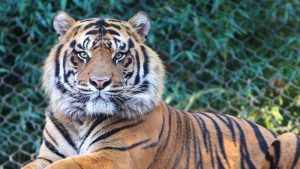
A tiger from Madhya Pradesh’s Satpura Tiger Reserve (STR) has been allegedly poisoned to death leading to arrest of five people in the case.
- Satpura Tiger Reserve is located in Madhya Pradesh.
- It is situated in the Satpura ranges of the Central Indian Landscape.
- It lies south of the river Narmada.
- The tiger reserve comprises three protected areas, Satpura National Park, Bori Wildlife Sanctuary, and Pachmarhi Sanctuary.
- The terrain here is extremely rugged and consists of sandstone peaks, narrow gorges, ravines, and dense forests.
- Geological formations include the Deccan trap series, Gondwanas, and metamorphic rocks.
- It mainly consists of mixed deciduous forest with a variety of flora typical of the Central Indian Highlands.
- It includes teak, bamboo, Indian ebony, various acacias, wild mango, Indian gooseberry, satinwood, etc.
- Twenty-six species of the Himalayan region and 42 species of the Nilgiri areas are found. Hence, STR is also known as the northern extremity of the Western Ghats.
- It is home to tigers, leopards, sloth bears, Indian gaurs (bison), and sambar deer.
Nyctibatrachus kali : New Frog Species
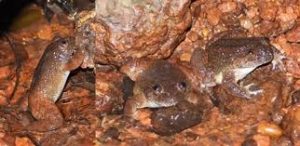
The new frog species was discovered and named it as Nyctibatrachus kali.
- Nyctibatrachus kali is more commonly called ‘Kali Night Frog’.
- It was found in the Kali Tiger Reserve in Uttara Kannada district of Karnataka.
- It was named after the nearby Kali River (the reserve is also named after the river which flows through it).
- The new frog species is known to be a ‘cryptic’ one, which has similarities with the ‘Kumbara Night Frog’ (Nyctibatrachus kumbara) discovered in 2014.
- Its sound resembles that of wood-chopping in the forest.
- Kali Tiger Reserve is situated in the Uttara Kannada district of Karnataka.
- It is composed of Dandeli Wildlife Sanctuary and Anshi National Park.
- The Kali River, which forms the major source of water for Uttara Kannada, flows through the tiger reserve
- It is a blend of semi-evergreen and moist deciduous forests, interspersed with patches of bamboo and grasslands.
- It features species like teak, silver oak, eucalyptus, and various medicinal plants.
- Animals found in the Tiger Reserve include Tiger, Leopard, Elephant, Bison, Wild dog, Sambar, Spotted deer.
G7 Group:

The Union External Affairs Minister met French President Emmanuel Macron on the sidelines of the G7 Foreign Ministers’ Summit.
- The Group of Seven (G7) is an informal grouping of seven of the world’s advanced economies.
- It was founded in 1975 in response to the oil crisis.
- Members: Canada, France, Germany, Italy, Japan, the United Kingdom, and the United States.
- Russia was member from 1998, the group temporarily became the G8.
- In 2014, the group returned to the G7 format.
- The G7 originally dealt exclusively with issues related to the development of the global economy.
- It now covers the entire spectrum of global issues, such as foreign and security policy, trade, climate, and development.
Governance - There is no firmly established secretariat, procedural guidelines, or administrative structures.Its presidency rotates each calendar year among the member states. The EU does not hold the rotating presidency of the G7.
- The changing agenda and thematic priorities of the G7 are determined by the respective presidency.
- Decisions are usually taken by consensus.
Shigellosis : Outbreak
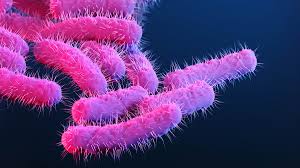
An outbreak of shigellosis, or shigella infection has been reported in Kerala.
- Shigellosis is an infection caused by the Shigella bacteria.
- It is highly contagious, causes acute diarrhoea, and can affect anyone, but children under five are particularly susceptible.
- It is one of the leading bacterial causes of diarrhoea worldwide.
- Humans are the only natural reservoir of the Shigella bacteria.
- The disease may be more severe in young children, older adults, immune-compromised individuals or malnourished persons.
- The infection is transmitted through direct, close contact with infected individuals, through the faecal-oral route and through sexual contact.
- It can also spread through contaminated food and water or contact with faeces of an infected person.
- The most common symptoms is diarrhoea, which can be bloody, contain mucus and last for a prolonged period of three days or more.
- Other symptoms include stomach cramps, vomiting, fever and feeling the need to pass stool even when the bowels are empty.
- It is typically self-limiting, which means in most mild cases.
- Medicines, including antibiotics may be prescribed for a serious infection.
Zojila Pass: Snow Avalanche
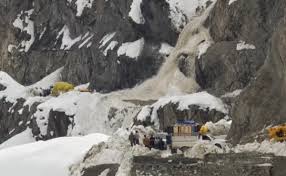
A massive snow avalanche has hit the Zojila Pass in Ladakh.
- Zojila Pass, also known as ‘The Mountain Pass of Blizzards’, is a high mountain pass located in the Kargil district of Ladakh.
- It is located on the Srinagar-Kargil-Leh highway (NH-1).
- It lies in the Greater Himalayan Range.
- Avalanche is a large amount of snow that quickly moves down a slope.
- It can be deadly because it will bury or sweep away anything in its path.
- Many different conditions make an avalanche possible.
- An avalanche is more likely to happen on a slope without trees or large rocks. These things help to keep snow in place.
- A weak layer of snow also makes an avalanche likely.
Rashtriya Vigyan Puraskar 2026:

The central government has opened nominations for the Rashtriya Vigyan Puraskar (RVP) 2026.
- It is a prestigious national award recognizing outstanding contributions in the fields of science, technology, and innovation.
- The RVP seeks to honour scientists, technologists, and innovators whose work has significantly advanced India’s scientific landscape and contributed to national development.
- Eligibility:
- Scientists/technologists/innovators working in government or private sector organizations or any individual working outside any organization, who have made distinguished contributions in terms of path-breaking research or innovation or discovery in any field of science, technology, or technology-led innovation shall be eligible for the awards.
- People of Indian Origin staying abroad with exceptional contributions benefiting the Indian communities or society shall also be eligible for the awards.
- The awards will be presented in four categories:
- Vigyan Ratna (VR): For lifetime achievements in science and technology.
- Vigyan Shri (VS): For distinguished contributions in the field.
- Vigyan Yuva–Shanti Swarup Bhatnagar (VY-SSB): To encourage young scientists (up to 45 years) showing exceptional promise.
- Vigyan Team (VT): For collaborative excellence by research teams of three or more members.
- The awards are administered by the RVP Secretariat, Council of Scientific and Industrial Research (CSIR), Ministry of Science & Technology, under the guidance of the Principal Scientific Advisor to the Government of India.
Earth Hour:

The World Wildlife Fund (WWF) India, in collaboration with the Ministry of Environment, Forest and Climate Change organised awareness and outreach activities in Gwalior to mark 20 years of Earth Hour.
- Earth Hour is a global grassroots movement uniting people to take action on environmental issues and protect the planet.
- It is organized by the World Wildlife Fund (WWF).
- It started in Sydney, Australia, in 2007as a symbolic lights-out event and has since grown into a global movement involving millions of people in over 190 countries and territories.
- It takes place towards the end of March every year.
- “Earth Hour” encourages people to switch off all lights for an hour, from 8:30 p.m. to 9:30 p.m. local time, to promote awareness of climate change challenges and energy conservation.
- Governments and companies also participate by turning off non-essential lights in their buildings, monuments, and landmarks to raise awareness about the impact of energy consumption on our planet.
- This symbolic act, known as the ‘lights off’ moment, unites people worldwide in a show of support for the planet and serves as a reminder of the environmental issues facing us.
Biotechnology Research and Innovation Council:
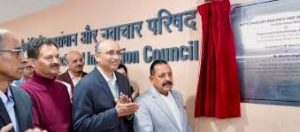
An inaugural meeting of the Biotechnology Research and Innovation Council-Research Advisory Board (BRIC-RAB) was held at the Regional Centre for Biotechnology (RCB), Faridabad.
- Biotechnology Research and Innovation Council is an Apex Autonomous Body established as a registered Society.
- It was formed by subsuming 14 Autonomous Institutes of the Department of Biotechnology (DBT).
- BRIC aims to provide a centralized and unified governance mechanism for the administration of its research institutions through intra-mural core grants.
- It emphasizes multi-disciplinary research support from basic discovery to application in areas of strength within the DBT institutions.
- BRIC seeks to nurture the next generation of scientific leaders by enabling the pursuit of knowledge and innovation in globally competitive and nationally relevant ecosystems.
- The objectives of BRIC are:
- Promoting cutting-edge research in biotechnology aligned with national priorities
- Fostering innovation and translation across institutional boundaries
- Developing indigenous technologies and capabilities in line with the principles of Atmanirbhar Bharat
- Nodal Ministry: Ministry of Science and Technology
Advanced Short Range Air-to-Air Missile:
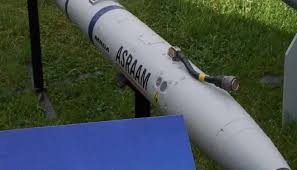
The Indian Air Force is set to equip its fleet of MiG-29 fighter jets with the Advanced Short Range Air-to-Air Missile, or ASRAAM.
- It is a European-designed short-range air-to-air missile built by the multinational company MBDA.
- The ASRAAM uses heat-seeking technology and is optimised for close-in dogfights.
- It operates on a fire-and-forget principle, which means once launched; the missile guides itself to the target without further input from the pilot.
- It reaches speeds in excess of Mach 3, can engage fast-moving fighter aircraft at ranges greater than 25 kilometres and delivers pinpoint accuracy.
- The technology features a Lock-On After Launch (LOAL) capability, allowing the pilot to fire the weapon before the seeker even sees the target.
- It has already been integrated on the indigenous LCA Tejas and Jaguar aircraft.
- The weapon is highly manoeuvrable, capable of pulling extreme G-forces to track rapidly turning fighter jets.
- Once fired, its aerodynamic design and powerful rocket motor ensure it maintains high energy throughout its flight path.
India recorded 24,700 maternal deaths in 2023:
India has reported 24,700 maternal deaths in 2023 a nd with it placed his position among countries who have the highest maternal mortality burden. This numbers are coming rom the global analysis published in The Lancet. The study which is led by researchers from the Institute for Health Metrics and Evaluation (IHME) has estimated India’s Maternal Mortality Ratio (MMR) at 116 per 1 lakh live births. Globally the maternal deaths remain a critical concern and with countries like Nigeria, Ethiopia and Pakistan contributing significantly to the global burden.
Pradhan Mantri Shram Yogi Maandhan (PM-SYM):
India’s unorganized sector workers will have the great chance to secure their future via the Pradhan Mantri Shram Yogi Maandhan (PM-SYM) scheme. With part of this scheme their saving as little as ₹55 per month and workers will get a fixed pension of ₹3,000 every month after the age of 60. This scheme is implemented by the central government for people who do not get the pension benefits like EPF or NPS. It also helps them to stay financially secure in the old age and reduces stress about the future.The PM-SYM scheme is a voluntary pension plan for workers in the unorganized sector. It was launched in the 2019 to help workers who do not have any social security.The important and best part of this scheme is that the government contributes the same amount as the worker. This means your savings can grow faster over time.It is made to be simple and affordable and so those people who have low income can save for their retirement.
India To Establishes First Port of Refuge to Strengthen Maritime Safety:
To strengthen the India’s maritime security Adani Ports and Special Economic Zone Ltd (APSEZ) has operationalized India’s first Port of Refuge (PoR). This initiative creates the structured system for the handling ships in distress and filling a long-standing gap in the country’s maritime infrastructure. As India has over 11,000 km of coastline and India comes that category who have some of the world’s busiest shipping lanes. As of today it lacked the structured mechanism to assist vessels during emergencies.A Port of Refuge (PoR) is a designated as the safe location where ships facing emergencies such as fire, collision or mechanical failure and with this they can seek shelter. The goal of PoR to stabilize the vessel, protect lives and minimize environmental damage.