
Mpemba Effect:
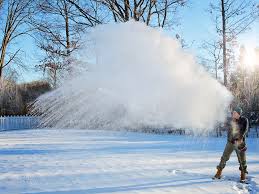
Researchers from Jawaharlal Nehru Centre for Advanced Scientific Research have used supercomputers to develop the first simulation of ice formation proving the Mpemba effect of water.
- Mpemba effect is a paradoxical phenomenon in which a hot liquid can cool or freeze faster than a cold liquid under certain conditions.
- The effect was described by Aristotle, in his book Meterologica.
- It is named after Tanzanian student Erasto Mpemba, who brought attention to this counterintuitive phenomenon in 1969, makes for curious observation.
- Possible causes to Mpemba Effect:
- Micro bubbles: One cause, scientists have posited, is micro bubbles left suspended in water that has been heated by boiling.
- These cavities promote convection and transfer heat faster as the water cools.
- Evaporation: as warmer water evaporates more, it also takes away some heat (evaporation is inherently endothermic, which is how sweat cools your skin).
- Both convection and accelerated heat transfer are enhanced in warmer water because such water is less dense.
- Presence of frost in cold water: Frost is an insulator and could slow the loss of heat.
- Scientists have also considered whether compounds in water like calcium carbonate could be precipitated by boiling, and then dissolve, thus increasing the water’s freezing point.
- Recent Findings related to Mpemba effect:
- The researchers also found that the Mpemba effect is not unique to water.
- The simulation demonstrates that similar behaviour can occur during fluid-to-solid phase transitions in other materials.
- Supercomputer simulation of ice formation gives evidence of paradoxical phenomenon of water.



