
Today’s Current Affairs: 28th February 2026 for UPSC IAS exams, State PSC exams, SSC CGL, State SSC, RRB, Railways, Banking Exam & IBPS, etc
Table of Contents
Yadava Dynasty:
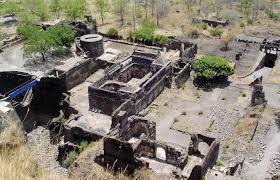
Remains of a 12th-century Mandir-style stone pillar from the Seuna (Yadava) dynasty have been recently discovered near the Vena River in Hinganghat, Wardha district, Maharashtra.
- The Yadava Dynasty, also known as the Seuna Dynasty, ruled around 12th–14th-in central India.
- At its zenith they ruled a vast kingdom stretching from the River Tungabhadra to the River Narmada, including modern Maharashtra, the north of Karnataka, and parts of Madhya Pradesh.
- Originally a feudatory of the Eastern Chalukyas of Kalyani, the dynasty became paramount in the Deccan under Bhillama (c. 1187–91), who founded Devagiri (later Daulatabad) as his capital.
- Under Bhillama’s grandson Singhana (reigned c. 1210–47), the dynasty declared independence and reached its height, as the Yadava campaigned against the Hoysalas in the south, the Kakatiyas in the east, and the Paramaras and Chalukyas in the north.
- Later rulers continued expansionist wars with varying success.
- During the reign of the last Yadava king, Ramachandra (reigned 1271–c. 1309), a Muslim army commanded by the Delhi sultan Alauddin Khilji invaded the kingdom in 1294 and imposed tributary status.
- A later attempt to throw off the vassalage brought another Delhi army; Ramachandra was imprisoned but was later released and remained loyal to Delhi until his death.
- In a further attempt, his son and successor died in battle, and the kingdom was annexed by the Khilji empire in 1317.
- The foundations of Marathi culture were laid by the Yadavas, and the peculiarities of Maharashtra’s social life developed during their rule.
- The Hemadpanti architectural style (stone masonry without mortar) is associated with this period.
Carbon-14:
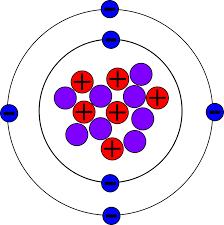
Martin Kamen and Samuel Ruben’s discovery of the radioactive isotope carbon-14 in 1940 helped usher in a new era of dating artifacts from past civilizations.
- Carbon has three main isotopes: carbon-12, carbon-13, and carbon-14. The first two are stable.
- Carbon-14 is a radioactive isotope of carbon.
- It is created in the atmosphere through the bombardment of nitrogen by cosmic rays.
- It has six protons and eight neutrons in its nucleus.
- It is used in radiocarbon dating to determine the age of organic substances by measuring its decay over time.
- Radiocarbon Dating, or Carbon-14 Dating is a method that provides objective age estimates for carbon-based materials that originated from living organisms.
- It is based on the fact that living organisms—like trees, plants, people, and animals—absorb carbon-14 into their tissue.
- When they die, the carbon-14 starts to change into other atoms over time.
- Carbon-14 has a half-life of approximately 5,730 years (i.e., half the amount of the isotope present at any instant will undergo spontaneous disintegration during the succeeding 5,730 years).
- Because carbon-14 decays at this constant rate, an estimate of the date at which an organism died can be made by measuring the amount of its residual carbon-14.
- Over the years, carbon-14 dating has also found applications in geology, hydrology, geophysics, atmospheric science, oceanography, paleoclimatology, and even biomedicine.
Gitchak nakana:
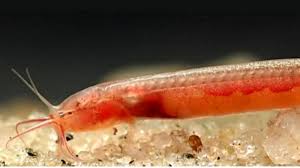
A new groundwater fish species, ‘Gitchak Nakana’, has been recently discovered in Assam.
- It is a new species of groundwater fish.
- It belongs to a newly described genus within the family Cobitidae (loaches).
- Named Gitchak nakana, the species draws from the Garo language, “Gitchak” meaning red, referencing its striking blood-red live colour, and “na-tok” and “kana” referring to a blind fish.
- It displays classic subterranean adaptations, or troglomorphies: no externally visible eyes, a translucent, pigmentless body, and extreme miniaturization.
- It is the most unusual among other groups due to the complete lack of a skull roof, with the brain covered dorsally only by skin.
- It lives in aquifers, groundwater habitats far more difficult to access.
- While more than 300 fish species worldwide are known from subterranean habitats, the vast majority inhabit caves.
- Fewer than 10 percent are known from groundwater aquifers, making such discoveries rare.
Porcelain:
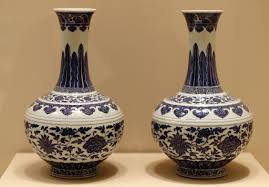
In the waters off Singapore, a recently uncovered shipwreck with a huge cargo of blue-and-white porcelain is shedding light on the storied Chinese craft produced during the turbulent era of the Mongol Empire.
- It is a type of ceramic material that is highly durable and has high-performance characteristics due to its production process.
- It is made from a combination of natural materials including kaolin (china clay), feldspar, and quartz.
- Porcelain was first made in China—in a primitive form during the Tang dynasty (618–907 CE) and in the form best known in the West during the Yuan dynasty (1279–1368 CE).
- The word porcelain is derived from porcellana, used by Marco Polo to describe the pottery he saw in China.
- There are three major types of porcelain historically used in dinnerware and decorative pieces: hard paste, soft paste, and bone china.
- Properties of Porcelain:
- High material density.
- Smooth, glossy surface, which is particularly translucent and gives porcelain products a refined, elegant character.
- High resistance to scratches and breakage, making it ideal for everyday use as well as special occasions.
Sulawesi Island:
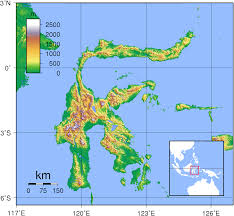
In a limestone cave on the Indonesian island of Sulawesi, a hand stencil has been dated to at least 67,800 years ago, making it the oldest known example of rock art currently identified anywhere in the world.
- Sulawesi, formerly known as Celebes, is a large island in Southeast Asia, in the Indonesian archipelago.
- It sits centrally within the Indonesian archipelago.
- It is part of the island chain known as the Greater Sunda Islands.
- Makassar is the largest city on the island.
- The island is surrounded on all sides by other big islands: Borneo to the west, the Philippines to the north, the Maluku Islands to the east, and Flores and Timor to the south.
- The island is highly mountainous, with some active volcanoes.
- The highest peak on the island of Sulawesi is Ratenkombola, which is also known simply as Mario.
- Sulawesi is known for its rainforests, which once covered the entire island until human activity led to mass deforestation.
- A large number of the species are endemic to the island.
- The island contains thirteen freshwater lakes, including the deepest lake, Matano, in Southeast Asia.
- It has several remarkable prehistoric cave paintings depicting ancient hunts and animal life.
- Seven major ethnic groups inhabit Sulawesi: the Toala, Toraja, Buginese, Makassarese, Minahasan, Mori, and Gorontalese.
Micron Opens World’s Largest Semiconductor Clean Room in Gujarat:
India achieved a landmark milestone in its semiconductor mission as Micron Technology began operations at its Sanand ATMP facility in Gujarat. The plant houses a 500,000 sq ft raised floor clean room, the largest of its kind globally. Prime Minister Narendra Modi inaugurated the facility, marking India’s first advanced memory Assembly, Testing, Marking and Packaging (ATMP) site. The company also shipped its first DRAM module to Dell Technologies, signalling India’s entry into high-end semiconductor assembly.
Foreign Portfolio Investors (FPIs) infused ₹22,615 crore into Indian equities in February 2026:
Foreign Portfolio Investors (FPIs) pumped ₹22,615 crore into Indian equities in February 2026 which is marking the highest monthly inflow in 17 months. The surge comes after three consecutive months of heavy selling and reflects renewed foreign confidence driven by the interim India-US trade deal, improved corporate earnings, and corrected market valuations. The inflow signals a potential shift in sentiment after a turbulent start to 2025 for foreign investments.The latest data shows that FPI inflow February 2026 stood at ₹22,615 crore the strongest monthly inflow since September 2024.
This follows significant outflows,
January 2026: ₹35,962 crore withdrawn
December 2025: ₹22,611 crore withdrawn
November 2025: ₹3,765 crore withdrawn



