
Discovery of the Xi-cc-plus Baryon at CERN:
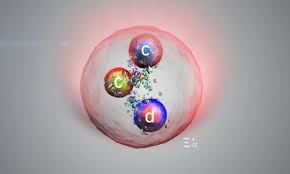
The Large Hadron Collider beauty (LHCb) experiment at CERN’s Large Hadron Collider (LHC) has announced the discovery of a new particle, the Xi-cc-plus, a heavy baryon that will help physicists better understand how the strong force binds protons, neutrons and other composite particles together.
- The Xi-cc-plus consists of two charm quarks and one down quark, making it a heavy sibling of the proton (which has two up quarks and one down quark).
- It was produced by smashing high-energy protons in the Large Hadron Collider (LHC). Like most hadrons, it is unstable and decays rapidly.
- This is the first new particle found since the 2023 LHCb detector upgrades, bringing the total number of hadrons discovered by LHC experiments to 80.
- Due to the presence of two heavy charm quarks, the particle is approximately 4 times heavier than a proton and has a significantly shorter lifetime than its counterparts.
- This marks only the 2nd time a baryon containing two heavy quarks has ever been observed. The first, a similar particle with two charm quarks and an up quark, was discovered by LHCb in 2017.
- The discovery helps theorists test models of Quantum Chromodynamics (QCD), the theory describing the strong force that binds quarks into hadrons (mesons and baryons).
- It opens doors for studying exotic hadrons like tetraquarks and pentaquarks, setting the stage for future research at the High-Luminosity LHC.
- QCD is the theoretical framework in particle physics that describes the strong nuclear force, one of the four fundamental forces of nature.
- It explains how quarks and gluons interact to form composite particles like protons, neutrons, and mesons.
- Large Hadron Collider (LHC)
- LHC is the world’s largest and most powerful particle accelerator located at CERN near Geneva. It boosts particles, such as protons, to nearly the speed of light in two high-energy beams traveling in opposite directions.
- These beams are then made to collide at four specific points around the ring, where massive detectors (like ATLAS, CMS, and LHCb) record the resulting “subatomic debris.



