
Mahavir Jayanti 2026:
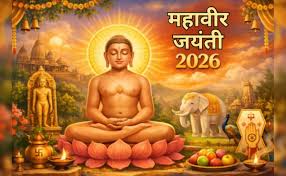
The President of India extended greetings on the eve of Mahavir Jayanti (Mahaveer Janma Kalyanak), which marks the birth anniversary of Lord Vardhamana Mahavira, who was the 24th and last Tirthankara (supreme preacher and spiritual teacher) of Jainism.
- In 2026, it is observed on 31st March, falling on Trayodashi tithi, the 13th day of Shukla Paksha (waxing phase of the moon) in the month of Chaitra.
- He was born as Vardhamana in 599 BCE in Kundalagrama, located near Vaishali in present-day Bihar.
- He belonged to the Ikshvaku dynasty and was born to King Siddhartha and Queen Trishala.
- At the age of 30, Vardhamana renounced his royal privileges, family, and material wealth to become an ascetic in pursuit of spiritual awakening.
- He attained ‘Kevala Jnana’ (omniscience or supreme infinite knowledge) under a Sal tree on the banks of the Rijupalika river.
- Upon conquering his senses and inner enemies (like anger, greed, ego, and deceit), Vardhamana earned the titles ‘Jina’ (the conqueror) and ‘Mahavira’ (the great hero).
- Lord Mahavira attained Moksha (liberation from the cycle of birth and death) at the age of 72 at Pavapuri, near modern-day Rajgir in Bihar.
- According to Mahavira, Nirvana or salvation is achieved through liberation from worldly desires, which begins with renunciation and is guided by the observance of the Tri-Ratna (Three Jewels) – (Samyak Darshan (right faith), Samyak Gyan (right knowledge), and Samyak Charitra (right conduct)).
- Mahavira prescribed five fundamental vows (Maha-vratas) for a meaningful life. Earlier, Parshvanatha (23rd Tirthankara) had taught four vows (Ahimsa, Satya, Asteya, and Aparigraha) while Mahavira added the fifth vow of Brahmacharya.
- The supreme principle (Ahimsa Paramo Dharma). It means not causing harm to any living creature physically, mentally, or verbally.
- Satya (Truthfulness): To always speak the truth and refrain from falsehood, exaggeration, or deception.
- Asteya (Non-stealing): Not taking anything that is not willingly offered or acquired through legitimate means.
- Aparigraha (Non-possessiveness): Complete detachment from material wealth, property, and worldly attachments.
- Brahmacharya (Chastity/Self-control): Exercising strict restraint over sensual pleasures and physical desires.
- Disciplinary Lineage: He organised his followers into the fourfold Jain Sangh—monks (Sadhus), nuns (Sadhvis), laymen (Shravaks), and laywomen (Shravikas).
- Mahavira had eleven chief disciples (ganadharas), among whom Indrabhuti Gautama and Sudharman played a key role in establishing the early monastic tradition.
- His teachings were preserved in the Agam Sutras, initially transmitted orally and later recorded on palm leaves, though many were lost over time.
- Anekantavada (Doctrine of Pluralism): The philosophy that truth and reality are complex and always have multiple aspects. It teaches that no single perspective possesses the absolute truth.
- Syadvada (Theory of Conditioned Predication): The premise that all judgments and truths are conditional and relative, holding good only under certain circumstances.