
Trans-Neptunian object:
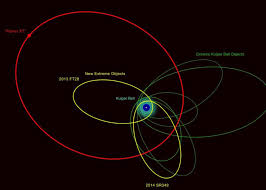
Astronomers have discovered a thin atmosphere on the trans-Neptunian object (612533) 2002 XV93, making it only the second such body after Pluto known to possess one.
- Trans-Neptunian Object: 2002 XV9 is a small, icy celestial body located in the Kuiper Belt, a vast region of the solar system beyond the orbit of Neptune. It is a trans-Neptunian object (TNO) that likely dates back to the dawn of the solar system, approximately 4.5 billion years ago.
- Discovered By:
- The atmosphere was identified through stellar occultation—observing the object as it passed in front of a distant star—using ground-based telescopes in Japan (Kyoto, Nagano, and Fukushima).
- Key Features
- It has a diameter of roughly 310 miles (500 km), making it much smaller than dwarf planets like Pluto or Eris.
- The atmosphere is extremely tenuous—roughly 5 to 10 million times thinner than Earth’s. It is believed to be dominated by methane, nitrogen, or carbon monoxide.
- It follows an elliptical path around the Sun, completing one orbit every 247 years. Its distance from the Sun averages about 39.6 AU (3.7 billion miles).
- Primarily consists of water ice, rock, and organic-rich materials.
- Possible Origin of Atmosphere:
- Gases seeping or venting from the interior through surface cracks (internal supply).
- Temporary gases released following a collision with another smaller object.



