
Cordyceps:
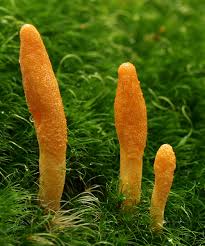
A rare and highly valued species of mushroom, Cordyceps, has been recently discovered in Arunachal Pradesh’s East Siang district, drawing significant scientific attention.
- It is a genus of parasitic fungi that grows on insect larvae.
- When these fungi attack their host, they replace its tissue and sprout long, slender stems that grow outside the host’s body.
- The fungi have a cosmopolitan distribution and are found on every continent except Antarctica.
- Some of the rarest kinds are at higher altitudes in the Himalayan regions of China, Nepal, and India.
- It is one of the most prized medicinal fungi.
- It is often referred to as “Himalayan gold” because of their exceptionally high commercial value and extensive use in traditional medicine, nutraceuticals, and pharmaceutical research.
- It produces a wide range of bioactive compounds, including cordycepin, adenosine, and polysaccharides.
- These compounds are associated with immunomodulatory, antioxidant, anti-inflammatory, antimicrobial, antiviral, and antitumor properties.



