
Eublepharis jhuma:
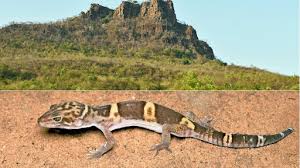
Scientists from the Zoological Survey of India recently discovered a new species of leopard gecko named Eublepharis jhuma from the rocky hills of Bihar, India.
- Eublepharis jhuma is a new species of leopard gecko.
- It was discovered during a wildlife survey on the outskirts of the Kaimur Wildlife Sanctuary, Bihar.
- It is the first of its kind ever recorded in the state, with unique physical traits and distinct DNA.
- It is named in honour of Dr. Dhriti Banerjee, the first female director of the Zoological Survey of India, nicknamed Jhuma.
- Reaching about 14 centimetres in body length, this medium-sized reptile sports a dark brown back decorated with two pale, spotty bands.
- Unlike its closest known relative, Eublepharis satpuraensis, this new species has large, flat, bumpy scales on its back with unusually wide gaps in between them.
- It also features a higher number of tiny, textured ridges, known as lamellae, underneath its fourth toe, which help with gripping.
- It has a specific pattern of 12 to 13 pores near its tail, and if its tail drops and regrows, the new scales grow back in a distinct, flat, and rectangular shape rather than a circular one.



