
Today’s Current Affairs: 4th jun 2026 for UPSC IAS exams, State PSC exams, SSC CGL, State SSC, RRB, Railways, Banking Exam & IBPS, etc
Table of Contents
Agricultural and Processed Food Products Export Development Authority:

The Agricultural and Processed Food Products Export Development Authority (APEDA) facilitated the flagging off of the first-ever sea shipment of botanical-infused ready-to-cook millet functional foods from Karnataka to New Zealand.
- It is a statutory body established by the Government of India under the Agricultural and Processed Food Products Export Development Authority Act in December, 1985.
- It works under the Ministry of Commerce and Industry.
- Objective: To develop and promote the export of scheduled products.
- Functions:
- Setting the standards and specifications for the scheduled products.
- Registration of exporters of the scheduled products on payment of required fees.
- Carrying out an inspection of products to ensure the quality of such products.
- Training in various aspects of the industries connected with the scheduled products.
- Development of industries relating to the scheduled products and undertaking surveys, feasibility studies, etc.
- It is responsible for providing financial assistance, information, and guidelines for the development of scheduled products.
- It also functions as the Secretariat to the National Accreditation Board (NAB) for the implementation of accreditation of the Certification Bodies under National Programme for Organic Production (NPOP) for Organic exports.
- APEDA is headed by a Chairman appointed by the Central Government.
- Headquarters: New Delhi
- APEDA has set up 15 Regional Offices at Mumbai, Bengaluru, Telangana, Kolkata, Guwahati, Ahmedabad, Varanasi, Chandigarh, Bhopal, Chennai, Kochi, Tripura, Srinagar, Jammu, and Ladakh.
National Awards for e-Governance:

The Union government named 16 projects of the Central, state and local governments across the country as the winners of the National Awards for e-Governance(NAeG).
- NAeG are presented every year to recognize and promote excellence in implementation of e-Governance initiatives.
- Nodal Ministry: Ministry of Personnel, Public Grievances & Pensions
- The NAeG Awards, 2026 consist of:
- Trophy, Certificate and an incentive of Rs 10 lakh for Gold Awardees and Rs 5 lakh for Silver Awardees to be awarded to Central Ministry/Department/State/UT/ District/Organisation/Gram Panchayat for being utilised for implementation of project/programme or bridging resources gaps in any area of public welfare.
- This year 16 Awards are being conferred under the NAeG 2026. Of these 10 will be Gold Awards and 6 will be silver Awards.
- The seven categories for the NAeG 2026, are:
- Government Process Re-engineering by Use of Technology for Digital Transformation
- Innovation by Use of AI and Other New Age Technologies for Providing Citizen Centric Services
- Best e-Gov Practices/Innovation in Cyber Security
- District Level Initiatives in e-Governance
- Grassroots Level Initiatives by Gram Panchayats or equivalent Traditional Local Bodies for Deepening/Widening of Service Delivery
- Replication and Scaling of Nationally Awarded and Mission-Mode e-Governance Projects by States/UTs/Districts,
- Digital transformation by Use of Data Analytics in Digital Platforms by Central Ministries/States/UTs.
Cambodia:
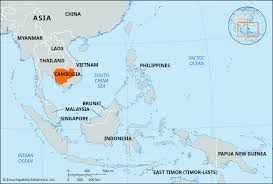
The National Payments Corporation of India has officially partnered with ACLEDA Bank to launch Unified Payments Interface (UPI) acceptance in Cambodia.
- It is located in the southern portion of the Indo China Peninsula in Southeast Asia.
- It is bordered by three countries namely Vietnam (East and southeast) Laos (Northeast) and Thailand (Northwest).
- It is bounded by the Gulf of Thailand to the southwest.
- Capital: Phnom Penh
Geographical Features of Cambodia: - The country is characterised by a tropical savanna climate and monsoons.
- It mainly consists of Dangrek Mountains, Krâvanh and Dâmrei Mountains.
- The highest point in Cambodia is the 1,810 m (5,938 ft) high Phnom Aural.
- Major Rivers: Mekong River
- Lake: Tonlé Sap Lake is a large lake that is connected to the Mekong River.
- It mainly consists of iron ore, copper, and gold.
- World Heritage Sites: Temple of Angkor Wat and Temple of Preah Vihear (It is dedicated to Lord Shiva).
Pennar River : In News
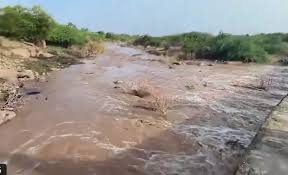
The Pennar River, also known as Penna, Pinakini, or Penneru, is a river in southern India that flows through the states of Karnataka and Andhra Pradesh.
- The name Penna is derived from the Telugu word “Pennu” which means “silt”.
- The river gets its name due to the high amount of silt it carries, which has been instrumental in shaping the land around it.
- The Penna River is also mentioned in ancient Indian literature, including the Ramayana and Mahabharata.
- It originates in the Nandi Hills of Karnataka and flows through the Deccan Plateau before entering Andhra Pradesh.
- The river then flows through the Eastern Ghats, creating several waterfalls and rapids before reaching the flat plains of the coastal region.
- The river finally meets the Bay of Bengal near the town of Nellore.
- It travels approximately 597 kilometers, forming a semi-arid yet agriculturally important river basin.
- The river basin lies in the rain shadow region of the Eastern Ghats.
- The river is seasonal, becoming a torrent after the rains and a thin stream during dry periods.
- The Penna River has several tributaries, most of which are seasonal.
- Major ones include the Chitravati, Papagni, Cheyyeru, and Kunderu rivers.
- The Penna River is crucial to agriculture in parts of Andhra Pradesh, particularly the drought-stricken Rayalaseema region.
- Several irrigation projects, such as the Somasila, Mylavaram, and Gandikota projects, have been constructed to use the river’s waters for farming and drinking purposes.
New Hoverfly Species:
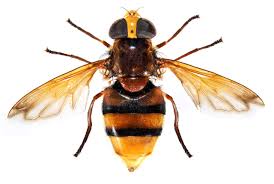
Researchers from the Zoological Survey of India (ZSI) recently discovered two new species of hoverflies named Eristalinus sapphirinus and Eristalinus brunettii from the Gangetic Plains of West Bengal.
- Eristalinus sapphirinus and Eristalinus brunettii are two new species of hoverflies.
- They were discovered from the Gangetic Plains of West Bengal.
- Eristalinus sapphirinus is named for its striking, sapphire-blue metallic coloration.]
- Eristalinus brunettii is named in honour of entomologist Enrico Adelelmo Brunetti, acknowledging his immense historical contributions to the study of Indian Diptera (flies).
- The discovery expands the known diversity of the Eristalinus genus in India, with the last major contribution to the group’s taxonomy dating back to 1923.
- Members of the Eristalinus genus support ecosystems in two distinct life stages.
- As adults, they act as critical pollinators for wild and cultivated plants.
- As larvae (commonly known as “rat-tailed maggots”), they develop in aquatic habitats where they decompose organic matter and recycle essential nutrients.
- Hoverflies, often referred to as flower flies or drone flies, are beneficial insects that appear in large numbers during the spring and summer.
Hellfire Missile:
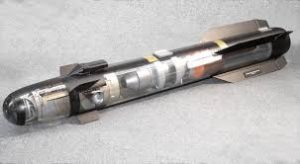
The U.S. military fired a Hellfire missile at a tanker heading toward Iran recently as part of a blockade being imposed by President Donald Trump, who is pressing Tehran to negotiate a peace agreement on his terms.
- AGM-114 Hellfire is a short-range, air-to-ground, subsonic tactical missile.
- Manufactured by Lockheed Martin, the Hellfire originates from the United States and entered service in 1984 as a potent anti-tank weapon.
- It can also be used as an air-to-air weapon against helicopters or slow-moving fixed-wing aircraft.
- The missile is compatible with a wide array of platforms, including attack helicopters (AH-64 Apache), drones (MQ-1 Predator, MQ-9 Reaper), fighter jets, and ground launchers.
- It is currently used by the United States military as well as 30 US allies.
- The Hellfire missile is capable of defeating any known tank in the world today.
- The Hellfire family of missiles consists of 4 generations: the basic (AGM-114A, AGM-114B, AGM-114C) and the Anti-Ship-Missile (AShM) interim (AGM-114F), the Hellfire-2 (AGM-114K, AGM-114M, AGM-114N, AGM-114R), and the Longbow (AGM-114L).
- All Hellfire missiles are similar in shape in that they have a cylindrical body with a dome-shaped nose section that has four small clipped delta stabilising-fins in a cruciform configuration.
- They have a range of 7-11 km while carrying a payload of 8-11 kg.
- The missile flies at subsonic speeds to a maximum of Mach 1.3 (450 m/s).
- It is propelled by a single-stage solid-propellant solid-fuel rocket motor.
- Its guidance options include laser, radar, and imaging infrared (IIR) systems, allowing for both fire-and-forget and semi-active targeting.
- Its warheads are modular, supporting high-explosive anti-tank (HEAT), fragmentation, and thermobaric payloads, making it effective against armored vehicles, bunkers, radar installations, and small naval vessels.
Crotalaria phulei:
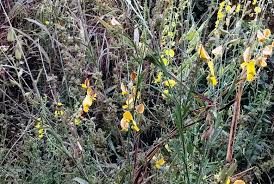
Indian botanists recently identified a previously unknown species of flowering plant named Crotalaria phulei from forests of Nagpur.
- It is a new species of flowering plant.
- It was discovered in the Khairi-Umred forest near Nagpur, Maharashtra.
- It was named in honour of Savitribai Phule, India’s first woman teacher and one of India’s most influential social reformers.
- Belonging to the Fabaceae family, Crotalaria phulei is an undershrub that grows up to 1.5 metres in height.
- It produces pods containing seeds of a distinctive mottled creamy-olive colour, which researchers identified as unique within the genus.
- The species most closely resembles Crotalaria juncea, commonly known as sunhemp, and Crotalaria shrirangiana from the Western Ghats of Maharashtra.
- The species has been assigned a preliminary conservation status of Data Deficient under the IUCN criteria.
Virupaksha Temple:
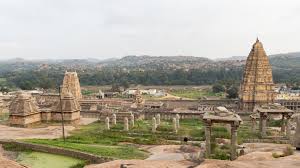
The Archaeological Survey of India (ASI) recently removed the walls built inside the main gopuram of Virupaksha Temple, where a mantapa was converted into an office
- The Virupaksha, also known as the Pampapathi temple, is a Hindu temple dedicated to Lord Virupaksha, a form of Lord Shiva.
- It is located in Hampi, within the Vijayanagara district of Karnataka.
- Situated on the southern bank of the Tungabhadra River, it is part of the Group of Monuments at Hampi, designated as a UNESCO World Heritage Site since 1986.
- Considered the most renowned and significant temple in Hampi, Virupaksha Temple has been operational without interruption since its establishment in the 7th century AD, making it one of the oldest functioning temples in India.
- Initially a modest shrine, it was later expanded during the Chalukyas and Hoysala periods.
- The temple experienced considerable growth and enhancement during the Vijayanagara Empire (14th-16th centuries), evolving into a prominent religious and cultural hub.
- The rulers of Vijayanagara, especially King Deva Raya II and King Krishnadevaraya, played a crucial role in the temple’s expansion, contributing structures such as the eastern gopuram and the central pillared hall.
- The temple is built in the Dravidian architectural style, featuring towering gopurams, detailed carvings, pillared halls, and expansive courtyards.
- The design of the temple includes repeating patterns, showcasing the architectural and mathematical expertise of the era.
- The triangular form of the temple and the manner in which patterns are divided and repeated are particularly remarkable.
- The temple complex includes a sanctum sanctorum, multiple pillared halls (the most elaborate being a hall with 100 pillars), antechambers, and grand gopurams (gateway towers).
- The temple has three prominent gopurams, with the eastern gopuram being the largest, reaching a height of 160 feet and consisting of nine tiers.
- The gopurams are adorned with beautiful sculptures of various Hindu deities.
- The temple’s design incorporates principles of physics, such as the Rectilinear Light Theory and the pinhole camera effect.
- Notably, the temple features an inverted pinhole image of its tower on the inner wall, a remarkable example of ancient engineering.
Valley of Flowers National Park: Opened For Tourist

The Valley of Flowers national park located in Chamoli district of Uttarakhand has been opened to tourists.
- Valley of Flowers National Park is located in the Chamoli district of
- The valley is believed to have been discovered in 1931, when three British mountaineers – led by Frank S. Smythe.
- It is a UNESCO World Heritage Site and forms one of the two core zones (the other being the Nanda Devi National Park) of the Nanda Devi Biosphere Reserve.
- The gentle landscape of the Valley of Flowers National Park complements the rugged mountain wilderness of Nanda Devi National Park.
- Together they encompass a unique transition zone between the Zanskar and Great Himalayan ranges.
- It is famous for its alpine meadows and rich biodiversity.
- It remains covered with a thick blanket of snow during the winter season.
- Exotic flowers (over 600 species) like orchids, poppies, primulas, marigolds, daisies, and anemones are an eye-catching spectacle.
- The valley also abounds in medicinal plants and herbs.
- Sub-alpine forests birch and rhododendron cover parts of the park’s area.
- It is home to such rare and amazing wildlife species like the gray langur, the flying squirrel, the Himalayan weasel, black bear, the red fox, the lime butterfly, and the snow leopard.



