
India’s First Flex-Fuel Passenger Vehicle:
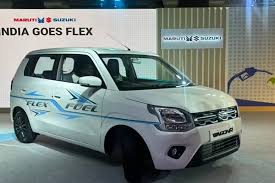
Union Minister for Petroleum and Natural Gas launched India’s first flex-fuel passenger vehicle, developed by Maruti Suzuki, in New Delhi.
- A Flex-Fuel Vehicle (FFV) is an advanced transport solution equipped with an internal combustion engine configured to run seamlessly on a wide range of fuel combinations.
- Unlike traditional petrol engines that tolerate only low-level updates, these vehicles can adapt dynamically to varying mixtures of petrol and ethanol, ranging from E20 (20% ethanol, 80% petrol) all the way up to E100 (100% pure ethanol).
Flex-Fuel Vehicle Works:
- Fluid Ingestion: The driver pumps any approved fuel blend, from standard E20 up to high-concentration E100, into a single, unified fuel tank.
- Real-Time Fuel Sensing: A specialized fuel composition sensor installed in the fuel line continuously analyzes the passing liquid, instantly detecting the exact alcohol-to-gasoline ratio.
- Dynamic ECU Adaptation: The sensor transmits this composition data to the vehicle’s Engine Control Unit (ECU). Because ethanol has a lower energy density but a higher octane rating than standard petrol, the ECU automatically adapts the engine’s settings.
- Combustion Optimization: The ECU instantly adjusts the timing and volume of the fuel injectors and advances or retards the spark plug ignition.
- This continuous tracking ensures smooth, high-efficiency combustion without any knocking or loss of engine power, regardless of the ethanol blend used.



