
The MAVEN Mars Mission:
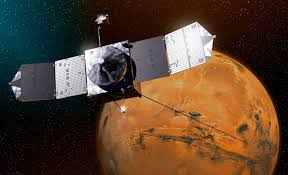
NASA has officially begun the decommissioning process for the MAVEN (Mars Atmosphere and Volatile Evolution) spacecraft after an anomaly review board determined it is unrecoverable.
- MAVEN (Mars Atmosphere and Volatile Evolution) was NASA’s first robotic space probe explicitly devoted to observing the Martian upper atmosphere, ionosphere, and its overall climate evolution.
- Launched in November 2013, the spacecraft successfully completed over 11 years in orbit around the Red Planet, extending a full decade beyond its primary one-year mission timeline.
- The aim of MAVEN was to explore how Mars lost its upper atmosphere and volatile compounds to space over billions of years.
- By measuring current atmospheric erosion rates, the mission sought to give scientists deep insight into the history of the planet’s climate shift from a warm, potentially habitable world with liquid water into today’s cold, arid desert.
Key Features:
- Operated as the only spacecraft at Mars capable of simultaneously taking data measurements of both the incoming solar wind and the immediate Martian atmospheric response.
- Measured atmospheric “sputtering” for the first time at any planet by tracking non-reactive argon gas, revealing in real time how high-speed ions physically blast gas molecules into deep space.
- Discovered multiple types of Martian light shows, proving that proton-driven auroras are not confined to tiny polar pockets like they are on Earth, but can occur across the entire surface of Mars.
- Tracked the 2018 global dust storm to confirm that regional heating lofts water molecules far higher into the atmosphere than normal, triggering a sudden surge of water escaping the planet.
- Designed a specialized campaign utilizing ultraviolet (UV) and multi-wavelength filters to capture high-resolution images of comet 3I/ATLAS, mapping its atomic hydrogen to study its composition.
- Served as an instrumental anchor for NASA’s Mars Relay Network, transmitting communication data from surface rovers to Earth and holding the solar system record for the most data relayed from another planet in a single day.