
Today’s Current Affairs: 5th jun 2026 for UPSC IAS exams, State PSC exams, SSC CGL, State SSC, RRB, Railways, Banking Exam & IBPS, etc
Table of Contents
Navachar Mantra Initiative:
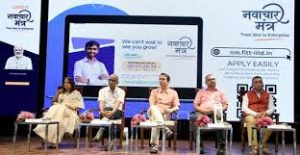
The Union Minister of Skill Development and Entrepreneurship (MSDE) launched Navachar Mantra, a flagship national programme in New Delhi aimed at identifying, mentoring and scaling grassroots innovators.
- Launched by the Ministry of Skill Development and Entrepreneurship (MSDE), Navachar Mantra is a national initiative to identify, nurture, and amplify India’s most promising grassroots innovators and early-stage entrepreneurs.
- The programme creates pathways for innovators from Tier-2 and Tier-3 towns, aspirational districts, and underserved geographies to access mentorship, visibility, and growth opportunities.
- It is executed by the National Institute for Entrepreneurship and Small Business Development (NIESBUD) in partnership with the Foundation for Innovation and Technology Transfer (FITT), IIT Delhi.
- The initiative will support innovations in sectors such as Agritech, HealthTech, EdTech and Skilling, Climate and Sustainability, Rural Commerce and MSME Enablement.
- Selected innovators will join a year-long programme with mentorship, webinars, showcases, investor interactions, and guidance on business development, market access, and scaling strategies.
- The initiative aims to build a strong pipeline of grassroots innovators, support local problem-solving, strengthen India’s startup ecosystem and contribute to an innovation-driven Viksit Bharat.
India–UK Critical Minerals Global Supply Chain Observatory:
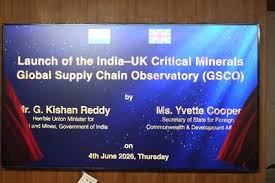
India and the UK launched the India–UK Critical Minerals Global Supply Chain Observatory (GSCO) in New Delhi to strengthen resilient and diversified supply chains for critical minerals essential for clean energy technologies and advanced manufacturing.
- The GSCO is a tripartite joint initiative spearheaded by TEXMiN (Technology Innovation in Exploration & Mining Foundation at IIT-ISM Dhanbad), the Indian Institute of Technology (ISM) Dhanbad, and the University of Cambridge.
- The initiative stems from the India–UK Technology Security Initiative. GSCO was announced during the India–UK Prime Ministers’ bilateral engagement in October 2025 and subsequently formalised through a Research Collaboration Agreement signed in March 2026.
- The GSCO functions as a data-driven digital platform dedicated to monitoring global critical mineral flows, mapping supply risks, anticipating market disruptions, and providing strategic intelligence to policymakers, industry leaders, and researchers.
- Supports the National Critical Mineral Mission (NCMM) by providing data for mineral exploration, processing, and recycling initiatives.
- Reduces supply chain vulnerabilities by helping India monitor and mitigate risks arising from the concentration of critical mineral processing in a few countries, particularly China.
- Facilitates the clean energy transition by ensuring secure access to key minerals such as lithium, cobalt, nickel, and rare earth elements, essential for EVs, battery storage, and renewable energy technologies.
73rd NEC Plenary Meeting:
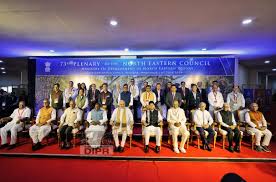
The 73rd Plenary Meeting of the North Eastern Council (NEC) outlined a comprehensive, multi-sectoral development strategy, emphasizing the Ministry of Development of North-East Region (DoNER) transition into a pivotal facilitator for regional growth aligned with the vision of Viksit Bharat 2047.
- Eight High-Level Task Forces, constituted after the 72nd NEC Plenary, submitted action plans on investment promotion, agriculture and horticulture, handicrafts, infrastructure and connectivity, economic corridors, livestock and fisheries, sports, and tourism.
- A proposal has been initiated to establish a High-Level Steering Committee (comprising Union Ministers and relevant Chief Ministers) to strictly monitor the execution of the task force recommendations.
- Grassroots financial penetration has rapidly accelerated with the integration of 6,500 previously unbanked villages, consequently driving the region’s digital payment adoption via UPI to nearly 90%.
- Development of iconic, high-yield geographical circuits is prioritized, specifically highlighting the Matabari Tourism Circuit (Tripura) and the Sohra Tourism Circuit (Meghalaya) to catalyze sustainable local livelihoods.
- Soft diplomacy and scientific temper are being institutionalized through the Ashtalakshmi Darshan Student Exchange Programme and strategic ISRO exposure visits for regional youth.
- Under One State One Product (OSOP) initiative, states are promoting unique products such as Lakadong Turmeric (Meghalaya), Muga Silk (Assam), Kiwi (Arunachal Pradesh), Queen Pineapple (Tripura), and Organic Farming (Sikkim) to strengthen exports and local incomes.
- The Ministry of DoNER is operating under the Three-C framework of Connect, Converge, and Catalyse to accelerate regional policy implementation.
- DoNER’s expenditure increased from around Rs 1,000 crore in 2022-23 to a budget allocation of Rs 6,500 crore for FY 2026-27, reflecting greater focus on North East development.
- The Rising North East Investment Summit generated investment commitments worth Rs 4.5 lakh crore.
North Eastern Council (NEC) - The NEC is a statutory body established under the North Eastern Council Act, 1971, and functions under the administrative control of the MDoNER.
- It serves as the nodal agency for the economic and social development of the North Eastern Region, comprising Arunachal Pradesh, Assam, Manipur, Meghalaya, Mizoram, Nagaland, Sikkim, and Tripura.
- The Council consists of the Governors and Chief Ministers of all eight member states along with three members nominated by the President of India.
- The Union Home Minister serves as the ex-officio Chairman, while the Minister of State (Independent Charge), DoNER acts as the ex-officio Vice-Chairman of the Council.
India Signs BrahMos Missile Deal with Vietnam:
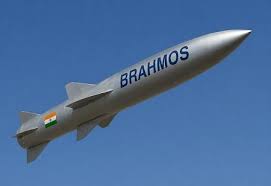
The Defence Secretary said at the Shangri-La Dialogue in Singapore that India has signed a BrahMos missile deal with Vietnam, while a similar agreement with Indonesia is in the final stages following a March 2026 agreement.
- The Philippines was the first foreign buyer, signing a contract worth nearly $375 million in 2022, highlighting India’s export of the missile system in Southeast Asia.\
- India shares advanced defence technologies with countries it regards as friendly partners, including ASEAN nations, emphasizing trust and strategic alignment.
- Several ASEAN members, including the Philippines and Vietnam, have overlapping maritime claims with China in the South China Sea, making BrahMos exports significant for regional defence partnerships.
- Shangri-La Dialogue is an important annual inter-governmental security forum held in Singapore. It brings together defence ministers, military officials and strategic experts to discuss Indo-Pacific and global security issues.
BrahMos Missile:
- The BrahMos missile is a supersonic cruise missile jointly developed by India and Russia, integrating Indian guidance and control systems with Russian propulsion technology for high performance and reliability. Its name is derived from the Brahmaputra and Moskva rivers.
- BrahMos was inducted into the Navy in 2005, the Indian Army in 2007, and first successfully launched from an IAF Sukhoi-30 MKI fighter in 2017.
- It is land, air, sea, and submarine-launched, with multiple versions featuring extended ranges and evolving onboard sensing capabilities, making it versatile across operational domains.
- The missile travels at supersonic speeds of around Mach 2.8–3, enabling rapid engagement of targets.
Mega Science Vision-2035 Report on Climate Research:
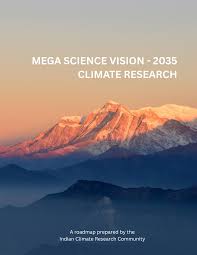
The Mega Science Vision-2035 (MSV) Report on Climate Research raised an alarm that India has significantly lost its ability to build indigenous scientific instruments.
- This has made the country heavily dependent on imported equipment for climate observations, which is often run uncalibrated for years, severely compromising the quality of India’s climate data.
Key Highlights of the Report Climate Research:
- India’s climate science sector has almost entirely lost its domestic instrument-manufacturing capacity.
Consequently, critical environmental data relies on imported equipment. - Because imported instruments are routinely operated without proper calibration for years, it has led to “incorrect data being reported in national and international journals.”
- This is triggering global questions regarding the credibility of Indian scientific output.
- While India is racing toward its Paris Agreement commitment of 500 GW of non-fossil fuel capacity by 2030, the report warns that the long-term climate consequences of massive solar and wind energy installations remain “poorly understood” and require systematic, long-term environmental monitoring.
- An Earth System Model combines oceanic, land surface, and atmospheric data to simulate long-term climate trajectories.
- Currently, Indian models are primarily adapted from the US and Europe. These foreign models are highly sensitive to regional inputs that they were never designed to integrate, making them inadequate for India’s specific climatic conditions.
- The mandatory use of the Government e-Marketplace (GeM) (prioritizes the lowest-bidding India-registered vendors) for procurement created challenges for scientific institutions, as vendors often failed to supply the customized, high-precision equipment required for advanced research.
- While global tenders offered an alternative, they were frequently delayed by lengthy bureaucratic procedures.
- The Finance Ministry in June 2025 relaxed procurement norms, allowing select institutions to procure scientific instruments outside GeM for purchases up to Rs 200 crore.
Funding India’s Climate Future:
India’s ambitious transition toward a low-carbon economy has brought intense focus onto the domestic institutional architecture required to bridge its massive climate-financing deficits.
- Funding India’s climate future refers to the strategic mobilization, allocation, and deployment of large-scale public, private, and blended capital to achieve the nation’s climate objectives.
- This financial architecture is designed to support decarbonization across heavy industries, accelerate the adoption of clean energy, and fund localized climate adaptation projects.
Data and Statistics on India’s Climate Funding:
- The Trillion-Dollar Target: India will require an estimated ₹162.5 trillion (approximately $2.5 trillion) by 2030 to successfully fulfill its Nationally Determined Contributions (NDCs).
- Achieving absolute net-zero emissions by the target year of 2070 will demand a cumulative capital infusion of $10.1 trillion, a figure nearly three times India’s current gross domestic product (GDP).
- The Reserve Bank of India’s (RBI) Report on Currency and Finance estimates that the nation must inject an additional annual investment of at least 2.5% of its GDP purely into green financing until 2030.
- Demonstrating initial momentum, India had successfully issued $55.9 billion in green, social, and sustainability-linked debt by the end of 2024, marking a 186% rise since 2021.
The First Sea Shipment of Botanical-Infused Millets:
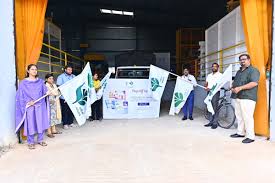
The Agricultural and Processed Food Products Export Development Authority (APEDA) facilitated the first-ever sea shipment of botanical-infused, ready-to-cook millet functional foods from Karnataka to New Zealand.
- Botanical-infused millet functional foods are a new category of value-added, ready-to-cook agricultural products that blend highly nutritious, climate-resilient traditional Indian millets with specialized plant-based botanical extracts.
- Developed and Shipped By: M/s Infini Agrotek LLP, an agri-technology firm based in Bengaluru, Karnataka.
- Facilitating Nodal Agency: Agricultural and Processed Food Products Export Development Authority (APEDA), Ministry of Commerce and Industry, Government of India.
- The primary aim of this initiative is to diversify India’s agricultural export basket by transitioning from raw grain shipments to premium, value-added functional food products.
- It targets international health-and-wellness markets to capture growing global consumer demand for functional, nutrient-dense, and sustainable food options.
- Key Features:
- Combines the natural micronutrient profiles and climate resilience of traditional millets with targeted botanical infusions to offer specialized wellness and functional health benefits.
- Formulated into modern, consumer-friendly, ready-to-cook formats, making traditional Indian grains accessible and easy to prepare for global households.
- The initial export order was directly generated through business match-making at APEDA-supported global trade exhibitions, including World Food India 2025, Indus Food 2025, and Gulfood 2026.
- Deploys a sea-freight transport model to ship processed millet goods, proving that value-added Indian functional foods can successfully handle long-distance maritime cold chains.
- Meets the strict biosecurity, food safety, and quality standards required for compliance in major international markets like New Zealand.
India’s First Flex-Fuel Passenger Vehicle:

Union Minister for Petroleum and Natural Gas launched India’s first flex-fuel passenger vehicle, developed by Maruti Suzuki, in New Delhi.
- A Flex-Fuel Vehicle (FFV) is an advanced transport solution equipped with an internal combustion engine configured to run seamlessly on a wide range of fuel combinations.
- Unlike traditional petrol engines that tolerate only low-level updates, these vehicles can adapt dynamically to varying mixtures of petrol and ethanol, ranging from E20 (20% ethanol, 80% petrol) all the way up to E100 (100% pure ethanol).
Flex-Fuel Vehicle Works:
- Fluid Ingestion: The driver pumps any approved fuel blend, from standard E20 up to high-concentration E100, into a single, unified fuel tank.
- Real-Time Fuel Sensing: A specialized fuel composition sensor installed in the fuel line continuously analyzes the passing liquid, instantly detecting the exact alcohol-to-gasoline ratio.
- Dynamic ECU Adaptation: The sensor transmits this composition data to the vehicle’s Engine Control Unit (ECU). Because ethanol has a lower energy density but a higher octane rating than standard petrol, the ECU automatically adapts the engine’s settings.
- Combustion Optimization: The ECU instantly adjusts the timing and volume of the fuel injectors and advances or retards the spark plug ignition.
- This continuous tracking ensures smooth, high-efficiency combustion without any knocking or loss of engine power, regardless of the ethanol blend used.
The Immigration and Foreigners (Amendment) Rules, 2026:

The Union Ministry of Home Affairs (MHA) officially notified the Immigration and Foreigners (Amendment) Rules, 2026.
- The Immigration and Foreigners (Amendment) Rules, 2026, are a set of updated regulatory modifications enacted by the executive branch to govern the entry, stay, registration, and documentation workflows of foreign nationals within India.
- This amendment acts as a corrective update to Rule 12 of the comprehensive Immigration and Foreigners Rules, 2025, modernizing administrative processes to match changing border security requirements and digital infrastructure.
- The objective of the amended framework is to tighten immigration tracking by eliminating the post-stay grace period previously enjoyed by short-term visa holders.
- By requiring registration before a stay expires and launching a structured, time-bound digital appeals mechanism, the MHA aims to enhance security oversight, prevent illegal overstays, and simplify exceptions for international families and medical institutions.
- Key Features of the Amendment:
- Pre-Expiry Registration Rule: Foreigners seeking stay extension beyond 180 days must register before the 180-day limit, replacing the earlier 14-day grace period.
- TighterMulti-Entry Visa Rules: Long-term visa holders must register before crossing the 180-day stay limit; late approvals will be allowed only in exceptional cases.
- Online Appeals System: Introduces a digital mechanism to appeal immigration-related orders directly to the Bureau of Immigration.
- Time-Bound Appeals: Appeals must be filed within 30 days, and decisions must be issued within 60 days.
- Relief for Mixed-Citizenship Children: Birth reporting requirements are relaxed if one parent is an Indian citizen and the child retains Indian nationality.
- Updated Hospital Reporting Norms: Revises reporting procedures for hospitals and institutions accommodating foreign nationals.
Exoplanet WASP-94A b:

Scientists using NASA’s James Webb Space Telescope (JWST) have mapped weather patterns on the exoplanet WASP-94A b, located nearly 700 light-years from Earth.
- WASP-94A b is a gaseous extra-solar planet located approximately 700 lightyears away from Earth. Its atmospheric dynamics and distinct morning-and-evening weather systems were mapped using the unprecedented infrared sensitivity of the James Webb Space Telescope (JWST).
- It is classified as a “hot Jupiter” gas giant; it is roughly twice the physical size of Jupiter but contains only half of its absolute mass.
- The planet orbits exceptionally close to its parent host star, completing a full revolution in just four days. This extreme proximity leaves the planet tidally locked, synchronizing its rotation with its revolution.
- Because it is tidally locked, one side perennially faces the star as a scorching desert hot enough to melt rock, while the perennially dark nightside drops close to absolute zero.
- The planet features a starkly divided atmosphere. Its mornings are blanketed by heavy clouds composed of magnesium silicate, iron, and magnesium sulphide, whereas its early evenings sport completely clear skies.
- Clouds continuously form on the cooler nightside, are swept rapidly across the globe by ferocious, extremely fast winds, and promptly dissipate/vaporize upon entering the blistering dayside.
- Astronomers isolated the planet’s atmospheric signature from its host star using the transit method. By split-scanning the light at different wavelengths as the planet passed slowly in front of the star, they mapped variations between the morning and evening horizons.
The MAVEN Mars Mission:
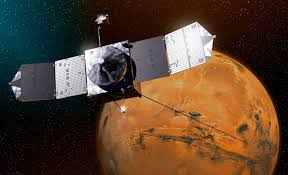
NASA has officially begun the decommissioning process for the MAVEN (Mars Atmosphere and Volatile Evolution) spacecraft after an anomaly review board determined it is unrecoverable.
- MAVEN (Mars Atmosphere and Volatile Evolution) was NASA’s first robotic space probe explicitly devoted to observing the Martian upper atmosphere, ionosphere, and its overall climate evolution.
- Launched in November 2013, the spacecraft successfully completed over 11 years in orbit around the Red Planet, extending a full decade beyond its primary one-year mission timeline.
- The aim of MAVEN was to explore how Mars lost its upper atmosphere and volatile compounds to space over billions of years.
- By measuring current atmospheric erosion rates, the mission sought to give scientists deep insight into the history of the planet’s climate shift from a warm, potentially habitable world with liquid water into today’s cold, arid desert.
Key Features:
- Operated as the only spacecraft at Mars capable of simultaneously taking data measurements of both the incoming solar wind and the immediate Martian atmospheric response.
- Measured atmospheric “sputtering” for the first time at any planet by tracking non-reactive argon gas, revealing in real time how high-speed ions physically blast gas molecules into deep space.
- Discovered multiple types of Martian light shows, proving that proton-driven auroras are not confined to tiny polar pockets like they are on Earth, but can occur across the entire surface of Mars.
- Tracked the 2018 global dust storm to confirm that regional heating lofts water molecules far higher into the atmosphere than normal, triggering a sudden surge of water escaping the planet.
- Designed a specialized campaign utilizing ultraviolet (UV) and multi-wavelength filters to capture high-resolution images of comet 3I/ATLAS, mapping its atomic hydrogen to study its composition.
- Served as an instrumental anchor for NASA’s Mars Relay Network, transmitting communication data from surface rovers to Earth and holding the solar system record for the most data relayed from another planet in a single day.
The MUC1-Targeted Silica Nanocarrier (MPPM):
Scientists from the Agharkar Research Institute (ARI) in Pune have developed an innovative gene-silencing nanomedicine that drives effective tumor inhibition in breast cancer.The nanomedicine is named the MUC1-Targeted Silica Nanocarrier, also structurally designated as MPPM. It is an engineered, biodegradable mesoporous silica nanohybrid platform designed to operate as a vehicle for targeted gene therapy. The system uses customizable surface chemistry to encapsulate and transport genetic material safely into the body.This platform was developed by a team of Indian scientists from the Nanobioscience Group at the Agharkar Research Institute (ARI), Pune.The aim of MPPM is to achieve precise, localized gene silencing within malignant breast cancer cells while minimizing systemic toxicity.By shutting down specific survival pathways that allow tumors to resist conventional treatments, the platform seeks to offer a safer and more effective alternative to traditional chemotherapy.



