
Today’s Current Affairs: 10th jun 2026 for UPSC IAS exams, State PSC exams, SSC CGL, State SSC, RRB, Railways, Banking Exam & IBPS, etc
Table of Contents
Project 18 Programme:

India’s ambitious Project 18 programme is steadily taking shape as what is expected to be one of the most powerful surface combatant projects ever undertaken by the Indian Navy, according to a recent report.
- Project 18 (P-18) Indian Navy’s Next-Generation Destroyer (NGD) programme.
- It is overseen by the Indian Navy’s Warship Design Bureau (WDB) in collaboration with Mazagon Dock Shipbuilders Limited (MDL) and Garden Reach Shipbuilders & Engineers (GRSE).
- Conceived as a successor to the Visakhapatnam-class (P-15B) destroyers, the P-18 class will be a fleet of advanced, multi-role stealth destroyers.
- With an estimated displacement exceeding 13,000 tonnes, the P-18 will rank among the largest destroyers ever operated by the Indian Navy.
- Under international classification, warships above 10,000 tonnes fall into the cruiser category — a segment that India currently does not possess. Project 18 will mark India’s entry into this class of warships.
- They will use an advanced electric propulsion system powered by gas turbines and diesel generators.
- It is also expected to incorporate extensive automation throughout the ship, reducing crew requirements by an estimated 25 to 30 percent compared to existing platforms.
- Each ship will feature 114 vertical launch systems capable of firing a range of India’s homegrown missiles, such as:
- BrahMos and BrahMos Next Generation
- Long-Range Land-Attack Cruise Missiles (LR-LACM)
- Precision-Guided Long-Range Surface-to-Air Missiles (PGLRSAM)
- Short-Range Surface-to-Air Missiles (SRSAM)
- Supersonic Missile-Assisted Release of Torpedo (SMART)
- The ships will be able to carry unmanned underwater vehicles and kamikaze drones, used for surveillance, detecting mines, and attacking submarines.
- Advanced radar systems will give the ships 360-degree awareness and the ability to detect threats up to 500 kilometres away.
Maharaja Chhatrasal:
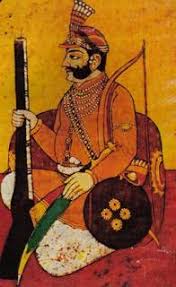
Underway at the Madhya Pradesh Tribal Museum at Shyamal Hills in Bhopal, the second day of Mahua Festival carried a theme steeped in local legend: the life of Maharaja Chhatrasal.
- Maharaja Chhatrasal (4 May 1649 – 19 December 1731) was a medieval Indian warrior who fought against the Mughal Emperor Aurangzeb and established his own kingdom in Bundelkhand.
- He belonged to the Bundela clan of Rajputs, born under Mughal supremacy but died as an independent king of an independent kingdom.
- Maharaja Chhatrasal started a revolt at the age of 22 and formed a kingdom of his own at the age of 26 against Mughal dominance.
- During the first ten years of his revolt, he conquered a large tract of land between Chitrakoot and Panna on the east and Gwalior on the west.
- His victory march continued as far as Malwa, Punjab, Rajasthan, establishing the Bundela kingdom.
- Some of the Mughal generals who were defeated by him were Rohilla Khan, Kaliq, Munawwar Khan, Sadruddin, Sheikh Anwar, Sayyid Latif, Bahlol Khan and Abdus Ahmed.
- In 1729, Chhatrasal sought help from Peshwa Baji Rao I against the Mughal commander Muhammad Khan Bangash.
- Baji Rao I defeated Bangash and helped Chhatrasal retain his kingdom.
- In gratitude, Chhatrasal granted a portion of his territory to the Marathas, strengthening Maratha influence in central India.
- As a sign of appreciation for the Peshwa, Chhatrasal gave his daughter Mastani as a bride to Baji Rao I.
- He was not only a great warrior but an able administrator too; his governance ensured his kingdom would always have a full treasury.
- Highly respected for his sense of honour and love for his people, he was given the title of ‘Maharaja’ by Sant Prannath.
Shiveluch Volcano:
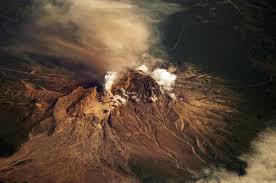
The Shiveluch Volcano in Russia’s Far East erupted recently, sending ash plumes 10 km into the air and triggering red-level aviation alerts for the area.
- Shiveluch Volcano is one of the largest and most active volcanoes located on Russia’s Kamchatka Peninsula, one of the most intense volcanic regions in the world.
- It is a stratovolcano—a steep-sloped volcano composed of alternating layers of solidified ash, hardened lava, and volcanic rocks.
- The summit is truncated by a broad 9-km-wide caldera. The lava dome complex was constructed within the large open caldera.
- Many lava domes occur on the outer flanks.
- Frequent collapses of the dome complex have produced debris avalanches; the resulting deposits cover much of the caldera floor.
Pradhan Mantri Surakshit Matritva Abhiyaan:
The Union Health and Family Welfare Ministry will launch nationwide celebrations to commemorate ten years of successful implementation of the Pradhan Mantri Surakshit Matritva Abhiyan.
- Pradhan Mantri Surakshit Matritva Abhiyaan was launched in 2016 by the Ministry of Health & Family Welfare (MoHFW).
- It aims to ensure early risk detection, timely medical intervention, and safer pregnancies for every woman in India, regardless of where she lives.
- It provides free, comprehensive antenatal care to pregnant women — particularly those in their second and third trimesters — at designated government health facilities on the 9th of every month.
- Minimum one comprehensive and quality antenatal checkup by Obstetrician & Gynaecologist or Comprehensive Emergency Obstetric and Newborn Care (CEmONC).
- Comprehensive Emergency Obstetric and Newborn Care (CEmONC) / Basic Emergency Obstetric and Newborn Care (BEmONC) trained doctor during the second or third trimester.
- Mobilizing the pregnant women for specialist Antenatal care services at designated public health facilities.
- High Risk Pregnancy (HRP) identification by screening for 25 high risk factors and management at an early stage.
- Linking of HRPs to the nearest first referral unit (FRU) for a safe delivery.
- Empanelment of private service providers for PMSMA service provision.
- High-risk pregnancy cases receive priority attention and follow-up care.
- Women who are dropouts from regular antenatal care are actively encouraged to participate.
Aurora Borealis:

Aurora Borealis more popularly called ‘northern lights’ was expected to be visible in India.
- It is popularly called as ‘northern lights’.
- The phenomenon is called ‘northern lights’ because they are concentrated around the North Pole or the magnetic pole in Earth’s northern hemisphere.
- They are frequently seen in Norway, Sweden, Finland, Iceland, Canada, Alaska, and Greenland.
- Aurora Borealis’ is the scientific name for these lights in the night sky in the northern hemisphere.
- The ones in the southern hemisphere are called ‘Aurora Australis’ or ‘southern lights.’
- Formation of Auroras:
- It is due to activity on the surface of the Sun.
- The star continuously releases a stream of charged particles, mainly electrons and protons, and magnetic fields called the solar wind.
- As the solar wind approaches the Earth, it is deflected by the planet’s magnetic field, which acts like a protective shield.
- However, some of the charged particles are trapped in the magnetic field and they travel down the magnetic field lines at the north and south poles into the upper atmosphere of the Earth.
- These particles then interact with different gases present there, resulting in tiny flashes that light up the night sky.
- When solar wind particles collide with oxygen, a green colour light is produced. Interaction with nitrogen produces shades of blue and purple.
- Auroras expand to midlatitudes when the solar wind is extremely strong.
- This happens when the activity on the Sun’s surface goes up, leading to solar flares and coronal mass ejections (CMEs), which are essentially extra bursts of energy in the solar wind.
- In such cases, the solar wind is so intense that it can result in a geomagnetic storm, also known as a magnetic storm — a temporary disturbance of the Earth’s magnetic field.
Bovista colorata:

Researchers recently documented a rare bright yellow puffball mushroom named Bovista colorata in Arunachal Pradesh’s Longding district.
- Bovista colorata, commonly known as the yellow puffball mushroom, is a species of puffball fungus belonging to the family Agaricaceae.
- It is generally found in grasslands, open fields, meadows, and disturbed soils.
- Bovista colorata has a spherical shape and striking yellow fruiting body.
- Unlike conventional mushrooms that produce spores through gills beneath a cap, puffball fungi develop spores inside a closed spherical fruiting body.
- As the mushroom matures, the internal tissue transforms into a fine powdery mass of spores, which are dispersed through wind, raindrops, or physical disturbance, allowing the species to spread over considerable distances.
- Puffball species play an important ecological role as decomposers, aiding nutrient recycling, carbon cycling and soil formation.
- Some species are also known for their nutritional value and bioactive compounds with potential medicinal properties.
Zojila Tunnel : Closer To Completion
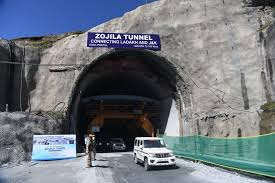
The strategic Zojila Tunnel between Kashmir and Kargil moved closer to completion with its final breakthrough, marking a major milestone in all-weather connectivity to Ladakh.
- The Zojila Tunnel is a high-altitude road tunnel connecting Jammu & Kashmir with Ladakh and is expected to provide all-weather connectivity between Kashmir, Kargil and Ladakh. It is located near Zojila Pass, which connects the Kashmir Valley with Drass, Kargil and Ladakh.
- It is around 13.14 km to 14.15 km long and is projected to be among the world’s longest single-tube, bi-directional road tunnels at an altitude of about 11,578 feet.
- The existing Kashmir-Ladakh highway remains closed for nearly five to six months in winter due to heavy snowfall, avalanches and landslides, cutting off Ladakh and restricting civilian and military movement.
- Zojila is one of three key corridors to Ladakh, along with the Rohtang route through Himachal Pradesh and the Shinku La tunnel route connecting Himachal with Ladakh’s Zanskar Valley.
- The tunnel will enhance the movement of military vehicles and logistics to forward areas, especially during emergencies along the Line of Control (LoC) and Line of Actual Control (LAC).
- During the 1999 Kargil War, the Kashmir–Kargil highway became vulnerable to Pakistani shelling, creating difficulties in transporting troops and material.
42nd Anniversary of Operation Bluestar:
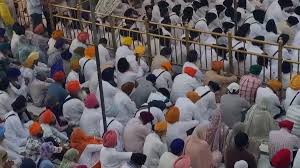
Pro-Khalistan slogans were raised inside the Golden Temple complex in Amritsar during the 42nd anniversary of Operation Bluestar.
- Operation Bluestar was carried out by the Indian Army in June 1984 at the Golden Temple complex in Amritsar to remove armed militants led by Jarnail Singh Bhindranwale, amid the rise of the Khalistan separatist movement.
- The Khalistan demand emerged after Partition, when Punjab was divided and many culturally and religiously significant Sikh sites, including Lahore and Nankana Sahib, went to Pakistan, creating a sense of political and historical grievance among sections of Sikhs.
- Discontent over issues such as river water sharing, demands for greater autonomy, and alleged support from Pakistan helped intensify separatist sentiments, while the reorganisation of Punjab in 1966 did not fully resolve these tensions.
- Jarnail Singh Bhindranwale emerged as a powerful religious-political figure who gained support among sections of Sikh youth, used aggressive rhetoric, and later moved into the Akal Takht inside the Golden Temple complex to evade arrest.
- The operation began after curfew, communication restrictions and media censorship were imposed in Punjab; the Army entered the Golden Temple complex on the night of 5th June 1984.
- The Army first tried to neutralise militant defensive positions, but heavy resistance from inside the complex led to the use of Vijayanta tanks against the Akal Takht, where Bhindranwale and his strongest defences were located.
- Bhindranwale was found dead inside the damaged Akal Takht, and by 10th June the remaining militants had either surrendered or been killed.
- It deeply hurt Sikh sentiments and had major political and social consequences. Later in 1984, Prime Minister Indira Gandhi was assassinated by her Sikh bodyguards, followed by anti-Sikh riots in several parts of India.
Additional Judges as Permanent Judges:
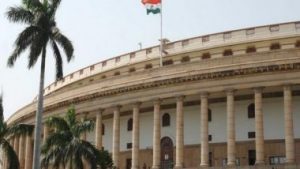
The President of India appointed six Additional Judges as Permanent Judges of the Bombay High Court.
- Article 224 provides for the appointment of Additional Judges in High Courts. They may be appointed when there is a temporary increase in the work of the High Court or arrears of pending cases.
- An Additional Judge can serve for a maximum period of two years and cannot continue in office after attaining the age of 62 years.
- A High Court (HC) judge is appointed by the President under Article 217 of the Constitution. The Chief Justice is appointed by the President after consultation with the Chief Justice of India and the Governor of the state concerned.
- For the appointment of other judges, the Chief Justice of the concerned High Court is also consulted. In case of a common High Court for two or more states, the governors of all the states concerned are consulted by the President.
The Gallantry Awards:
President Droupadi Murmu presented 51 Gallantry Awards during Phase-I of the Defence Investiture Ceremony at Rashtrapati Bhavan.Among the Kirti Chakra recipients was Indian astronaut-designate and Indian Air Force officer Air CommodorePrasanth Balakrishnan Nair, call sign Papa, one of the four selected Gagannauts for India’s first human spaceflight mission Gaganyaan.Gallantry Awards are the highest state decorations instituted by the Government of India to honor personnel of the Armed Forces, Central Armed Police Forces (CAPF), and State/UT Police forces. They recognize acts of raw courage, unparalleled bravery, and supreme self-sacrifice rendered in the line of duty.
2026 Phase-I Investiture Statistics:
During the June 2026 ceremony, a total of 51 medals were pinned by the President, including several posthumous honors for supreme sacrifice:
Kirti Chakra: 07 awarded (5 to living personnel, 2 posthumously)
Vir Chakra: 15 awarded (12 to living personnel, 3 posthumously)
Shaurya Chakra: 29 awarded (28 to living personnel, 1 posthumously)
Bonn Climate Conference 2026:

At the Bonn Climate Conference 2026 (SB64), health advocacy groups led by the Global Climate and Health Alliance (GCHA) urged developed countries to triple public adaptation finance to $120 billion annually by 2035.
- The Bonn Climate Conference refers to the annual mid-year climate negotiations held under the United Nations Framework Convention on Climate Change (UNFCCC).
- Officially known as the 64th Sessions of the Subsidiary Bodies (SB64), it serves as a technical and preparatory meeting ahead of the annual COP summit.
- The 2026 conference is being held in Bonn, Germany
- Aim:
- To advance implementation of commitments made under the Paris Agreement and previous COP decisions.
- To facilitate negotiations on adaptation, mitigation, climate finance, loss and damage, and just transition.
Key Outcomes:
- Health groups called for increasing public grant-based adaptation finance from the COP26 target of $40 billion to $120 billion annually by 2035.
Fossil Fuel Transition - Developed countries were urged to publish national roadmaps for transitioning away from fossil fuels.
- Discussions stressed alignment with the 1.5°Cglobal warming pathway.
- Technical discussions began on operationalizing the 59 Belém Adaptation Indicators adopted at COP30.
- Deliberations continued under the Sharm el-Sheikh Joint Work on Agriculture and Food Security to improve climate resilience in agriculture.
- Discussions focused on operationalizing the new Just Transition Mechanism agreed at COP30 to support capacity building and technical cooperation.
NZP Saathi App:
Union Minister of State for Environment, Forest and Climate Change officially launched the NZP Saathi App and inaugurated advanced self-ticketing kiosks at the National Zoological Park (NZP) in New Delhi.The NZP Saathi App is a high-tech, interactive digital zoo guide and navigation mobile application. It transforms traditional paper-map zoo visits into a smart, GPS-assisted educational experience, acting as a virtual companion for anyone exploring the wildlife sanctuary.The application was designed, deployed, and managed under the direct authority of the National Zoological Park, New Delhi.The objective of the application is to drive a comprehensive digital transformation at the national zoo.
By integrating real-time routing technologies and curated audio-visual itineraries, it aims to eliminate visitor confusion, decrease structural crowd bottlenecks, and deepen public awareness regarding wildlife conservation and animal habitats.



