
India-Estonia Relations:
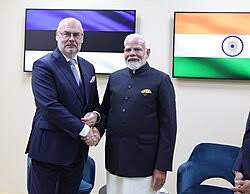
Estonian government officials and tech industry executives have expressed a strong desire to expand cooperation with India across critical sectors, particularly defence, cybersecurity, trade, and artificial intelligence (AI).
- India-Estonia Relations: India first recognized Estonia in 1921 when it joined the League of Nations.
- Following the dissolution of the Soviet Union, India re-recognized the Republic of Estonia in September 1991.
- In 2024, the two nations held the inaugural India-Estonia Cyber Dialogue, acknowledging Estonia’s status as a world leader in IT and digital governance, and India’s massive scale in rolling out Digital Public Infrastructure.
- Bilateral trade between India and Estonia stood at 139.3 million euros in goods and 66.4 million euros in services in 2025.
- As of December 2025, Indian FDI in Estonia amounted to 13.6 million euros, while Estonian FDI in India totalled 4.15 million euros during the period 2000–2025.
Estonia:
- Geographical Location: Estonia is a country located in northeastern Europe and is the northernmost of the three Baltic states (alongside Latvia and Lithuania).
- It shares land borders with Russia in the east and Latvia in the south.
- The country is bounded by the Gulf of Finland in the north, the Baltic Sea in the west, and Lake Peipus in the east. It also shares maritime borders with Finland and Sweden.
- Estonia’s territory encompasses around 1,500 islands and islets. The two largest islands, Saaremaa and Hiiumaa, are located off the mainland’s western coast.
- The highest point in the country is Suur Munamägi (318m). Its major rivers include the Narva, Pärnu, Pedja, and Kasari.
- The capital and largest city is Tallinn and it functions as a parliamentary republic.
- After being ruled by various powers including Denmark, Sweden, and the Russian Empire, Estonia saw its first period of independence in 1918. It was forcibly incorporated into the USSR in 1940.
- It remained a Soviet constituent republic until 1991, when it successfully declared its independence during the collapse of the Soviet Union.
- Following its transition to a parliamentary democracy and market economy, the country integrated with major Western institutions, becoming a full member of the European Union, the Eurozone, North Atlantic Treaty Organization, and the Nordic-Baltic Eight (NB8).



