
GRAPES-3 Telescope:
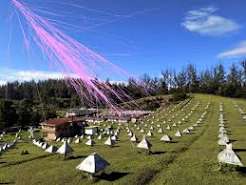
Researchers from Mumbai, Kochi, and Japan used the GRAPES-3 telescope to track how the Earth’s upper atmosphere temperature and the Sun’s magnetic field affect muons — subatomic particles from space.
- Gamma Ray Astronomy PeV EnergieS phase-3 (GRAPES-3) is designed to study the origin, acceleration and propagation of cosmic rays through measurement of extensive air showers.
- It is induced by primary cosmic rays or gamma rays entering the Earth’s atmosphere in tera to peta electronvolt energies.
- It also studies solar and thunderstorm phenomena using cosmic ray muons.
- GRAPES-3 employs an array of plastic scintillator detectors and a large area muon detector based on proportional counters.
- It is located in Ooty, India.
- It is operated by the Tata Institute of Fundamental Research.
- Cosmic Rays were discovered more than a century ago.
- They are considered to be the most energetic particles in the universe.
- Our planet is constantly bombarded by them from outer space, almost uniformly from all directions at a constant rate.
- They enter Earth’s atmosphere and induce a shower of particles that travel to the ground almost at the speed of light.
- The shower particles constitute electrons, photons, muons, protons, neutrons, etc.
- They have been observed over a remarkably wide energy range (108 to 1020 eV).



