
Three-Language Formula and Nagaland’s Linguistic Challenge:
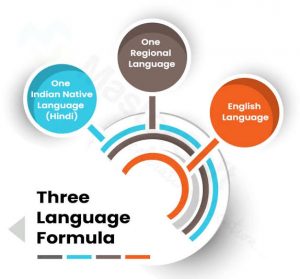
The Association of Unaided CBSE Schools in Nagaland has expressed concerns over the Central Board of Secondary Education’s (CBSE) mandate to implement the Three-Language Formula under National Education Policy (NEP) 2020.
- The association has termed the policy “not viable” for the state due to its unique linguistic demographic and severe resource constraints.
- Nagaland has no single common regional language, with 17 major tribes speaking distinct languages. English serves as the official language and medium of instruction, while none of the state’s tribal languages is included in the Eighth Schedule.
- Additionally, a lack of trained teachers, textbooks, and standardized curricula makes implementation difficult, especially in linguistically diverse classrooms.
- The Three-Language Formula was first formulated by the Ministry of Education in 1968 based on the recommendations of the Kothari Commission (1964-66).
- NEP, 1968 emphasised study of Hindi, English and a modern Indian language (preferably one of the southern languages) in Hindi-speaking States and Hindi, English and a regional language in non-Hindi speaking States.
- Three-Language Formula under NEP 2020: The National Education Policy (NEP) 2020 requires students to learn three languages. This policy is designed to promote multilingualism while respecting India’s cultural and regional diversity.
- At least two of the three chosen languages must be native Indian languages.
- Unlike the NEP of 1968, which rigidly mandated Hindi, English, and a regional language, the NEP 2020 allows for flexibility in language selection. States, regions, and students have the autonomy to choose the languages they wish to study.
- A foreign language can only be taken as the third language (R3) if the other two are native Indian languages. Alternatively, a foreign language can be taken as an optional fourth language.
- Under the National Curriculum Framework for School Education (NCF-SE), CBSE proposed that students study three languages up to Class 10, with at least two being native Indian languages.
- Schools facing shortages of qualified native language teachers can use existing staff who have “functional proficiency” in the language as an interim measure.
- Schools are encouraged to use flexible solutions like inter-school sharing (Sahodaya clusters), hybrid/virtual teaching, or hiring retired teachers.



