
Euclid Space Telescope:
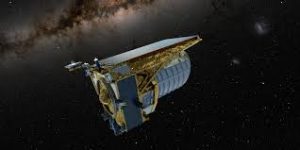
The Euclid space telescope has delivered one of the most detailed views ever captured of Milky way galaxy’s crowded heart and revealed more than 60 million stars in a single extraordinary image.
- Euclid Space Telescope is a 1.2-metre telescope launched in 2023 by the European Space Agency.
- It is designed to map large spatial structures, like galaxies, in our universe and help reconstruct how the universe expanded and how galaxy structures are shaped the way they appear today.
- It is designed to explore the composition and evolution of the dark Universe.
- The space telescope will create a great map of the large-scale structure of the Universe across space and time by observing billions of galaxies out to 10 billion light-years.
- It explores how the Universe has expanded and how structure has formed over cosmic history, revealing more about the role of gravity and the nature of dark energy and dark matter.
- It has two scientific payloads: Near-Infrared Spectrometer and Photometer (NISP) and Visible Imager (VIS).
- Visible-Wavelength Camera (VISible Instrument – VIS):
- It captures high-resolution images of galaxies.
- Helps detect tiny distortions in galaxy shapes caused by gravitational lensing—a method used to study dark matter.
- Near-Infrared Spectrometer and Photometer (NISP):
- It measures how fast galaxies are moving apart, providing insight into the influence of dark energy over time.
- Developed with NASA’s contribution, including sensor-chip electronics and detectors.



