
Today’s Current Affairs: 7th jul 2026 for UPSC IAS exams, State PSC exams, SSC CGL, State SSC, RRB, Railways, Banking Exam & IBPS, etc
Table of Contents
Ulhas River:
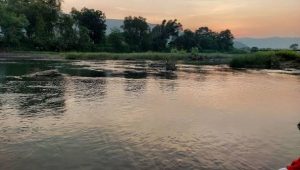
The Ulhas river recently crossed the warning level at Mohane and Jambhulpada following continuous heavy rainfall, prompting the district administration to issue an alert for residents living close to the banks.
- It is a prominent west-flowing river located entirely within Maharashtra.
- Originating from the Sahyadri hill ranges in the Raigad district, the river travels westward and eventually drains into the Arabian Sea near Vasai Creek, north of Mumbai.
- The river basin is bounded by the main Sahyadri hill range on the east, its offshoots to the north and south, and opens narrowly to the Arabian Sea in the west.
- It passes through cities such as Kalyan, Thane, and Navi Mumbai.
- Along its route, the Ulhas River forms several distributaries and creeks, which are vital for irrigation, drinking water supply, and local ecosystems.
- Important Tributaries: Pej, Barvi, Bhivapuri, Murbari, Kalu, Shari, Bhatsa, Salpe, Poshir, and Shilar.
- Major Dams: Barvi Dam and Bhatsa Dam.
- The estuary of Ulhas houses several historical ports of Kalyan, Kopri, and Shurparaka.
National Highways Logistics Management Limited:

The Union Minister for Road Transport and Highways recently reviewed the progress of key infrastructure projects being implemented by the National Highways Logistics Management Limited (NHLML).
- NHLML, (formerly known as Cochin Port Road Company Limited), is a 100% owned company of the National Highways Authority of India (NHAI) formed under the guidance of the Ministry of Road Transport and Highways (MoRTH).
- NHLML is responsible for spearheading pivotal initiatives aimed at improving transport logistics, infrastructure, and asset monetization.
- It is at the forefront of transformative projects across the country in various domains. These include
- The development of Multimodal Logistics Parks (MMLPs)
- Construction of ropeways
- Deployment of Optical Fibre Cable networks
- Establishment of Wayside Amenities
- Facilitation of port connectivity roads
- Creation of warehousing zones
- Enhancement of passenger transport terminal infrastructure
- Deployment of solarization on highways
- Development of other allied infrastructure facilities.
Indiahandmade:

India’s traditional handloom and handicraft sector is finding a stronger foothold in the digital economy through Indiahandmade.
- Indiahandmade is a government-backed dedicated digital marketplace that brings India’s handloom and handicraft traditions into the online economy.
- Developed by the Digital India Corporation for the Ministry of Textiles and launched in 2023, it showcases some of the world’s oldest and most traditional crafts of India.
- The main motive behind this online eCommerce portal is to provide a platform for Indian handloom weavers and handicraft artisans to sell their traditional products online, paving the way for their financial and social empowerment.
- Salient Features:
- The platform enables artisans and weavers to sell their products directly to consumers, reducing dependence on intermediaries and improving opportunities for fair compensation.
- It also equips sellers with digital tools and greater online visibility, allowing them to participate more effectively in e-commerce.
- The marketplace showcases an extensive range of handmade products spanning apparel, home décor, furnishings, paintings, furniture, religious items, stationery, musical instruments, jewellery, bags, and footwear.
- Alongside everyday handmade products, the platform gives prominence to region-specific crafts through dedicated sections for GI-tagged and ODOP products.
- Buyers benefit from free shipping, secure payment systems, purchase protection, and buyer support mechanisms.
- For artisans and weavers, the platform offers a guided onboarding process to simplify participation in digital commerce.
- Aimed at making online selling more inclusive, artisans who do not have GST registration can register using an Enrolment ID, although they are permitted to sell only within their own state.
- This provision enables smaller artisans and first-time digital sellers to access online markets with fewer barriers.
- The platform also highlights the stories of artisan enterprises that continue to preserve India’s traditional crafts through digital commerce.
Chief Labour Commissioner:
The Chief Labour Commissioner (Central) Organisation continues to strengthen labour welfare and industrial harmony across the country through sustained awareness programmes, effective grievance redressal mechanisms, and timely conciliation efforts.
- The organization of the Chief Labour Commissioner (Central), also known as the Central Industrial Relations Machinery, is an apex organization in the country responsible for maintaining harmonious industrial relations mainly in the sphere of central Government.
- It is under the aegis of the Ministry of Labour & Employment, Government of India.
- Headquarters: New Delhi
- In pursuance of the recommendation of the Royal Commission on Labour in India, the organization was set up in April 1945 by combining the former organizations of the conciliation Officer (Railways), Supervisor of Railway Labour and the Labour Welfare Advisor.
- It was then charged mainly with duties of prevention and settlement of industrial disputes, enforcement of labour laws, and to promote welfare of workers in the industrial establishments falling within the sphere of the Central Government.
- It started with a small complement of staff comprising a Chief Labour Commissioner (C) at New Delhi, 3 Regional Labour Commissioners at Bombay, Kolkata & Lahore, 8 Conciliation Officers, and 18 Labour Inspectors.
- The Conciliation Officers and Labour Inspectors were redesignated as Assistant Labour Commissioner (C) and Labour Enforcement Officer (C).
- The organization was further augmented gradually by establishing regional offices at various places across India.
- The Organisation of Chief Labour Commissioner (Central) is entrusted with the following functions.
- Prevention and settlement of industrial disputes through conciliation/mediation.
- Enforcement of labour laws and rules made there under the Central Sphere.
- Quasi-Judicial functions
- Verification of trade union membership
- Miscellaneous functions.
Global Passport Index: Report
India’s ranking in the Global Passport Index (GPI) has slipped to 125th spot, one rank drop from last year.
Key Highlights of Global Passport Index 2026:
- The strongest passports of this year’s index are: Sweden, Switzerland, Finland, Germany, Denmark (joint) and Netherlands (joint).
- Global Passport Index ranks passports not only on the ease of international travel but also on the benefits they offer for living, working and investing in other countries.
- It is a comprehensive passport ranking that goes beyond measuring the number of countries passport holders can travel to without a visa.
- It is published by residency and citizenship advisory firm Global Citizen Solutions (GCS).
- It measures passports across three key categories: Enhanced Mobility (50 per cent), Investment (25 per cent) and Quality of Living (25 per cent). These are based on 14 separate indicators.
- It draws on quantitative data from various international institutions and multilateral organisations such as the World Bank, the World Economic Forum and the Sustainable Development Report
Mahabodhi Temple:
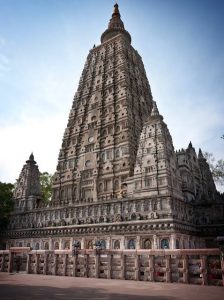
The Mahabodhi Temple received donations worth nearly Rs 2 crore in a six-day census of donation boxes, including Rs 1.5 crore from Indian and Rs 50 lakh from foreign countries.
- Mahabodhi Temple is an ancient Buddhist temple located in Bodh Gaya, Bihar, on the banks of the Niranjana River.
- It is one of the four most sacred sites of Buddhism, marking the location where Buddha attained Enlightenment (Bodhi), along with:
- Lumbini (Buddha’s birthplace)
- Sarnath (Buddha’s first sermon)
- Kushinagar (Buddha’s parinirvana)
- The original temple was constructed by the Mauryan emperor Ashoka in the 3rd century BC.
- The present structure is estimated to have been erected between 5th and 6th century AD during the Gupta Period.
- The temple was heavily restored in the 19th century by Myanmar (Burmese) Buddhists and then by the British archaeologist Sir Alexander Cunningham.
- It was recognized as a UNESCO World Heritage site in 2002.
- It is constructed of brick and is one of the oldest brick structures to have survived in India.
- Its pyramidal shikhara (tower) comprises several layers of niches, arch motifs, and fine engravings.
- Four additional towers, each identical to the main tower but smaller in size, adorn the corners of the two-story structure.
- A shrine inside the temple holds a yellow sandstone statue of the Buddha encased in glass.
- In 2013, the upper portion of the temple was covered with gold, as a gift from the King and devotees of Thailand.
- A descendant of the Bodhi tree under which the Buddha is said to have sat until he attained enlightenment stands adjacent to the temple.
- Vajrasana (Diamond Throne): A stone slab marking the exact spot where Buddha meditated and attained enlightenment, originally installed by Emperor Asoka.
- Stone railings surround the temple as well as the Bodhi tree.
- One of the most famous of Ashoka’s many pillars (on which he had engraved his proclamations and his understanding of religious doctrine) stands at the southeast corner of the temple.
Changpa Community:
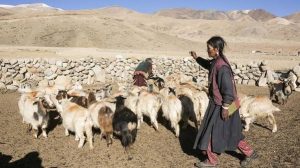
The Ladakh lieutenant governor has taken decisions for improving the livelihoods of indigenous Changpa pastoral communities.
- The Changpas are a semi-nomadic people found mainly in the Changthang region of the Trans-Himalayas of the Indian subcontinent.
- They are nomads who have been shepherding their world-class pashmina goats (or cashmere goats) for centuries.
- The Changpa are a semi-nomadic Tibetan pastoral community inhabiting the high-altitude Changthang plateau of Ladakh, India, and western Tibet
- They were granted official status in India as a scheduled tribe.
- They can be identified by their conical yak-skin tents called reboo.
- Each reboo invariably accommodates the family deity, and a picture of their spiritual head, in most cases, the Dalai Lama.
- The Changpa who live nomadic lives are known as Phalpa and those who have settled down in fixed locations are called Fangpa.
- One of the main purifying rituals of the Changpas is known as Jyabten where they make different kinds of food as an offering to Lord Padmasambhav. Another festival is Tangpe Chona (15th day of the first month of the lunar calendar).
Bandipur Tiger Reserve: In News

A team of Forest department personnel recently rescued a 12-year-old female Tigress and her five cubs along a thick canal on the fringes of Nugu forest range of the Bandipur Tiger Reserve in Mysuru.
- Bandipur Tiger Reserve is situated in the Mysore and Chamarajanagar revenue districts of southern Karnataka.
- It is located at the tri-junction area of the States of Karnataka, Tamil Nadu, and Kerala.
- It is an “ecological confluence” of the Western and Eastern Ghats.
- It was once a hunting ground for the rulers of the neighbouring kingdom of Mysore.
- It is part of the larger Nilgiri Biosphere Reserve, which is recognized as a UNESCO World Heritage Site.
- BTR is surrounded by:
- Nagarahole Tiger Reserve (Tamil Nadu) in the North West (Kabini Reservoir separates the two).
- Mudumalai Tiger Reserve (Tamil Nadu) in the South.
- Wayanad Wildlife Sanctuary (Kerala) in the South West.
- It is surrounded by River Kabini in its north and River Moyar in its south.
- The Nugu River runs through the reserve.
- Himavad Gopalaswamy Betta Hill is the highest point in the park.
- It has a typical tropical climate with distinct wet and dry seasons.
- The park has various biomes, including dry deciduous forests, moist deciduous forests, and shrublands.
- It supports a wide range of timber trees, including teak wood, rosewood, sandalwood, and a variety of bamboo.
- There are also several notable flowering and fruiting trees and shrubs including Indian gooseberry, kadam tree, golden shower tree.
- It is home to mammals such as the Bengal tiger, gaur, sloth bear, golden jackal, dhole, four-horned antelope, etc.
- It is a shelter for the largest population of wild Asian elephants in South Asia.
- It is home to over 200 species of birds, among which the Indian peafowl is the most commonly spotted
Eurasian Lynx:

The elusive Eurasian lynx has been photographed for the first time in Sikkim
- The Eurasian lynx (Lynx lynx) is a medium-sized wild cat.
- It lives in a wide range from Western Europe to Russia and Central Asia.
- They live in temperate broadleaf boreal or mixed forests with lots of undergrowth for cover.
- These animals also inhabit the Himalayas’ northern slopes, the alpine tundra, mountains in the central Asian desert area, and all of the Tibetan Plateau.
- They can live in rocky areas, brushy spaces, and open forests.
- The Eurasian Lynx is an elusive, solitary and territorial animal
- Typically crepuscular or nocturnal, Eurasian lynxes are mainly active at dawn and dusk
- They are good climbers and sometimes lie in trees and high rocks.
- They are strictly carnivorous.
- Habitat loss as a result of deforestation, loss of prey due to illegal hunting, and game hunting
- Conservation Status:
- IUCN: Least Concern.
Sirsa Kinnow:

Sirsa’s kinnow recently received its Geographical Indication (GI) tag, with the Registry in Chennai sealing the certificate of registration.
- Sirsa Kinnow is a variety of Kinnow grown in the Sirsa district of Haryana.
- It is Haryana’s first fruit to receive a Geographical Indication (GI) tag.
- Kinnow is a hybrid citrus fruit.
- It is a hybrid between two citrus cultivars, namely ‘King’ (Citrus nobilis) and ‘Willow Leaf’ mandarin (Citrus deliciosa).
- The hybrid was developed in 1915 by HB Frost at the University of California Citrus Experimentation Station.
- It is round, large, and has golden-orange skin similar to an orange.
- It has a sweet and sour taste.
- It comprises a high amount of juice content, making it ideal for extracting juice and pulp.
- It is a rich source of Vitamin C and minerals like calcium and potassium, which are beneficial for health.
- It contains 0.2 to 0.3% pectin, which is anti-cancerous and also helps in lowering cholesterol.
- The peel of the Kinnow fruit contains oil which is used in cosmetics.
- It is a largely cultivated fruit of North India, and Punjab holds the major share of the Kinnow-producing area of the country, with other states including Rajasthan, Haryana, Madhya Pradesh, Himachal Pradesh, Jammu, and Kashmir.
- It is popularly known as the “king of fruits” in Punjab.
- It has the ability to withstand soaring temperatures as high as 40°C during summer and 0°C during winter.
Doctrine of Per Incuriam:

The Supreme Court recently clarified the circumstances under which a judicial decision can be declared per incuriam—a legal doctrine that allows courts to disregard a precedent rendered in ignorance of binding law or an earlier authoritative judgment.
- The term “per incuriam,” meaning ‘through lack of care,’ refers to judgements passed without reference to, or in ignorance of, a statute or an earlier judgement/precedent which would have beenrelevant and therefore affected the result of the case.
- As per legal principles, these judgements, which are decided based on incorrect interpretations of the law, may cause legal and practical issues.
- Therefore, they are not treated as binding precedent, and the courts often take steps to correct them.
- Since per incuriam decisions involve precedent, the doctrine bears a direct relation to the doctrine of “stare decisis” which translates to, ‘‘let the decision stand’’ or ‘‘to stand by that which is decided’’, and gives binding force to decisions of the courts.
- The doctrine is an exception to Article 141 of the Constitution of India, which embodies the precedents as a matter of law. However, this principle is applied only in exceptional cases.
- The present doctrine is strictly and rightly applicable to the maxim ratio decidendi, which is the point that determines the judgement and is binding in nature, and not to the obiter dicta i.e., a remark made during the course of the discussion having persuasive value.
- In the State of Assam v. Ripa Sarma, it was held that when a judgement is pronounced in such a manner that is ignorant of earlier judgments of the court by either similar or larger benches, it would be per incuriam.
- The Court held that a judgement may be treated as per incuriam when its ratio is irreconcilable with an earlier decision rendered by a bench of equal or larger strength or when a relevant statutory provision, rule, or regulation was not brought to the Court’s attention.
- It is not the numerical strength of judges taking a particular view that is relevant, but it is instead the strength of the bench, which is the determinative factor of the binding nature of a particular view.
- The doctrine applies only to the binding reasoning (ratio decidendi) of a judgement and not to its observations (obiter dicta).
- The judicial discipline requires a bench of co-equal strength that disagrees with an earlier decision to refer the matter to a larger bench rather than take a contrary view.
- It also reiterated that a decision of a larger bench is binding on subsequent benches of equal or lesser strength.
- The Court clarified that a judgement cannot be declared per incuriam merely because it reached an incorrect conclusion after considering an earlier precedent or because an alternative interpretation may suggest a conflict with prior decisions.
Sub-Orbital Launch Vehicle for Experiment:
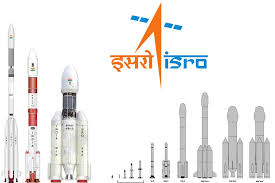
The Indian Space Research Organisation (ISRO) has successfully carried out the first ground test of the Sub-Orbital Launch Vehicle for Experiments (SOLVE) solid motor at the Static Test Facility, Satish Dhawan Space Centre, Sriharikota.
- Sub-Orbital Launch Vehicle for Experiment is a test platform to carry out Integrated Parachute Tests for validation of deceleration system of Gaganyaan Crew Module under various test conditions.
- During these test missions, the Crew Module will be carried to an altitude of 10 – 17 km and separated from the vehicle.
- A series of 10 parachutes will be deployed to reduce the velocity of the Crew Module before splashdown in the sea.
- The solid stage of SOLVE is derived from the Polar Satellite Launch Vehicle (PSLV) Strap-on Motor with few modifications to meet the Gaganyaan test requirements.
- It includes development of slow burn rate propellant and straight nozzle with secondary injection thrust vector control.
- Gaganyaan mission is India’s ongoing project to send a 3-day manned mission to the Low Earth Orbit (LEO) of 400 km with a crew of 3 members and bring them safely back to Earth.
- Objectives
- To undertake human space flights: Its immediate aim is to demonstrate indigenous capability to undertake human space flights.
- Space exploration: In the long run, it will lay the foundation for a sustained Indian human space exploration programme.
- Conduct Experiments: As part of the mission, Gaganyaan also encourages and supports micro-gravity experiments.



