
Today’s Current Affairs: 11th jul 2026 for UPSC IAS exams, State PSC exams, SSC CGL, State SSC, RRB, Railways, Banking Exam & IBPS, etc
Table of Contents
Hemophagocytic Lymphohistiocytosis (HLH):
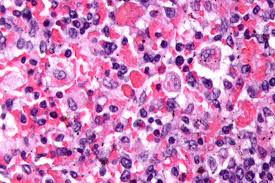
Former Afghanistan fast bowler Shapoor Zadran died at the age of 38 recently after battling Hemophagocytic Lymphohistiocytosis (HLH), a rare immune system disorder.
Hemophagocytic Lymphohistiocytosis (HLH):
- It is a rare but serious condition in which the body’s immune system becomes overactive.
- Instead of protecting the body from infections, the immune system starts attacking healthy tissues and organs.
- This causes severe inflammation that can affect the liver, spleen, bone marrow, brain, and other parts of the body.
- The condition can become life-threatening if left untreated.
- HLH can occur for different reasons. It is mainly divided into two types:
- Primary (Familial) HLH:
- This type is caused by genetic changes passed down from parents.
- It usually appears during infancy or early childhood, although it can sometimes develop later in life.
- Secondary (Acquired) HLH:
- This type develops due to medical conditions that trigger the immune system.
- Primary (Familial) HLH:
- Common triggers include:
- Viral infections such as Epstein-Barr virus (EBV) or cytomegalovirus (CMV)
- Certain bacterial, fungal, or parasitic infections
- Autoimmune diseases like lupus or rheumatoid arthritis
- Blood cancers such as lymphoma or leukemia
- A weakened immune system due to certain medications or medical conditions
- Treatment:
- HLH treatment depends on the cause, the patient’s age when the disease starts, and how severe the disease is.
- Chemotherapy and cancer drugs, immunotherapy, steroids that fight inflammation, antibiotics, and antiviral drugs are all mentioned as part of the treatment protocol.
Behali Wildlife Sanctuary:

Serious allegations of illegal encroachment, large-scale tree felling, and firing on forest personnel have surfaced recently from the Behali Wildlife Sanctuary in Assam’s Sonitpur.
- Behali Wildlife Sanctuary is located at the foothills of the Eastern Himalayas in Assam.
- Situated in the north of the Brahmaputra River, Behali is situated at a disputed border between Assam and Arunachal.
- With Kaziranga National Park as its close neighbour, it serves as an important elephant corridor.
- It is part of the Sonitpur Elephant Reserve that was notified in 2003.
- The forest is Tropical Wet Evergreen and Semi-evergreen.
- Some fine patches of primary rainforest are still to be seen in the area.
- The top canopy consists of species such as Tetrameles nudiflora, an emergent deciduous species, which is widely used by hornbills for nesting.
- It is home to several threatened wildlife species, including the Asian Elephant, Tiger, Bengal Slow Loris, White-winged Duck, Hog Deer, and Chinese Pangolin, along with critically endangered species such as the Black Softshell Turtle and Red-necked Vulture.
- It has also been declared an “Important Bird Area”. Common bird species include the Wreathed Hornbill, Rufous-necked Hornbill, Great Hornbill, Woolly-necked Stork, Lesser Adjutant Stork, etc.
INS Surat:

Warship JS Takanami (DD-110) of the Japan Maritime Self Defence Force (JMSDF) recently conducted joint naval activities with the Indian Navy warship INS Surat.
- INS Surat is a state-of-the-art stealth guided missile destroyer of the Indian Navy.
- It is the fourth and final vessel of the Visakhapatnam-class (Project 15B Guided Missile Destroyer Project) destroyers.
- It was designed by the Navy’s Warship Design Bureau and built by Mazagon Dock Shipbuilders, Mumbai. It has 75 percent Indigenous content.
- It was commissioned into the Indian Navy in 2025.
- With a displacement of 7,400 tonnes and length of 164m, the INS Surat is among the largest destroyers in the world.
- Stealth Design: Reduced radar cross-section with X-band stealth hull; integrated mast for sensors.
- It is powered by a Combined Gas and Gas (COGAG) propulsion set comprising four gas turbines.
- It has a top speed of 30 knots (56 km/h) and carries 300 personnel (50 officers and 250 sailors).
- It is India’s first artificial intelligence-enabled warship, utilizing indigenously developed AI solutions to enhance operational efficiency.
- 16 BrahMos supersonic cruise missiles (range 290-450 km), 32 Barak-8 MR SAMs (range 70 km), 2 twin torpedo tubes, 76mm SRGM gun, CIWS.
- Aviation: Hangar for 2 ALH or 1 MH-60R helicopter; enhanced deck for operations.
Hummus Trail:

The Hind Rajab Foundation (HRF), a Palestinian rights organisation, recently filed a war crimes complaint against Israeli soldier Eitan Gilboa, traced in India’s popular ‘Hummus Trail’ hotspots.
- Hummus Trail is a term coined to denote the travel route through India most frequented by Israelis, particularly post-military service.
- Every year, around 80,000 Israelis visit India, a large number of them young veterans who have been discharged from the mandatory Israeli army service.
- This trip, known as the Tiul Gadol, could last up to 6 months or a year and is mainly funded by the bonus they receive after serving in the army.
- From the north to the south of the country, there are several areas which are frequented by Israelis, and this is colloquially known as the ‘Hummus trail in India’.
- The Hummus Trail starts from the Union Territory of Ladakh, moves further to Kasol (also known as mini-Israel), Bhaghshu, Dharamkot, Tosh, and Kullu in the Parvati valley of Himachal Pradesh.
- It also includes remote areas like Kalga, Pulga and Talga, which are known for their ‘Israeli settlements’.
- It connects the Hindu religious places of Mathura and Vrindavan and moves towards Pushkar in Rajasthan.
Astra Mk 1:
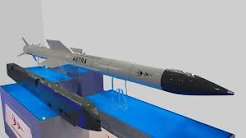
India and Indonesia reached a significant milestone in their growing strategic cooperation by signing a deal for the supply of the Astra Mk 1 missiles.
- Astra Mk 1 is an indigenous Beyond Visual Range Air-to-Air missile (BVRAAM).
- It will be integrated with the Air Force and the Navy.
- It is developed by the Defence Research and Development Organisation (DRDO).
- Features of Astra Mk 1
- Speed and Range: It has a range of 80 to 110 km, an altitude of up to 20 km and a speed of Mach 4.5 (or 4.5 times the speed of sound).
- Astra Mk 2 has an enhanced range of 200 km.
- The key features of this missile include inertial guidance, mid-course update and terminal active radar homing.
- It uses a single-pulse smokeless solid-fuel motor.
- The missile is being integrated with the IAF’s Sukhoi-30 MKI fleet and is also planned to be integrated with the indigenous Light Combat Aircraft Tejas Mk 1 A and the French Rafale jets in future.
Khadakwasla Dam:
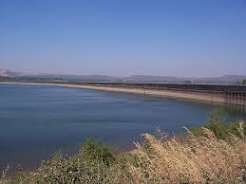
With heavy rains lashing the catchment areas of Pune’s reservoirs, water is being released from the Khadakwasla Dam into the Mutha River flowing through the city, leading to waterlogging in some low-lying areas.
- It is a dam on the Mutha River in Maharashtra.
- In 1869, the detailed work on the dam was started by the Captain Fife RE of the British Army as a respite to severe droughts.
- The man-made lake close to the dam, Khadakwasla Lake is therefore called Lake Fife.
- The dam also provides water for drinking and industrial purposes to Pune and its neighboring areas..
- The dam is also an important source of hydroelectric power generation.
- It has two power stations that produce 12 MW and 10 MW of electricity respectively.
TribeX Platform:
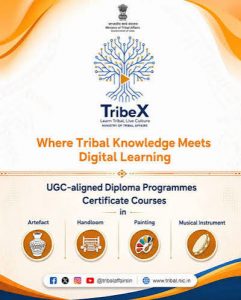
The Ministry of Tribal Affairs launched the TribeX platform.
- TribeX Platform is a first-of-its-kind digital learning platform dedicated to tribal arts, culture, traditional knowledge and skill development.
- Launched by: It was launched by Ministry of Tribal Affairs.
- Features of TribeX Platform:
- Digital Learning Platform: It is conceived as a comprehensive digital learning ecosystem and offers structured learning opportunities through free certificate courses and UGC-recognized Post Graduate diploma programmes in tribal languages, art forms, crafts and traditional knowledge.
- Digital Repository: It serves as a digital repository for documenting, preserving and promoting tribal languages, oral traditions, performing arts, cultural practices and indigenous knowledge systems for future generations.
- It currently hosts 20 free certificate courses across a diverse range of tribal art forms, including paintings, handicrafts, handloom, artefacts and traditional musical instruments.
- It integrates a robust Learning Management System (LMS), and a Repository Management System providing a secure and seamless digital ecosystem for learning, knowledge management and progress tracking.
- It also has Heritage Archive which hosts more than 5000 multimedia resources, including audio, video and literature documenting tribal festivals, socio-cultural practices and oral traditions from across India.
Yak : Smart System To Monitor The Health
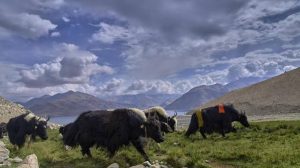
A team of scientists has developed an Internet of Things (IoT)-based smart system to monitor the health of the high-altitude yaks (Bos grunniens) and keep tabs on their movement near the international border in the Himalayas.
Core Features of the Smart Yak System:
- Real-Time Health Monitoring: Tracks vital signs and early indicators of illness to allow for timely veterinary intervention.
- Stress Prediction: Uses embedded algorithms to predict physiological stress in the animals, preventing severe health declines.
- Geo-Fencing: Establishes virtual boundaries to keep tabs on grazing herds.This prevents yaks from straying across sensitive international borders (such as near China and Bhutan) and helps reduce livestock loss.
- Yaks belong to the Bovini tribe, which also includes bison, buffaloes, and cattle.
- Wild yaks inhabit alpine tundra at altitudes of 5000 to 7000 meters. They thrive in environments such as alpine meadows, alpine steppes, and desert steppes.
- Found throughout the Himalayan region, Tibetan plateau, Mongolia, and parts of South-Central Asia.
- In India, yaks are reared in Arunachal Pradesh, Sikkim, Himachal Pradesh, and the union territories of Jammu & Kashmir and Ladakh.
- Characteristics of Yak:
- This bovine animal has long been recognised for its resilience and adaptability to extreme conditions.
- It features thick, shaggy coat. This woolly fur, provides insulation against the biting cold of high altitudes.
- They have large hearts and lungs, compact bodies, thick outer hair covering, and nonfunctional sweat glands, which help to withstand hypoxia and cold stress.
- Diet: Yaks are herbivorous, feeding on grasses and alpine plants.
- Conservation Status:
- IUCN: Vulnerable
- CITES: Appendix I
- Wildlife Protection Act of 1972:Schedule I
Costa Rica:
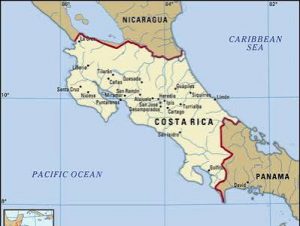
India and Costa Rica held the first joint economic and trade committee meeting.
- Costa Rica is a small country located in Central America.
- It is bordered by Nicaragua to the north and Panama to the
- Maritime Borders: To the west, it meets the Pacific Ocean, and to the east lies the Caribbean Sea.
- Capital City: San Jose
- Geographical Features of Costa Rica:
- Mountain Ranges: Central Valley has impressive mountain ranges, which include the Cordillera Volcanica to the north and the Cordillera de Talamanca to the south.
- Volcanoes: Arenal Volcano, the Poás Volcano, and the Irazú Volcano.
- Highest Point: Mount Chirripó.
- Lakes: Lake Arenal, the country’s largest lake.
- Rivers: The Reventazón River (Pours into the Caribbean Sea), Tempisque, the Sierpe, and the San Juan (forms a natural border with Nicaragua).
- Natural Resources: It consists of copper, manganese, gold, magnetite and bauxite.
India’s Toy Ecosystem:
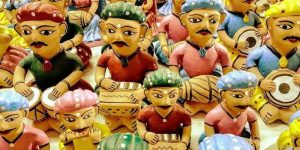
India’s toy industry is gaining attention for its rapid growth in domestic manufacturing, exports and employment, supported by government initiatives and rising demand for indigenous, educational and sustainable toys. India’s toy industry is an emerging sunrise sector that combines cultural heritage, indigenous manufacturing, innovation and export competitiveness.
Current Status of India’s Toy Industry:
- Export Growth: India’s exports across key toy-related categories increased from US$152.7 million in 2017-18 to US$384.7 million in 2025-26, reflecting growth of over 151.9%.
- Electronic and Non-Electronic Toys: Exports of electronic and non-electronic toys grew by nearly 160%, rising from US$77.35 million in 2017-18 to US$200.89 million in 2025-26.
- The United States emerged as the leading destination for Indian toy exports, with shipments increasing from US$26.7 million to about US$111.9 million. The United Kingdom, Poland, the Netherlands and Germany were other key markets.
- Gaming: Exports of video game consoles, machines, and related products nearly tripled from US$15.68 million in 2017-18 to US$46.75 million in 2025-26. The United States remained the largest market, while the UAE, Russia, France and the United Kingdom were other major destinations.
- Festive: Exports of festive, carnival and other entertainment articles increased by nearly 130%, from US$59.69 million in 2017-18 to US$137.03 million in 2025-26. Major destinations included the United States, Germany, the United Kingdom, the Netherlands and Sweden.
- Imports: Imports of traditional and educational toys declined by 66%, reducing import dependence and strengthening domestic manufacturing.
- Surplus: India recorded a trade surplus of US$152 million across key toy-related categories in 2025-26.
- Transition: This represented a major improvement from the trade deficit of US$213.01 million recorded in 2017-18, when imports exceeded exports.
- Employment: Employment in the Games and Toys industry more than doubled from 8,685 workers in 2018-19 to 17,693 workers in 2023-24.
India–Kyrgyzstan Tie-up to Study Shared Epic Heritage:
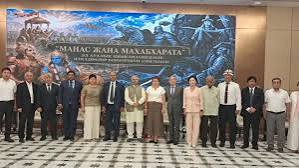
India and Kyrgyzstan have jointly established the International Centre for Civilizational Studies “Manas and Mahabharata” in Bishkek to promote comparative research on the two civilizations’ epic traditions and shared cultural heritage.
- Aim is to strengthen India–Kyrgyzstan cultural diplomacy through collaborative research, academic exchanges, civilizational studies, and preservation of shared literary and historical traditions.
Key Features:
- International Centre in Bishkek: Established jointly by the Centre for Studies of International Relations (CSIR), New Delhi, and the Manas National Academy as a permanent platform for civilizational research.
- Comparative Epic Studies: The centre will undertake research on the Mahabharata and the Manas Epic, exploring shared cultural values, history, literature, and philosophical traditions.
- Academic Collaboration: Cooperation agreements were signed with seven leading Kyrgyz universities to promote joint research, faculty exchange, publications, and researcher training.
- Hindi Translation of Manas: The initiative witnessed the release of the first Hindi translation of the Kyrgyz epic Manas, improving literary exchange and public accessibility.
Agreement on Sardar Sarovar Project Financial Disputes:
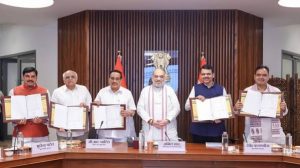
In a landmark development for cooperative federalism, the states of Maharashtra, Gujarat, Rajasthan, and Madhya Pradesh have signed a one-time settlement agreement to resolve decades-old financial disputes concerning the cost-sharing and pending dues of the Sardar Sarovar Project (SSP).
- The agreement resolves complex financial conflicts including cost-sharing of the Sardar Sarovar and Indira Sagar projects, Resettlement and Rehabilitation (R&R) expenditures for displaced communities, and the massive interest burden on construction-phase borrowings.
- In a move to facilitate closure, Gujarat agreed to increase its share of project costs to 75% (up from 50%), effectively reducing the financial burden on Madhya Pradesh.
- Sardar Sarovar Project (SSP) is a terminal gravity dam built on the Narmada River near Navagam, Gujarat.
- Located near the Statue of Unity, the Sardar Sarovar Dam is the largest major dam planned on the Narmada and one of the world’s largest concrete gravity dams by volume of concrete used.
- The idea of harnessing the Narmada River was envisioned by Sardar Vallabhbhai Patel in 1946, and the project gained momentum when Prime Minister Jawaharlal Nehru laid the foundation stone in 1961.
- The SSP is one of the largest water resource projects in India, covering four major states Maharashtra, Madhya Pradesh, Gujarat, and Rajasthan.
- It provides critical irrigation, drinking water, and hydropower. The project has transformed arid and drought-prone regions, particularly in Rajasthan and Gujarat, significantly enhancing agricultural productivity and skyrocketing land values.
- Narmada Water Disputes Tribunal (NWDT) constituted in 1969 under the Inter-State River Water Disputes Act, 1956, delivered its final award in 1979, determining the water and power-sharing arrangements among the four beneficiary States.
- While these allocations were largely settled, disputes over land compensation, rehabilitation costs, and shared infrastructure expenses persisted for decades.
- Narmada River is the largest river of Central India and Gujarat, originates from the Amarkantak Plateau in Madhya Pradesh and flows into the Arabian Sea through the Gulf of Khambhat (Cambay) in Gujarat.
- Spanning 1,312 km across Madhya Pradesh, Maharashtra, and Gujarat, it drains a vast basin of about 98,800 sq. km, making it one of India’s most important west-flowing rivers.
The PaBV-4 Bird Virus:
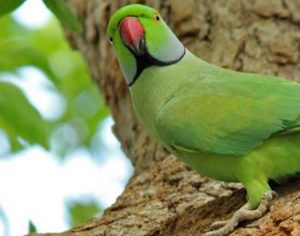
For the first time in India, a multi-institutional team of scientists has identified and genetically characterized parrot bornavirus 4 (PaBV-4) circulating among captive birds.
- Parrot bornavirus 4 (PaBV-4) is a highly contagious, single-stranded RNA virus belonging to the species Orthobornavirus alphapsittaciforme.
- It is the primary, most veterinary-relevant etiological agent responsible for causing Proventricular Dilatation Disease (PDD)—a progressive, largely fatal neurological and gastrointestinal wasting syndrome that affects psittacine birds (the parrot family, including macaws, parakeets, cockatiels, and lovebirds).
- Region Found In:
- Global Footprint: Previously documented across North America (U.S., Canada), South Korea, Japan, Israel, and Europe.
- In India: Identified across major captive aviculture hubs in Assam, Karnataka (Bengaluru), and West Bengal (Kolkata).
- The link between avian bornaviruses and Proventricular Dilatation Disease (PDD) was first discovered globally in 2008.
- Prior to this, the fatal condition was colloquially known as Macaw Wasting Disease since its initial description in the late 1970s.
- The July 2026 study marks the first official confirmation of the virus circulating within the Indian subcontinent.
Key Features:
- Systemic Non-Cytolytic Infection: The virus causes persistent infection and damages nerves mainly through immune-driven inflammation rather than directly destroying infected cells.
- The Asymptomatic Lurk Element: Many infected birds appear healthy yet silently shed the virus, spreading infection throughout aviaries without visible symptoms.
- Transmission Routes: The virus spreads through contaminated food, water, saliva, and feces, and can also pass from infected parents to eggs.
- Diagnostic Markers: RT-PCR detects the virus best from cloacal swabs in live birds and from brain and proventriculus tissues in dead birds
Once-Weekly Basal Insulin Awiqli:

Global healthcare giant Novo Nordisk announced the official launch of Awiqli in India, marking the country’s entry as only the seventh market in the world to introduce this drug.
- Once-Weekly Basal Insulin Awiqli (known generically as insulin icodec) is a long-acting background (basal) insulin analogue. It is the world’s first and only once-weekly basal insulin approved for clinical use in adults diagnosed with either Type 1 or Type 2 Diabetes Mellitus, offering background glycemic control that lasts a full seven days.
- Developed By: The breakthrough drug was researched, engineered, and brought to market by the Denmark-based pharmaceutical multinational Novo Nordisk.
- It aims to eliminate the psychological dread of needles, reduce physical injection pain, and lower patient resistance to starting insulin therapy early.
Key Features:
- Significant Drop in Injection Burden: Replaces the rigid requirement of daily injections administered every 24 hours.
- This drops the baseline treatment burden from 365 injections per year down to just 52 injections, simplifying long-term care.
- In extensive global clinical trials, Awiqli demonstrated superior blood sugar management compared to standard once-daily insulin glargine U100.
- It achieved greater reductions in HbA1c levels and significantly improved Time in Range without increasing the risk of dangerous drops in blood sugar (hypoglycemia).
- Distributed through Novo Nordisk’s proprietary, pre-filled FlexTouch pen device, which allows for highly accurate dosing and simple, user-friendly self-administration at home.
- The drug is priced competitively to encourage widespread adoption among insulin users:
- Per Unit Base Cost: Priced at approximately ₹3.73 per unit.
- The 1 ml Presentation: A 700-unit pre-filled pen is priced at ₹2,611.
- The 3 ml Presentation: A 2,100-unit high-capacity pen is priced at ₹7,833.
- The Cost Advantage: For a standard weekly dose of 70 units, the operational cost comes to roughly ₹261, making it more affordable than many legacy daily basal options that range from ₹345 to ₹453 for the same volume.
All India Survey on Higher Education Reports for 2022-23 and 2023-24:
The Union Ministry of Education has released the All India Survey on Higher Education (AISHE) Reports for 2022-23 and 2023-24, highlighting significant growth in higher education enrolment, Gross Enrolment Ratio (GER), female participation, social inclusion, and STEM education in India.AISHE Reports 2022-24 highlight significant expansion and inclusion in India’s higher education sector, with rising enrolment, GER, female participation, social-group representation, and STEM education.
Despite quantitative progress, structural challenges persist, including graduate unemployment, skill gaps, faculty shortages, low R&D investment, regional and digital divides, weak institutional autonomy, and uneven quality of education.
Key Highlights of AISHE 2022-23 & 2023-24:
- Gross Enrolment Ratio (GER): GER, calculated as the ratio of student enrolment to total population in the age group of 18-23 years based on 2011 population projection.
- GER increased from 23.7 in 2014-15 to 30 in 2023-24.
- Female GER rose from 22.9 to 31.2, while GER for Scheduled Caste (SC) students increased from 18.9 to 27.8 and for Scheduled Tribe (ST) students from 13.5 to 22.8 during the same period.
- Gender Parity Index (GPI): GPI, the ratio of female GER to male GER, stood at 1.08 in 2023-24 and has remained above 1 for seven consecutive years, indicating consistently higher female participation in higher education.
- Higher Education Enrolment: Total enrolment increased by 31.5%, from 3.42 crore in 2014-15 to 4.50 crore in 2023-24.
- Female enrolment grew faster by 42.2%, reaching 2.24 crore.
- Enrolment of Social Groups: Since 2014-15, enrolment increased by 51.4% among SC students, 75.7% among ST students and 60.2% among OBC students, reaching 69.72 lakh, 28.83 lakh and 1.80 crore, respectively, in 2023-24.
- STEM Enrolment: STEM enrolment increased from 91.5 lakh in 2014-15 to 1.02 crore in 2023-24, while the share of female students in STEM rose from 38.4% to 44%, indicating greater gender inclusion.
- Faculty Strength: The total number of faculty members reached 17.32 lakh in 2023-24, comprising 55.1% males and 44.9% females. Female faculty strength increased from 5.69 lakh in 2014-15 to 7.78 lakh in 2023-24.



