
Aral Sea:
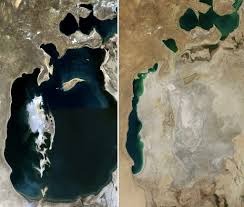
Drying of the Aral Sea has released more than 200 teragrams of carbon from exposed lake-bed sediments, turning a once-stable carbon reservoir into an active source of greenhouse gases, according to a new study.
- Aral Sea is a saline lake in Central Asia straddling the boundary between Uzbekistan and Kazakhstan to the south and north.
- It was once a large saltwater lake in Central Asia and the world’s fourth-largest body of inland water.
- The remnants of it nestle in the climatically inhospitable heart of Central Asia, to the east of the Caspian Sea.
- The Aral Sea depression was formed toward the end of the Neogene Period.
- It was made by waters from the Syr Darya and the Amu Darya rivers that were dependent on glacial melt.
- The Aral Sea is located within the harsh climate region of Central Asia.
- The area experiences a desert-continental climate, characterized by hot summers, cold winters, and varying diurnal air temperature.
- The lake once covered large area between the Kyzylorda and Aktobe regions in Kazakhstan and the Karakalpakstan region of Uzbekistan.
- However, the lake started shrinking in the 1960s, when the Soviet government decided to divert the Syr Darya and the Amu Darya, to irrigate the surrounding desert region.
- By the 1980s, the Aral Sea had shed 80% of its volume, resulting in the extinction of native fish species and severe ecological degradation, including the emergence of the Aralkum Desert.
- Today it is on the verge of complete disappearance.



