
Undavalli Caves:
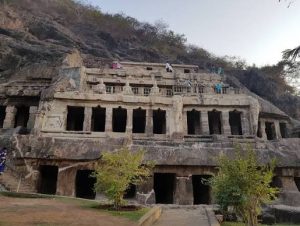
The two-day Telugu Mahotsavam, organised by the Andhra Pradesh State Creativity and Culture Society, commenced with grandeur at the historic Undavalli Caves in Guntur district recently.
- The Undavalli Caves are among the finest examples of ancient rock-cut architecture in India.
- They are located in Undavalli Village of Guntur district in Andhra Pradesh.
- They are believed to be built between the 4th and 5th centuries by the Gupta dynasty.
- The caves are located on a hill overlooking the Krishna River.
- These caves have been carved out of solid sandstone on a hillside.
- The best known and largest one has four stories with a huge statue of Lord Vishnu in a reclining posture sculpted from a single block of granite on the second floor.
- Other shrines inside the cave are dedicated to the Trimurti: Brahma, Vishnu and Shiva.
- The main cave belongs to the earliest examples of Gupta architecture, primarily primitive rock-cut monastery cells carved into the sandstone hills.
- Initially the caves were shaped as a Buddhist monastery, and the first floor still retains the style of a Buddhist vihara, including some Buddhist sculptures.
- The facade of the third floor is adorned with numerous sculptures, including depictions of lions and elephants.
- Undavalli caves are associated with the Vishnukundina kings of 420 to 620 CE. It is also believed that these caves were used by the Buddhist monks as rest houses.
- Once served as the Buddhist-Jain complexes, the Undavalli Caves were later converted to Hindu Temples.



