
The Large Hadron Collider (LHC):
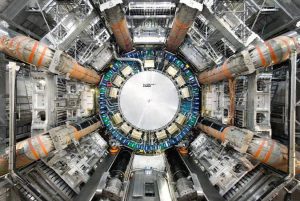
CERN officially switched off the Large Hadron Collider (LHC) to begin its 4-year Long Shutdown 3 (LS3).
- The temporary pause allows engineers to perform a major $1.5 billion hardware upgrade, transforming the machine into the High-Luminosity LHC (HL-LHC).
- The Large Hadron Collider (LHC) is the world’s largest, highest-energy, and most powerful particle accelerator. Built by the European Organization for Nuclear Research (CERN), it accelerates subatomic particles (protons or heavy lead ions) to near the speed of light and smashes them together to study fundamental physics and the origin of the universe.
- Built in a circular underground tunnel situated approximately 100 meters (328 feet) beneath the France–Switzerland border near Geneva.
- Facility: Governed and operated by CERN (European Organization for Nuclear Research).
- Protons are separated from hydrogen gas, fed into a chain of pre-accelerators, and injected into two ultra-high vacuum beam pipes traveling in opposite directions.
- Over 1,200 dipole magnets—chilled to -271.3°C (-456°F) using liquid helium—generate powerful magnetic fields to bend and focus particle beams as they approach 99.9999991% of the speed of light.
- Quadrupole magnets squeeze the beams together at four designated collision points, where massive particle detectors (ATLAS, CMS, ALICE, and LHCb) record subatomic debris from millions of collisions per second.