
Pickaxe Mountain:
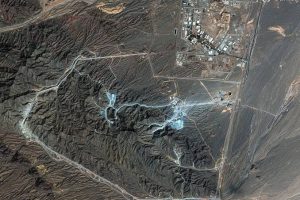
Pickaxe Mountain in Iran has gained global attention after US threatened military strikes, amid reports that the mountain may conceal deep underground nuclear facilities linked to Iran’s nuclear programme.
- The developments have also revived discussions on India’s decision not to launch a pre-emptive strike on Pakistan’s Kahuta nuclear facility in the 1980s despite strategic considerations.
- Situated roughly 220 km south of Tehran near Natanz, Pickaxe Mountain is a prominent ridge within the Karkas Range (Reshteh Kuh-e Karkas), which spans over 100 km between Kashan and Ardestan in an arid plateau.
- The range forms part of the Urumieh-Dokhtar magmatic belt, created through the subduction of the Neo-Tethyan Ocean under the Iranian continental plate prior to the Arabia-Eurasia continental collision over the last 66 million years.
- The bedrock is predominantly made of mechanically strong volcanic rocks (including andesite, rhyolite, and dacite) interbedded with pyroclastic deposits and volcanic tuffs.
- Extensive network of fault zones, fractures, and varied rock densities scatter seismic and kinetic shock waves, making military penetration and blast modelling unpredictable.
- The high energy required to fracture intact volcanic rock combined with deep-seated natural subterranean shielding complicates kinetic strikes, offering Iran an asymmetrical strategic advantage alongside control near key maritime chokepoints like the Strait of Hormuz.



