
HYDERACENE: Indian Patent
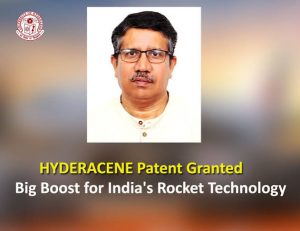
The University of Hyderabad (UoH) recently secured an Indian patent for HYDERACENE, a dual-action material designed specifically for rocket propellants and high-performance defence applications.
- It is a novel polymer-based material developed for use in solid rocket propellants for defence and space applications.
- The innovation was developed by Mutyalanaidu Ganivada, Sourav Jana, and Tushar Jana of the School of Chemistry, with the University of Hyderabad as the patentee.
- The patented material, formally described as Ferrocene Polyethylene Glycidyl Grafted Hydroxyl-Terminated Polybutadiene, was synthesised using ring-opening polymerisation.
- In conventional solid rocket propellants, two critical components are required:
- The Binder: A glue-like polymer that holds all active fuel components together while providing structural integrity.
- The Catalyst: A specialized chemical additive that speeds up and controls the burning rate of the propellant.
- Traditionally, these are two separate materials. HYDERACENE acts as both at the same time—a polymer binder-cum-catalyst.
- This improves long-term stability by preventing the catalyst from separating from the binder over time and enables more controlled and efficient combustion in solid rocket motors.
- Hyderacene has also been developed as an indigenous alternative to Butacene, a commercially used material in aerospace and defence applications.
- BUTACENE is largely imported from European countries.
- Named after the city of Hyderabad, the patented material is designed for use in high-performance rocket propellants and other advanced defence applications requiring controlled burn rates and improved propulsion efficiency.



