
TRISHNA Mission: Scheduled To Launch Next Year
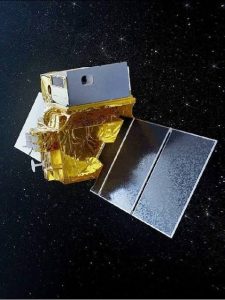
The PSLV is scheduled to launch the Indo-French TRISHNA mission next year which is a collaborative endeavor between ISRO and CNES.
- The TRISHNA (Thermal Infra-Red Imaging Satellite for High-resolution Natural Resource Assessment) mission, is a collaborative endeavor between the Indian Space Research Organisation (ISRO) and the French Space Agency Centre National d’Etudes Spatiales (CNES).
- It is engineered to deliver high spatial and high temporal resolution monitoring of Earth’s surface temperature, emissivity, biophysical and radiation variables for surface energy budgeting at regional to global scale.
- Objectives:
- Detailed monitoring of the energy and water budgets of the continental biosphere for quantifying terrestrial water stress and water use.
- High-resolution observation of water quality and dynamics in coastal and inland waters.
- A comprehensive assessment of urban heat islands detection of thermal anomalies linked to volcanic activity and geothermal resources.
- Precise monitoring of snow-melt runoff and glacier dynamics.
- Provide valuable data on aerosol optical depth, atmospheric water vapor, and cloud cover.
- Payloads: TRISHNA satellite is equipped with two primary payloads.
- The Thermal Infra-Red (TIR) Payload: It is provided by CNES and features a four-channel long-wave infrared imaging sensor capable of high-resolution surface temperature and emissivity mapping.
- The Visible – Near Infra-Red – Short Wave Infra-Red (VNIR-SWIR) payload: It is developed by ISRO, includes seven spectral bands designed for detailed mapping of surface reflectance of VSWIR bands for generating important biophysical and radiation budget variables.
- The satellite will operate in a sun-synchronous orbit at an altitude of 761 km.
- This orbit will provide a spatial resolution of 57 meters for land and coastal areas and 1 km for oceanic and polar regions. The mission is designed for a 5-year operational life.
- TRISHNA’s data will contribute to several global initiatives, such as GEOGLAM for agricultural monitoring, the UN’s Sustainable Development Goals and targets, and the Global Water Watch.
- Some of the mission’s outputs will serve as Essential Agricultural Variables (EAVs), and Essential Climate Variables (ECVs) for the global community.



