
Masaya Volcano:
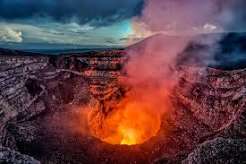
Satellite measurements of Nicaragua’s Masaya volcano suggest magma is entering one reservoir as another drains, offering clues that could improve monitoring for future hazards.
- Masaya Volcano is an active basaltic shield-like caldera volcano located in Nicaragua in Central America, about 20 km southeast of the capital city, Managua.
- It forms part of the Central American Volcanic Arc, formed by the subduction of the Cocos Plate beneath the Caribbean Plate.
- The caldera contains multiple collapse craters and cinder cones, with the currently active Santiago crater.
- The volcano is known for its persistent lava lake and high degassing rates.
- Activity is typically Strombolian to Vulcanian with ash emissions, lava fountains, and occasional lava flows.
- The current activity at Santiago crater includes a convecting lava lake and continuous gas emissions.
- In 1979, Masaya became Nicaragua’s first national park. It is officially called Masaya Volcano National Park (Parque Nacional Volcán Masaya).