
Macquarie Island:
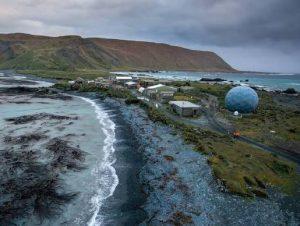
Australia recently confirmed its first case of H5N1 bird flu on the sub-Antarctic Macquarie Island, with the deadly virus found in the remote territory’s vulnerable elephant seal population.
- Macquarie Island is a subantarctic island located in the southwestern part of the Pacific Ocean.
- The island is politically a part of the Australian island state of Tasmania, and regionally it forms a part of Oceania.
- It is geographically positioned about 1,500 km to the southeast of the principal island of Tasmania, approximately midway between the island nation of New Zealand and the continent of Antarctica.
- In 1978, Macquarie Island became a part of the Tasmanian State Reserve and was subsequently designated as a UNESCO World Heritage Site in 1997.
- It has no permanent human population, but a meteorologic and geologic research station has been maintained on the island since 1948.
- It is a site of major geo-conservation significance, being the only place on earth where rocks from the earth’s mantle are being actively exposed above sea level.
- The island is an exposed portion of the undersea Macquarie Ridge, where the Pacific and Indian-Australian plates meet.
- Macquarie Ridge is one of only 3 such ridges that impede the Antarctic Circumpolar Circulation.
- This results in distinct differences between the west and east sides of the ridge, which are used in different ways by different species.
- There are a few small glacial lakes on the island.
- Although the island is treeless, there are a variety of native vegetation types, including grasses and many species of moss.
- It serves as a vital breeding ground for several penguin species, including the royal penguin, which breeds exclusively on the island, along with king, gentoo, and southern rockhopper penguins.
- The island is also home to various fur seal species, such as the New Zealand fur seal and the southern elephant seal.