
Lake Untersee:
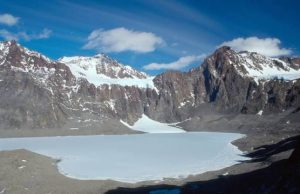
Glacial flood caused Lake Untersee to rise by two metres after a neighbouring lake released 17.5 million cubic metres of water.
- Lake Untersee, meaning “lower lake” in German, is a uniquely isolated freshwater lake in Antarctica.
- It is one of Antarctica’s largest and deepest surface lakes.
- Despite being a surface lake, it remains frozen throughout the year.
- The lake is fed from seasonal meltwater draining from the edges of the nearby Anuchin Glacier, which flows south from the Gruber Mountains.
- It is known for its distinctive water chemistry.
- Its ice-covered waters contain high levels of dissolved oxygen, very low levels of dissolved carbon dioxide, and a strongly alkaline, or basic, pH.
- It is one of the only perennially frozen lakes with a community of large, conical stromatolites.
- Stromatolites are layered microbial reef structures formed by communities of photosynthetic microbes, mainly cyanobacteria.
- The lake’s largest creatures are tardigrades—microscopic “water bear” invertebrates known for their ability to survive in extreme environments.
- Although Lake Unter-See appears stable, scientists have observed occasional changes. During fieldwork in 2019, researchers noticed that the lake’s water levels had risen.