
First Human Deep-Sea Mission:
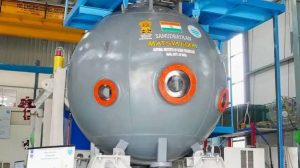
India aims to undertake its first human deep-sea mission to a depth of up to 6,000 metres by 2028 under the Samudrayaan Mission, as highlighted at the Indo-Pacific Regional Dialogue (IPRD) 2026, emphasising indigenous technological capabilities and international scientific cooperation.
- Samudrayaan Mission is India’s human deep-sea exploration initiative under the Deep Ocean Mission, aimed at developing indigenous technologies for deep-sea exploration and scientific research.
- The Deep Ocean Mission, approved by the Union Cabinet in 2021 and implemented by the Ministry of Earth Sciences, focuses on deep-sea mining technologies, ocean climate services, marine biodiversity conservation, seabed exploration, and ocean-based energy and freshwater resources.
- MATSYA-6000 Submersible is an indigenously developed human-occupied, battery-powered submersible, designed by the National Institute of Ocean Technology (NIOT), Chennai, to carry three aquanauts to depths of up to 6,000 metres.
- It is designed for 12 hours of normal operation, with 96 hours of emergency life-support capability, and incorporates a titanium-alloy personnel sphere to withstand extreme underwater pressure.
- Ocean Mineral Explorer Supports high-resolution exploration of hydrothermal sulphide deposits on the seabed, contributing to the identification and assessment of strategic deep-sea mineral resources.
- Satellite observations of ocean colour, sea-surface temperature and wind vectors strengthen ocean monitoring, climate research and assessment of marine renewable energy potential.
- It Facilitates direct observation and scientific study of deep-sea biodiversity, seabed geology and extreme marine environments, improving understanding of largely unexplored ocean ecosystems.
- India has proposed joint scientific missions, reciprocal access to research facilities and data sharing under the principle of “One Ocean, Shared Knowledge and Equitable Prosperity.”
- Key regional priorities include improving ocean observation networks, extreme-event forecasting, coastal climate services and sustainable management of marine resources.
- Strengthens India’s indigenous deep-sea technological capabilities, strategic resource security and interdisciplinary scientific research, while supporting a sustainable Blue Economy and the vision of Viksit Bharat 2047.