
What is Voyager 1?
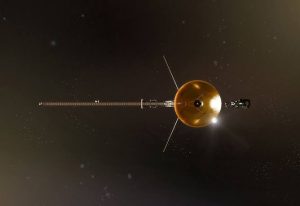
NASA’s Voyager 1 is set to cross a historic threshold in space exploration as it is about to become humanity’s first object to reach one light-day from Earth.
- Voyager 1 is a space probe launched by NASA in 1977.
- Objective is to explore the outer planets in our solar system.
- It is the first spacecraft to travel beyond the solar system and reach interstellar space.
- It is currently the most distant human-made object from Earth.
- Voyager 1’s mission has included flybys of Jupiter and Saturn, with the goal of studying their moons, rings, and magnetic fields.
- Instruments of Voyager 1: Cosmic Ray Subsystem, Plasma Wave Subsystem, Infrared Interferometer Spectrometer and Radiometer (IRIS), etc.
- Voyager 1 continues to communicate with NASA using its radio transmitter and the agency’s Deep Space Network.
- The network uses powerful radio antennas located in California, Spain and Australia to communicate with distant spacecraft.
- Voyager 1’s power supply is gradually declining. It relies on radioisotope thermoelectric generators, which produce electricity using heat released by the radioactive decay of plutonium-238.
- Key Achievements:
- It discovered a thin ring around Jupiter and two new Jovian moons: Thebe and Metis.
- It also found five new moons and a new ring called the G-ring at Saturn.
- Its discoveries included active volcanic eruptions on Jupiter’s moon Io, providing the first evidence of active volcanism beyond Earth.
- After completing its planetary exploration, the spacecraft continued travelling towards interstellar space.
- It was the first spacecraft to cross the heliosphere, the boundary where the influences outside our solar system are stronger than those from our Sun.
- It crossed into interstellar space in August 2012, making it the first human-made object to venture out of the solar system.
- It continues to travel through interstellar space, collecting scientific measurements and transmitting valuable information to Earth.