
Hydrogels for Targeted Micronutrient Delivery in Crops:
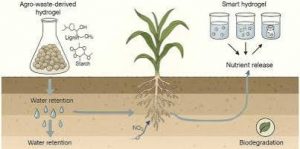
Researchers at IIT Gandhinagar (IITGN) developed pH-responsive, seaweed-based hydrogel microbeads for targeted delivery of micronutrients to plant roots by adapting the controlled-release principle used in medical treatments, including cancer therapy.
- Three-dimensional hydrophilic polymer networks capable of absorbing and retaining large amounts of water and releasing encapsulated substances in a controlled manner.
- Measuring roughly 3.5 mm, the biodegradable beads are made from Kappa Carrageenan (-carrageenan), a gelling agent extracted from red seaweed (such as Kappaphycus farmed along India’s southern coast) and trans-ferulic acid, a natural antioxidant found in rice, wheat, and oats.
Calcium chloride (CaCl₂) is used to facilitate gel formation. - Mechanism in the Rhizosphere: When plant roots lack micronutrients like iron or zinc, they secrete organic acids into the rhizosphere (the biologically active soil zone surrounding roots), lowering the soil pH.
- The microbeads detect this acidic cue, swell, and release encapsulated micronutrients (zinc, iron, manganese, and copper) directly near the roots.
- Under acidic conditions (pH 4), the beads swelled by nearly 80% in two days and released 68% of iron and 66% of zinc over 14 days, significantly higher than under neutral (46% iron, 44% zinc) or alkaline (pH 9) conditions (28% iron, 27% zinc).
- Standard micronutrient salts applied to soil are often chemically locked (fixed) or washed away (leached) before root absorption; foliar sprays are impractical on large fields, and chelated micronutrients are expensive and difficult to degrade in soil.
- Supported by IITGN grants and the Department of Biotechnology (DBT), the study was published in ACS Omega (American Chemical Society) and won the first prize at the SOMS 2026 Summit (organised by the Soluble Fertiliser Industry Association) at GIFT City, Gandhinagar.
- With an Indian patent application filed, the team is seeking industry partnerships for large-scale field trials to evaluate crop yield, nutritional quality, and long-term ecological safety on soil microbes, advancing an Aatmanirbhar precision-agriculture solution.