
81st Session of the United Nations General Assembly (UNGA) in New York:
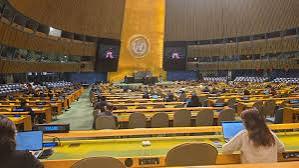
At the 81st Session of the United Nations General Assembly (UNGA) in New York, French President Emmanuel Macron renewed the push to regulate the use of the veto in the UN Security Council (UNSC) during humanitarian crises and mass atrocities.
- The United Nations Security Council (UNSC) is one of the six principal organs of the United Nations, established under the UN Charter in 1945. It has primary responsibility for maintaining international peace and security.
- The word veto does not appear in the United Nations Charter. Instead, it is established under Article 27(3), which requires that decisions of the Security Council on non-procedural matters be made by an affirmative vote of nine members, including the concurring votes of the permanent members.
- The French-Mexican Initiative (2015): Originally floated in 2013 and formally launched in 2015 by France and Mexico, the initiative calls on the P5 to voluntarily refrain from exercising their veto in situations involving genocide, crimes against humanity, and large-scale war crimes.
- The initiative frames the veto not as an unconditional privilege of great-power status, but as a responsibility tied to maintaining collective peace and security.
- Backing has reached 128 UN Member States (with 21 countries joining in mid-2026), marking the first time two permanent members (France and the UK) have formally committed to the principle.



