
Breeding of Indian Grey Hornbills in Gir:
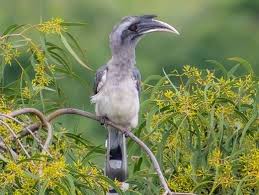
After disappearing from Gujarat’s Gir forests for over 60 years, the Indian Grey Hornbill has successfully bred for the fourth consecutive year following its reintroduction in 2021.
- 40 Indian Grey Hornbills were translocated from Gujarat’s Aravalli forests and released in two phases (28 birds during 2021–22 & 12 birds in 2023) 11 male hornbills were fitted with satellite transmitters to monitor their movement, habitat use, settlement patterns, and breeding behaviour.
Indian Grey Hornbill - The Indian Grey Hornbill is a hornbill species found in the Indian subcontinent and is associated with forests, wooded areas, orchards and human-modified landscapes.
- The Indian Grey Hornbill is scientifically known as Ocyceros birostris.
- It is the most widely distributed hornbill species in India, found from Jammu to Kerala and from Rajasthan to West Bengal.
- The species is also found in parts of Pakistan, Nepal and Bangladesh.
- It prefers dry plains, foothills and open habitats, and can be seen in deciduous forests, orchards, thorny scrub, gardens and urban areas with old trees.
- Improved protection after the declaration of Gir Wildlife Sanctuary in 1965 and Gir National Park in 1975 created favourable conditions for reintroduction.
- IUCN Status: Least Concern
- The bird has an ashy, silvery-grey body, long tail feathers with a white band, and a curved ivory-coloured beak that is blackish at the base.
- It has a narrow protruding casque on its beak, with males having a larger casque than females.
- Adults have red eyes and grey skin around the eyes, while juveniles have brown-orange eyes with reddish-orange skin around them.
- It acts as an important seed disperser and helps regenerate trees across forests, rural landscapes and urban spaces.



