
Easter Island:
A groundbreaking study suggests that the ancient Rongorongo script of Easter Island could be independently developed and predates the arrival of Europeans on the island.
- It is a Chilean dependency in the eastern Pacific Ocean.
- It is the easternmost outpost of the Polynesian island world.
- Named Rapa Nui by its earliest residents, it is one of the most isolated inhabited islands in the world.
- It was discovered by Europeans on Easter Sunday (1722) by Dutch explorer Jacob Roggeveen. Hence the name “Easter Island”.
- It faces a tropical rainforest climate.
- The island comprises three extinct volcanoes, namely Terevaka, Poike, and Rano Kau.
- The island has no permanent rivers but contains three crater lakes, namely Rano Aroi, Rano Raraku, and Rano Kau.
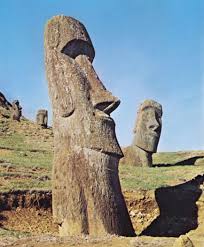
- It is known for its iconic Moai statues, carved by the indigenous Rapa Nui people.
- UNESCO named Easter Island a World Heritage Site and major parts of the island have been protected under the Rapa Nui National Park.
- Moai Statues Rapa Nui is famous for its large statues called moai.
- They are shaped like large human heads and erected on stone pedestals.
- They are famous for their carved heads and “Pukao,” a hat-like covering made from a soft red stone.
- They were carved in volcanic stone at quarries and then moved to their current locations across the island.
- Scholars believe the Rapa Nui people built the moai between the 13th and the 16th centuries and represented their revered ancestors.
- Rongorongo is a writing system that comprises carved symbols, known as glyphs, on wooden tablets and artefacts discovered in Easter Island.
- Rongorongo differs from other scripts in that it has not yet been deciphered.
- Rongorongo was noted for the first time in 1864 when it was observed by Europeans.
- Rongorongo looks very different from the European writing This has led some experts to believe it may have developed locally by the inhabitants.



