
Fusion Energy Viability:
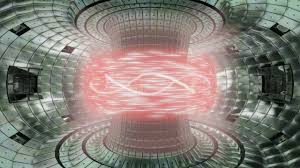
A recent study published in Nature Energy warns that current cost projections for nuclear fusion are overly optimistic, raising concerns about inefficient allocation of clean energy investments.
- Experts caution that such unrealistic projections may divert funds from more viable climate solutions and suggest exploring alternative reactor designs, fuels and smaller configurations to improve cost reduction and scalability.
- Fusion is the process where two small, light atoms (like hydrogen isotopes) come together to form a bigger, heavier atom, releasing vast amounts of energy.
- This is the energy process that powers the Sun and stars.
- For example, in the Sun, hydrogen nuclei fuse to form helium and release energy in the form of light and heat.
- The fusion of nuclei releases energy because the fused product has less mass than the sum of the individual atoms. This “lost” mass, known as the mass defect, is converted into energy according to Einstein’s theory of special relativity (E=mc²).
- A tokamak is a fusion reactor that uses magnetic fields to confine and control plasma within a doughnut-shaped vessel. Its effectiveness is measured by how long it can hold the plasma without dissipation.
- Longer confinement times bring reactors closer to achieving continuous and reliable fusion reactions.
- Q Value (Energy Gain Factor): The Q value measures the efficiency of a fusion reactor.
- It is the ratio of output energy to input energy. A Q value > 1 means the reactor produces more energy than it consumes.



