
India–Uzbekistan Comprehensive Strategic Partnership:
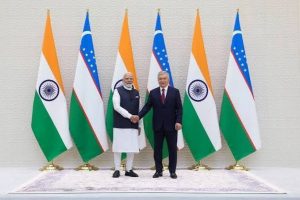
The Prime Minister undertook a State Visit to Uzbekistan to commemorate the 15th anniversary of the India-Uzbekistan Strategic Partnership (2011). During the visit, the two nations elevated their bilateral relations to a Comprehensive Strategic Partnership.
- The visit comes at a time when stakes are high for India as it actively seeks to reset and deepen its ties with Central Asian countries amid shifting geopolitical dynamics.
- The Prime Minister Narendra Modi was conferred with the “Oliy Darajali Do’stlik” Order, Uzbekistan’s highest state honour.
- Both nations formally upgraded their bilateral relationship to a Comprehensive Strategic Partnership, broadening long-term engagement across strategic, economic, and technological domains.
- Both countries adopted a zero-tolerance approach to terrorism and called for action against terror financing, safe havens and perpetrators.
- Both sides agreed to expand defence-industrial cooperation through the Joint Working Group on Military Cooperation.
- They welcomed the successful Dustlik military exercise, held in Uzbekistan in April 2026.
- Set a bilateral trade target of USD 5 billion by 2030, up from the current volume of over USD 1 billion.
- Both Nations agreed to establish a Coordination Council led by Foreign Ministers to oversee bilateral cooperation and upgrade the existing Joint Commission from the secretarial to the ministerial level.
- Created a Joint Working Group to address trade and investment barriers in sectors such as engineering, automobiles, electrical goods and pharmaceuticals.
- Both sides agreed to take time-bound steps towards an India-Uzbekistan PTA.
- India reaffirmed its support f`or Uzbekistan’s accession to World Trade Organization (WTO).
- Cooperation between Invest India and Uzbekistan’s Investment Promotion Agency will promote two-way investment flows.
- Agreed to implement joint ventures in geological exploration, mining, processing, value addition, and recycling of critical minerals.
- The two nations agreed to establish a framework for the long-term supply of uranium from Uzbekistan to India to meet the fuel requirements of India’s civil nuclear energy programme.
- Explored avenues for extended cooperation in the peaceful uses of nuclear energy, modernization of energy grids, and renewable energy infrastructure.
- Decided to scale up partnerships between startups, tech incubators, and IT parks, building on the success of the Tashkent IT Park (established in 2019 with Software Technology Parks of India(STPI) assistance).
- Agreed to collaborate on developing secure and trustworthy Artificial Intelligence (AI) systems for economic development and societal problem-solving.
- An agreement between NPCI International Payments Ltd and Uzbekistan’s National Interbank Processing Centre will allow Indian UPI apps to scan Uzbekistan’s UZQR national codes, boosting digital connectivity.
- India announced a USD 1 million grant under its Grant-in-Aid framework to support afforestation and ecological rehabilitation in the fragile Aral Sea region, linking Uzbekistan’s “Yashil Makon” with India’s “Ek Ped Maa Ke Naam”.
- Agreed to utilize the Tashkent Pharma Park cluster for joint manufacturing, technology transfer, and establishing Indian medical laboratories and research centres in Uzbekistan.
- Signed a Letter of Intent to conserve and restore the ancient Buddhist heritage sites of Fayaz Tepa and Karatepa, along with a Cultural Exchange Program (2026–2030).
- India announced the Lal Bahadur Shastri Scholarship for Hindi language learning in Uzbekistan and signed an MoU for cooperation in traditional medicines (AYUSH).
- Uzbekistan reaffirmed its support for India’s candidature for permanent membership in a reformed UN Security Council.
- Uzbekistan expressed its intent to join the International Solar Alliance (ISA) and the International Big Cat Alliance (IBCA).
- Uzbekistan backed India’s 2026 BRICS Chairship, while India pledged support for Uzbekistan’s upcoming Non-Aligned Movement (NAM) Chairship (2027–2030).
- Both reaffirmed cooperation within the SCO and the Central Asia–India framework.



